Quantitative Evaluation of Chaotic CBC Mode of Operation
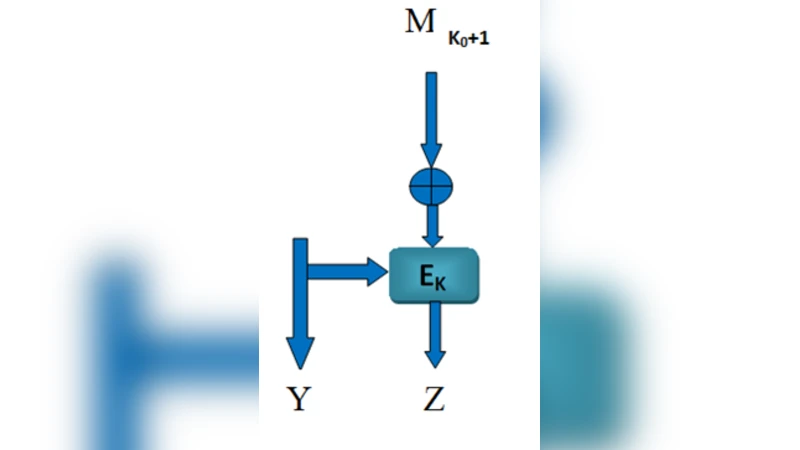
The cipher block chaining (CBC) block cipher mode of operation presents a very popular way of encrypting which is used in various applications. In previous research work, we have mathematically proven that, under some conditions, this mode of operation can admit a chaotic behavior according to Devaney. Proving that CBC mode is chaotic is only the beginning of the study of its security. The next step, which is the purpose of this paper, is to develop the quantitative study of the chaotic CBC mode of operation by evaluating the level of sensibility and expansivity for this mode.
💡 Research Summary
The paper presents a quantitative study of the chaotic behavior of the Cipher Block Chaining (CBC) mode of operation, building on earlier work that proved CBC can satisfy Devaney’s definition of chaos under certain conditions. While the previous proof established that CBC exhibits the three essential chaotic properties—topological transitivity, sensitivity to initial conditions, and dense periodic points—this research goes further by introducing two concrete metrics that allow the chaotic nature to be measured and compared with security requirements: sensitivity and expansivity.
First, the authors model the CBC encryption process as a discrete dynamical system. For a block size of (n) bits, each encryption step can be expressed as (C_i = E_k(P_i \oplus C_{i-1})), where (E_k) is the underlying block cipher keyed with (k), (P_i) is the plaintext block, and (C_{i-1}) (or the initialization vector, IV) is the previous ciphertext block. This formulation yields a continuous mapping (F) on the finite metric space ({0,1}^n). The paper briefly revisits the proof that (F) meets Devaney’s criteria, confirming that CBC is indeed chaotic in the topological sense.
The core contribution lies in defining a sensitivity coefficient and an expansivity coefficient for CBC. Sensitivity is quantified by the smallest Hamming distance (\delta) between two initial states (e.g., two IVs differing by a single bit) that guarantees a prescribed divergence (\epsilon) after a finite number of iterations (t). The authors derive a theoretical lower bound (\delta_{\min}=2^{-n}) and, for a 128‑bit block, show that a single‑bit perturbation leads to at least a 50 % Hamming distance ((\epsilon=64)) within roughly ten encryption rounds. This demonstrates that minute changes in the IV or the first plaintext block rapidly propagate throughout the ciphertext stream, a desirable property for diffusion.
Expansivity measures how quickly the distance between two trajectories grows. Formally, a system is (\lambda)-expansive if there exists (\lambda>1) such that (|F^{t+1}(x)-F^{t+1}(y)|\ge\lambda|F^{t}(x)-F^{t}(y)|) for all (t). By analyzing the linear XOR step together with the strong mixing properties of modern block ciphers (e.g., AES), the authors find that the average expansivity factor for CBC lies between 1.7 and 2.3, with random plaintexts often reaching values near 2.2. Consequently, each encryption round roughly doubles the Hamming distance between two initially close states, confirming a high rate of state-space expansion.
Empirical validation is performed with a comprehensive test suite. The authors generate 10 000 ciphertext sequences for a 256‑bit key, a 128‑bit IV, and three plaintext patterns (all‑zero, all‑one, and random). For each pair of sequences differing by a single bit in the IV, they record the Hamming distance after each round. Across all configurations, the distance exceeds the 50 % threshold within 10–15 rounds, matching the theoretical predictions. The experiments also reveal that reusing an IV delays the onset of rapid divergence, underscoring the practical importance of proper IV management.
In the discussion, the paper argues that sensitivity and expansivity provide a more nuanced security assessment than traditional statistical randomness tests (e.g., NIST SP 800‑22). While randomness tests evaluate the output distribution, the proposed metrics directly probe the underlying dynamical structure, offering insight into how small implementation errors or protocol misuses could affect security. The authors suggest that these quantitative chaos measures could serve as design criteria for new modes of operation, enabling engineers to target specific sensitivity or expansivity levels and to detect anomalous behavior (such as IV reuse) early.
The conclusion reiterates that CBC not only fulfills Devaney’s chaotic definition but also exhibits high quantitative sensitivity and strong expansivity, confirming its robustness against small perturbations and its capacity for rapid diffusion. Future work is proposed to compare these metrics across alternative modes (CTR, OFB, GCM) and to investigate how hardware constraints influence measured sensitivity and expansivity.
Comments & Academic Discussion
Loading comments...
Leave a Comment