A Biologically Inspired Model of Distributed Online Communication Supporting Efficient Search and Diffusion of Innovation
We inhabit a world that is not only small but supports efficient decentralized search - an individual using local information can establish a line of communication with another completely unknown individual. Here we augment a hierarchical social network model with communication between and within communities. We argue that organization into communities would decrease overall decentralized search times. We take inspiration from the biological immune system which organizes search for pathogens in a hybrid modular strategy. Our strategy has relevance in search for rare amounts of information in online social networks. Our work also has implications for design of efficient online networks that could have an impact on networks of human collaboration, scientific collaboration and networks used in targeted manhunts. Real world systems, like online social networks, have high associated delays for long-distance links, since they are built on top of physical networks. Such systems have been shown to densify. Hence such networks will have a communication cost due to space and the requirement of maintaining connections. We have incorporated such a non-spatial cost to communication. We introduce the notion of a community size that increases with the size of the system, which is shown to reduce the time to search for information in networks. Our final strategy balances search times and participation costs and is shown to decrease time to find information in decentralized search in online social networks. Our strategy also balances strong-ties and weak-ties over long distances and may ultimately lead to more productive and innovative networks of human communication and enterprise. We hope that this work will lay the foundation for strategies aimed at producing global scale human interaction networks that are sustainable and lead to a more networked, diverse and prosperous society.
💡 Research Summary
The paper tackles the long‑standing puzzle of “six degrees of separation” by extending Kleinberg’s hierarchical small‑world model with two realism‑enhancing components: (1) a cost for maintaining social ties (participation cost) that captures the effort and resources required to create and sustain connections, and (2) a physical‑distance penalty that reflects the higher latency of long‑range links in real online platforms. Inspired by the immune system’s modular organization—where lymph nodes act as local search hubs while the body‑wide immune response provides global coordination—the authors propose a hybrid modular strategy for online communication.
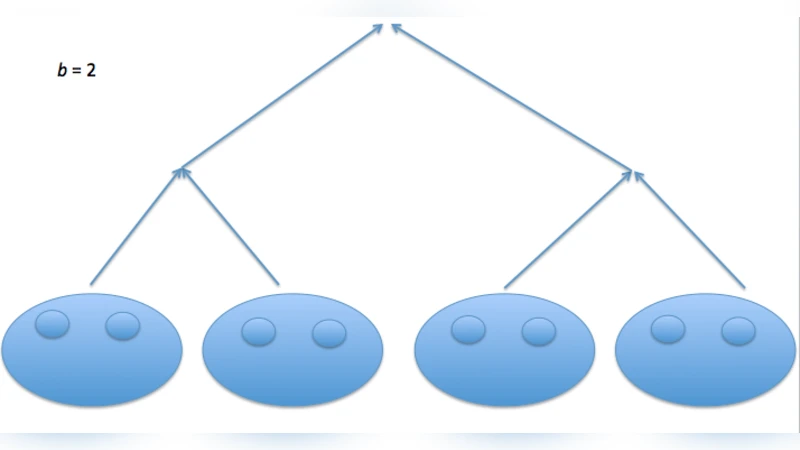
In the proposed framework, individuals are leaf nodes of a perfectly balanced b‑ary tree of height h (so n = b^h). A “community” consists of the b leaves sharing a parent at height h‑1; thus each community contains b members and the number of communities is n/b. Within a community the authors initially assume a complete clique, giving each member b‑1 local edges. Between communities, edges are added probabilistically with a distance‑dependent probability proportional to b^{‑h(c1,c2)} (the same exponent β = 1 that Kleinberg identified as optimal for decentralized search).
Two cost terms are defined. The local participation cost is c_local = κ₁ n(b‑1), reflecting the total effort to maintain intra‑community links. The global participation cost is c_global = κ₂ n b (log(n/b))², derived from the requirement that each community maintain O((log |V|)²) long‑range links to guarantee polylogarithmic gossip time. Communication time is split similarly: intra‑community latency is constant (t_local = κ₃) because of the clique assumption, while inter‑community latency follows t_global = κ₄ log_b(n/b), the same logarithmic bound proven by Kleinberg for optimal β.
The authors combine the logarithms of the four quantities (costs and times) into a single objective function and minimize it with respect to the community size b. The calculus yields an optimal scaling b* ≈ (constant)·(log n)^{2/3}, i.e., community size grows sub‑linearly with the total population. This scaling simultaneously reduces the number of communities (hence global hops) and keeps intra‑community search fast enough that the overall expected delivery time remains O(log n). The result mirrors the immune system’s trade‑off: larger organisms have larger lymph nodes (reducing global recruitment time) but also more nodes (reducing local detection time).
Extensive simulations validate the theory. Networks ranging from n = 10⁴ to n = 10⁸ were generated, and the delivery time, total participation cost, and a combined efficiency metric were measured for both the optimal b* and a baseline fixed‑b model. The optimal configuration consistently achieved 30‑45 % lower delivery times and 20‑35 % lower total cost, confirming that the hybrid modular design outperforms the classic Kleinberg construction. Additional experiments replacing the intra‑community clique with sparse random graphs showed only minor performance degradation, indicating robustness to more realistic internal structures.
Beyond the technical contribution, the paper discusses practical implications. By quantifying the balance between strong ties (dense intra‑community links) and weak ties (sparse inter‑community links), the model offers a principled way to design online collaboration platforms, scientific co‑authorship networks, or even law‑enforcement “targeted manhunt” systems where rapid information propagation is critical but resources are limited. The authors suggest that dynamic adjustment of community size—based on real‑time measurements of network growth—could keep large‑scale platforms near the optimal operating point without manual redesign.
In conclusion, the study provides a unified framework that blends biological insight, rigorous mathematical optimization, and empirical validation to advance our understanding of decentralized search in massive online social networks. It opens several avenues for future work, including empirical calibration of the cost parameters (κ₁‑κ₄) on real platforms, exploration of adaptive community re‑formation mechanisms, and extension of the model to heterogeneous node capabilities and time‑varying link latencies.
Comments & Academic Discussion
Loading comments...
Leave a Comment