Asynchronous Cellular Automata and Pattern Classification
This paper designs an efficient two-class pattern classifier utilizing asynchronous cellular automata (ACAs). The two-state three-neighborhood one-dimensional ACAs that converge to fixed points from arbitrary seeds are used here for pattern classification. To design the classifier, we first identify a set of ACAs that always converge to fixed points from any seeds with following properties - (1) each ACA should have at least two but not huge number of fixed point attractors, and (2) the convergence time of these ACAs are not to be exponential. In order to address the first issue, we propose a graph, coined as fixed point graph of an ACA that facilitates in counting the fixed points. We further perform an experimental study to estimate the convergence time of ACAs, and find that there are some convergent ACAs which demand exponential convergence time. Finally, we find that there are 71 (out of 256) ACAs which can be effective candidates as pattern classifier. We use each of the candidate ACAs on some standard data sets, and observe the effectiveness of each ACAs as pattern classifier. It is observed that the proposed classifier is very competitive and performs reliably better than many standard existing algorithms.
💡 Research Summary
Cellular automata (CA) were originally introduced as discrete dynamical systems that evolve on a lattice of cells, each updating its state according to a local rule. Traditional studies have focused on synchronous CA, where a global clock forces all cells to update simultaneously. However, many natural and engineered systems operate without such a global clock, prompting interest in asynchronous cellular automata (ACA) where cells are updated independently, often modeled as a stochastic process.
In this paper the authors design a binary two‑class pattern classifier based on one‑dimensional, two‑state, three‑neighbourhood ACAs that are updated fully asynchronously (i.e., at each step a single randomly chosen cell is updated). The key idea is to exploit the fact that some ACAs inevitably converge to fixed‑point attractors from any initial configuration. Each fixed point can be regarded as a prototype for one class; the basin of attraction of a fixed point contains all patterns that will evolve into that prototype under asynchronous updates.
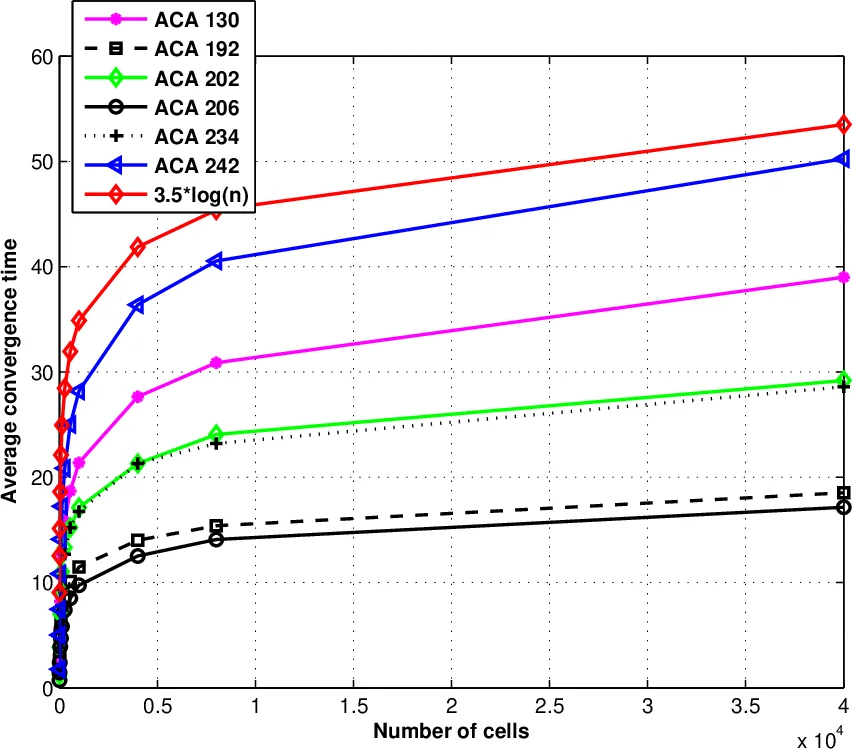
The study proceeds in three systematic stages. First, the authors examine all 256 possible elementary CA rules. Using a set of analytically derived conditions on the activity of specific rule‑minterms (RMTs), they prove a theorem that characterizes exactly which rules guarantee convergence to at least one fixed point for any seed. Second, to avoid trivial classifiers (rules with a single fixed point) and overly complex ones (rules with a huge number of fixed points), they introduce the “fixed‑point graph”. In this graph each node represents a candidate fixed‑point configuration (expressed as a sequence of RMTs) and edges capture the permissible transitions between neighboring RMTs. By traversing this graph they can count the number of distinct fixed points for each rule efficiently. Third, they assess the practical feasibility of each convergent rule by measuring average convergence time through extensive Monte‑Carlo simulations. Rules whose expected convergence steps grow exponentially with the lattice size are discarded, leaving only those with linear or sub‑linear scaling.
Applying the three filters yields 71 rules out of the original 256 that satisfy (i) guaranteed convergence, (ii) a moderate number of fixed points (at least two but not excessively many), and (iii) acceptable convergence speed. Each of these 71 ACAs is then instantiated as a classifier on several standard binary data sets (e.g., UCI benchmark problems). The classification procedure is straightforward: an input vector is encoded as the initial binary configuration of the ACA, the system is evolved under random asynchronous updates until a fixed point is reached, and the class label associated with that fixed point (pre‑stored in memory) is returned.
Experimental results show that the ACA‑based classifiers achieve classification accuracies that are comparable to or better than a range of well‑known algorithms such as support vector machines, decision trees, k‑nearest neighbours, and even some neural‑network models. Moreover, because the update rule is local and asynchronous, the approach is naturally amenable to parallel hardware implementations (e.g., FPGA or GPU), potentially offering high throughput with low energy consumption.
The paper contributes two main innovations: (1) a rigorous analytical framework for identifying convergent ACAs based on RMT activity patterns, and (2) the fixed‑point graph tool for efficiently enumerating attractors. These tools not only enable the construction of effective binary classifiers but also open avenues for applying ACA dynamics to other problems such as optimization, pattern generation, and modeling of distributed systems.
Limitations include the focus on one‑dimensional binary ACAs and binary classification tasks; extending the methodology to multi‑state, higher‑dimensional, or multi‑class scenarios remains an open research direction. Additionally, the need to store a mapping from each fixed point to a class label introduces a memory overhead that grows with the number of attractors. Future work could explore adaptive schemes for attractor selection, automated learning of rule sets, and integration with deep learning pipelines.
Comments & Academic Discussion
Loading comments...
Leave a Comment