Fast Multi-class Dictionaries Learning with Geometrical Directions in MRI Reconstruction
Objective: Improve the reconstructed image with fast and multi-class dictionaries learning when magnetic resonance imaging is accelerated by undersampling the k-space data. Methods: A fast orthogonal
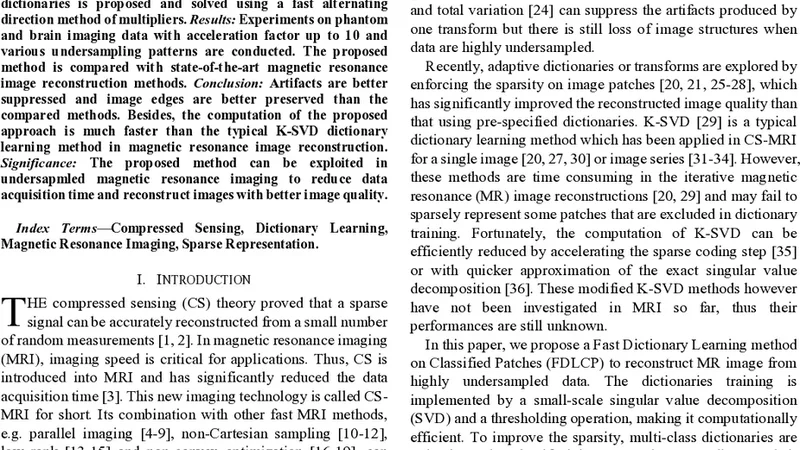
Objective: Improve the reconstructed image with fast and multi-class dictionaries learning when magnetic resonance imaging is accelerated by undersampling the k-space data. Methods: A fast orthogonal dictionary learning method is introduced into magnetic resonance image reconstruction to providing adaptive sparse representation of images. To enhance the sparsity, image is divided into classified patches according to the same geometrical direction and dictionary is trained within each class. A new sparse reconstruction model with the multi-class dictionaries is proposed and solved using a fast alternating direction method of multipliers. Results: Experiments on phantom and brain imaging data with acceleration factor up to 10 and various undersampling patterns are conducted. The proposed method is compared with state-of-the-art magnetic resonance image reconstruction methods. Conclusion: Artifacts are better suppressed and image edges are better preserved than the compared methods. Besides, the computation of the proposed approach is much faster than the typical K-SVD dictionary learning method in magnetic resonance image reconstruction. Significance: The proposed method can be exploited in undersapmled magnetic resonance imaging to reduce data acquisition time and reconstruct images with better image quality.
💡 Research Summary
The paper addresses the long‑standing challenge of accelerating magnetic resonance imaging (MRI) by undersampling k‑space while preserving diagnostic image quality. Conventional compressed sensing (CS) MRI relies on global sparsifying transforms (e.g., wavelets, total variation) or a single over‑complete dictionary learned from all image patches. Although dictionary learning—particularly K‑SVD—can capture richer image structures, its iterative sparse coding (OMP) and repeated singular value decompositions make it computationally prohibitive for clinical use, especially at high acceleration factors.
To overcome these limitations, the authors propose a two‑fold strategy: (1) Geometrical‑direction based patch classification and (2) Fast orthogonal dictionary learning within each class. First, each image patch is assigned a dominant edge direction using simple gradient operators (Sobel) or structure‑tensor analysis. Patches sharing the same direction are grouped into a class, under the assumption that they exhibit similar structural patterns and therefore can be represented efficiently by a dedicated dictionary. This class‑wise organization introduces locality in the sparse representation, which enhances sparsity compared with a universal dictionary.
Second, instead of a generic over‑complete dictionary, the authors enforce orthogonality ( DᵀD = I ) on each class‑specific dictionary D_c. Orthogonal dictionaries have two important consequences. (i) The learning step reduces to an eigen‑value decomposition (EVD) of the patch covariance matrix, eliminating the costly OMP‑SVD loop of K‑SVD. (ii) During reconstruction, the transform D_cᵀ and its inverse D_c are simply matrix transposes, allowing closed‑form updates in an Alternating Direction Method of Multipliers (ADMM) framework. Consequently, each ADMM iteration requires only fast matrix multiplications and soft‑thresholding, dramatically cutting runtime.
The reconstruction problem is formulated as
\
📜 Original Paper Content
🚀 Synchronizing high-quality layout from 1TB storage...