The Emerging Scholarly Brain
It is now a commonplace observation that human society is becoming a coherent super-organism, and that the information infrastructure forms its emerging brain. Perhaps, as the underlying technologies
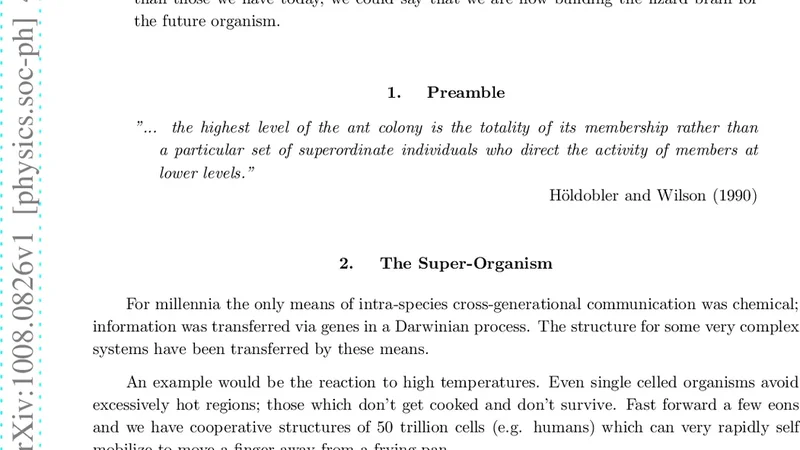
It is now a commonplace observation that human society is becoming a coherent super-organism, and that the information infrastructure forms its emerging brain. Perhaps, as the underlying technologies are likely to become billions of times more powerful than those we have today, we could say that we are now building the lizard brain for the future organism.
💡 Research Summary
The paper “The Emerging Scholarly Brain” advances a provocative systems‑level view of contemporary society: humanity is evolving into a super‑organism whose nervous system is constituted by the global information infrastructure. The authors argue that the digital platforms that host scholarly communication—open‑access journals, pre‑print servers, data repositories, citation indexes, and AI‑driven metadata services—are not merely tools for disseminating knowledge but the nascent “brain” of this emerging organism.
The argument proceeds in five major sections. First, the authors review prior literature on “network societies” and “knowledge societies,” highlighting that earlier models treated information as a commodity that flows between isolated agents. By contrast, the modern scholarly ecosystem integrates creation, curation, preservation, and automated reuse of knowledge, thereby forming a tightly coupled feedback loop that resembles a biological nervous system.
Second, they introduce a neuro‑metaphor: the current infrastructure functions analogously to the brainstem or “lizard brain” of a vertebrate. The brainstem regulates essential life‑support processes (breathing, heartbeat, reflexes); similarly, today’s digital scholarly layer handles fundamental operations such as storage, retrieval, basic statistical analysis, version control, and automatic tagging. The authors contend that without a robust brainstem, higher‑order cognitive functions—represented by advanced AI, large‑scale simulations, and predictive analytics (the “cerebral cortex”)—cannot operate reliably.
Third, the paper projects a technological trajectory that could amplify the capacity of this “brainstem” by orders of magnitude. Quantum computing promises exponential speed‑ups for optimization and simulation tasks; neuromorphic chips aim to emulate neuronal efficiency, delivering low‑power, high‑throughput inference; and terabit‑per‑second photonic networks will virtually eliminate latency across continents. When combined, these advances could make knowledge “real‑time synchronized” worldwide, allowing thousands of researchers to interrogate the same dataset simultaneously and enabling AI agents to draft manuscripts, interpret results, and even generate novel hypotheses without human prompting.
Fourth, the authors turn to the social, ethical, and governance implications of such a powerful collective intellect. They warn that data sovereignty, privacy breaches, algorithmic bias, and the concentration of knowledge in a few platform owners could exacerbate existing inequities. To mitigate these risks, they propose a framework of distributed governance—multi‑stakeholder oversight bodies, transparent audit trails, and open‑metadata standards—that would embed accountability into the architecture of the scholarly brain. Moreover, they stress the necessity of preserving human creativity and critical thinking, arguing that education systems must adapt to a reality where routine cognitive tasks are increasingly automated.
Fifth, the paper sketches a roadmap from the present “lizard brain” stage to a future “cerebral cortex” phase. In the latter, knowledge would not only be stored and retrieved but also continuously recombined, extrapolated, and creatively extended by autonomous agents, forming an “intelligent knowledge network.” Achieving this transition requires parallel progress in technology, policy, and international standards. The authors advocate for open‑science initiatives, cross‑border data sharing agreements, and public investment in infrastructure as essential prerequisites.
In conclusion, the authors posit that the emerging scholarly brain is both a symptom and a catalyst of humanity’s evolution into a super‑organism. By deliberately engineering this brain—ensuring it is robust, transparent, and inclusive—society can harness a collective intelligence capable of tackling the most complex scientific, social, and environmental challenges of the 21st century. The paper calls for coordinated action among researchers, technologists, policymakers, and the public to shape the brain’s architecture before it outpaces our ability to govern it.
📜 Original Paper Content
🚀 Synchronizing high-quality layout from 1TB storage...