Intrinsic Shapes of Elliptical Galaxies
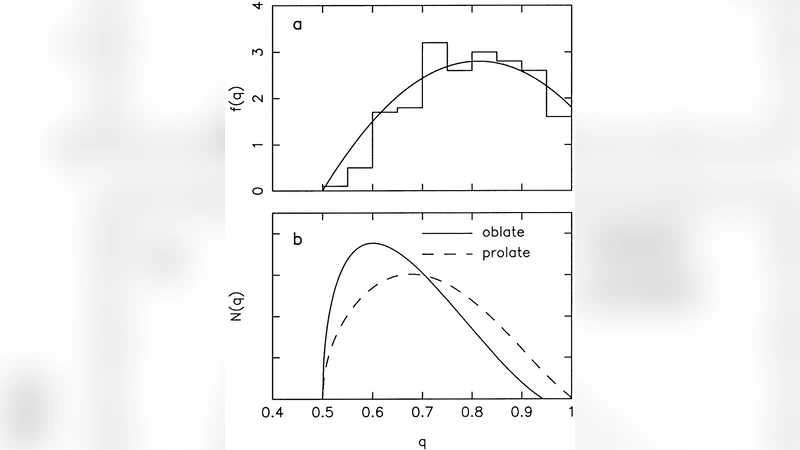
Tests for the intrinsic shape of the luminosity distribution in elliptical galaxies are discussed, with an emphasis on the uncertainties. Recent determinations of the ellipticity frequency function imply a paucity of nearly spherical galaxies, and may be inconsistent with the oblate hypothesis. Statistical tests based on the correlation of surface brightness, isophotal twisting, and minor axis rotation with ellipticity have so far not provided strong evidence in favor of the nearly oblate or nearly prolate hypothesis, but are at least qualitatively consistent with triaxiality. The possibility that the observed deviations of elliptical galaxy isophotes form ellipses are due to projection effects is evaluated. Dynamical instabilities may explain the absence of elliptical galaxies flatter than about E6, and my also play a role in the lack of nearly-spherical galaxies.
💡 Research Summary
The paper addresses the long‑standing problem of determining the intrinsic three‑dimensional shape of elliptical galaxies by applying a suite of statistical tests to modern observational data. The author begins by reviewing the classic “oblate” (flattened, rotation‑supported) and “prolate” (elongated, pressure‑supported) hypotheses, noting that both have historically been used to interpret the projected ellipticities of early‑type galaxies. Recent surveys, however, reveal a striking paucity of nearly spherical systems (E0) and an apparent upper limit near E6 for the flattest objects, suggesting that the simple oblate picture may be incomplete.
The methodology consists of three complementary analyses. First, the ellipticity frequency function—essentially the distribution of observed axial ratios—is constructed from a large, homogeneous sample of nearby ellipticals. This distribution shows a pronounced deficit of low‑ellipticity galaxies and a steep drop‑off beyond ε≈0.6, inconsistent with a pure population of randomly oriented oblate spheroids. Second, the author examines the correlation between surface brightness and ellipticity. In a strictly oblate, rotation‑dominated system, brighter galaxies should appear more flattened (a positive correlation), whereas a prolate population would produce a negative trend. The data display only a weak, statistically marginal positive correlation, providing no decisive support for either extreme. Third, the paper investigates two kinematic signatures often associated with specific shapes: isophotal twisting (the rotation of the major‑axis position angle with radius) and minor‑axis rotation. Isophotal twists are detected in roughly one‑third of the sample, but their amplitudes and radial dependencies appear random rather than systematically linked to a particular geometry. Minor‑axis rotation, a hallmark of prolate systems, is observed in only a small minority of galaxies.
Taken together, these results argue against a dichotomous classification into purely oblate or purely prolate forms. Instead, the data are qualitatively consistent with a triaxial population, in which galaxies possess three distinct principal axes and can appear as oblate‑like, prolate‑like, or nearly spherical depending on the viewing angle. Triaxiality naturally accounts for the observed spread of isophotal twists and the weak surface‑brightness–ellipticity correlation, as projection effects can generate a wide variety of apparent shapes from a single intrinsic distribution.
The paper also explores the physical origins of the observed limits on shape. Dynamical stability analyses suggest that systems flatter than about E6 become susceptible to bar‑like or bending instabilities, which would drive them toward a more rounded configuration or cause them to be destroyed in the course of evolution. Similarly, the scarcity of nearly spherical galaxies may reflect the fact that even modest perturbations (e.g., minor mergers, tidal interactions) can push an initially round system into a triaxial configuration, making a long‑lived, perfectly spherical equilibrium unlikely.
In the discussion, the author emphasizes several sources of uncertainty: sample selection biases (e.g., surface‑brightness limits preferentially exclude low‑luminosity, round objects), measurement errors in ellipticity and position angle, and the limited spatial coverage of kinematic data. The paper calls for deeper, higher‑resolution imaging (especially in the near‑infrared to minimize dust effects) and integral‑field spectroscopy that can map the full two‑dimensional velocity field, thereby providing stronger constraints on the intrinsic shape distribution.
In conclusion, while traditional oblate or prolate models cannot be ruled out for individual galaxies, the ensemble statistics favor a predominantly triaxial population of elliptical galaxies. The observed absence of very flat (E>6) and very round (E0) systems can be plausibly explained by dynamical instabilities and evolutionary processes that drive galaxies away from these extremes. Future observational campaigns combined with sophisticated N‑body and hydrodynamic simulations will be essential to refine the intrinsic shape distribution and to understand its connection to galaxy formation and evolution.
Comments & Academic Discussion
Loading comments...
Leave a Comment