Remarks on the Most Informative Function Conjecture at fixed mean
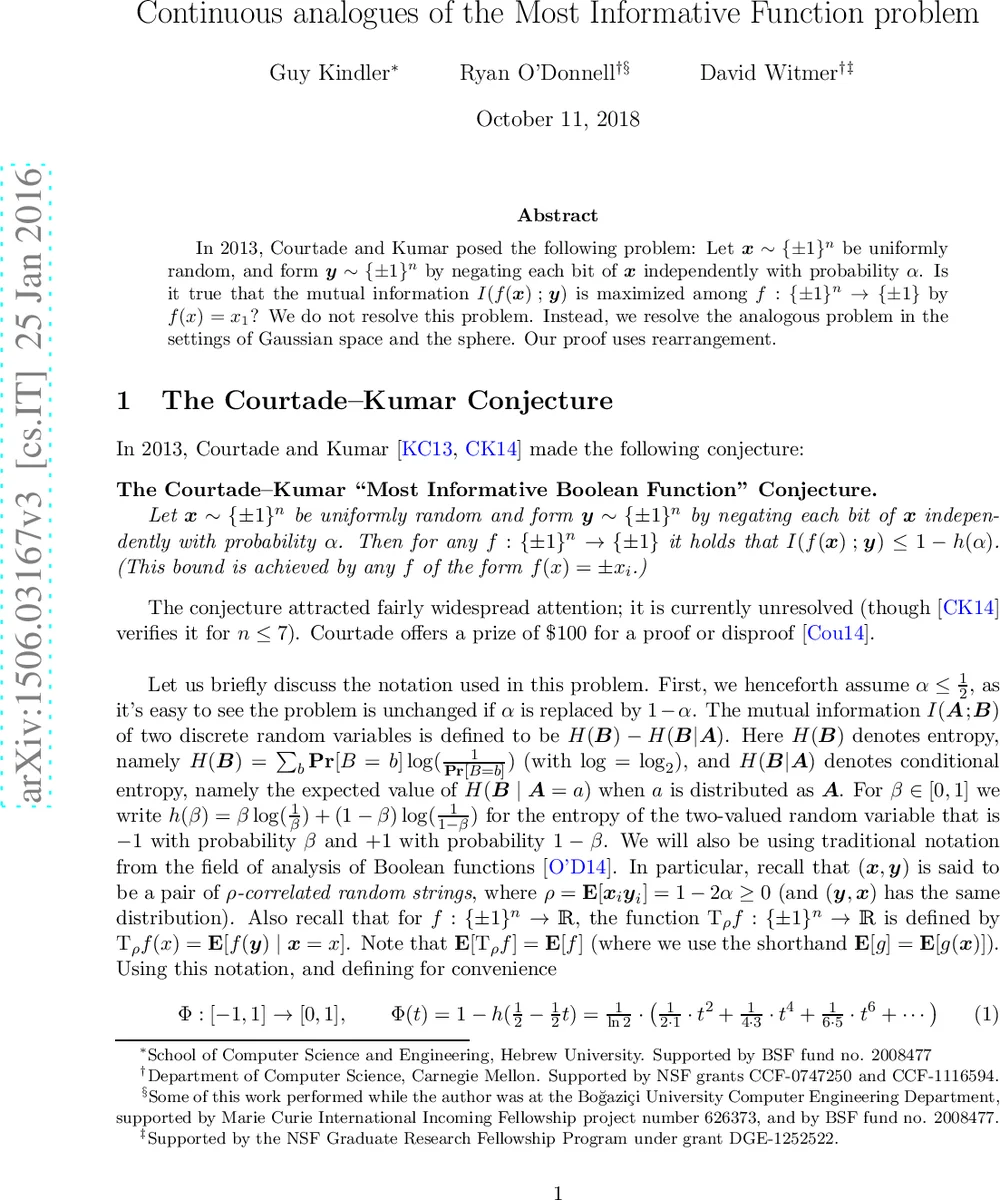
In 2013, Courtade and Kumar posed the following problem: Let $\boldsymbol{x} \sim {\pm 1}^n$ be uniformly random, and form $\boldsymbol{y} \sim {\pm 1}^n$ by negating each bit of $\boldsymbol{x}$ independently with probability $\alpha$. Is it true that the mutual information $I(f(\boldsymbol{x}) \mathbin{;} \boldsymbol{y})$ is maximized among $f:{\pm 1}^n \to {\pm 1}$ by $f(x) = x_1$? We do not resolve this problem. Instead, we make a couple of observations about the fixed-mean version of the conjecture. We show that Courtade and Kumar’s stronger Lex Conjecture fails for small noise rates. We also prove a continuous version of the conjecture on the sphere and show that it implies the previously-known analogue for Gaussian space.
💡 Research Summary
The paper tackles the Courtade–Kumar “most informative Boolean function” conjecture, which asks whether for a uniformly random vector x∈{±1}ⁿ and a noisy copy y obtained by flipping each coordinate independently with probability α, the mutual information I(f(x); y) is maximized by the single‑coordinate function f(x)=x₁, attaining the bound 1–h(α). Rather than solving the conjecture directly, the authors focus on two related aspects.
First, they examine the stronger “Lex Conjecture”, which posits that among all 0/1‑valued functions with a fixed mean µ, the lexicographically smallest set of µ·2ⁿ inputs (i.e., the indicator of the first µ·2ⁿ points in lex order) maximizes I(f(x); y). Building on earlier work that already showed this conjecture fails for certain parameters, the authors provide a new counter‑example in the regime of very small noise (ρ→0, equivalently α→½). By expanding the conditional entropy term h(T_ρ f(x)) in a Taylor series around ρ=0 they identify the leading non‑trivial term as proportional to the degree‑1 Fourier weight W₁
Comments & Academic Discussion
Loading comments...
Leave a Comment