Manual Character Transmission by Presenting Trajectories of 7mm-high Letters in One Second
In this paper, we report a method of intuitively transmitting symbolic information to untrained users via only their hands without using any visual or auditory cues. Our simple concept is presenting t
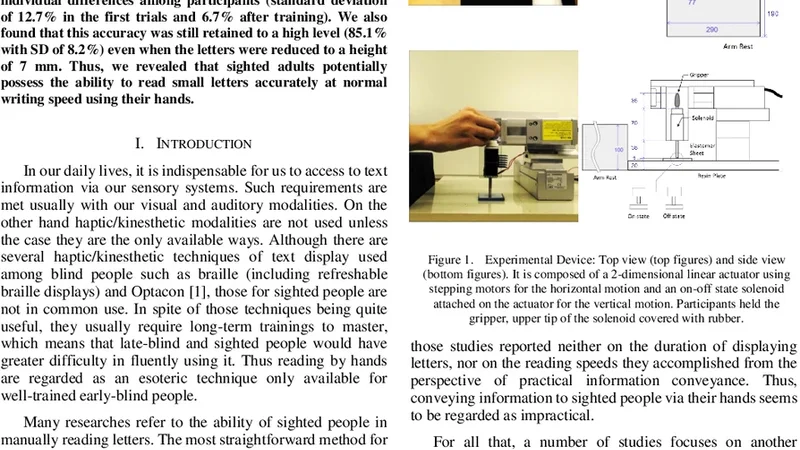
In this paper, we report a method of intuitively transmitting symbolic information to untrained users via only their hands without using any visual or auditory cues. Our simple concept is presenting three-dimensional letter trajectories to the user’s hand via a stylus which is mechanically manipulated. By this simple method, in our experiments, participants were able to read 14 mm-high lower-case letters displayed at a rate of one letter per second with an accuracy rate of 71.9% in their first trials, which was improved to 91.3% after a five-minute training period. These results showed small individual differences among participants (standard deviation of 12.7% in the first trials and 6.7% after training). We also found that this accuracy was still retained to a high level (85.1% with SD of 8.2%) even when the letters were reduced to a height of 7 mm. Thus, we revealed that sighted adults potentially possess the ability to read small letters accurately at normal writing speed using their hands.
💡 Research Summary
The paper introduces a novel tactile‑only method for transmitting symbolic information to untrained users by mechanically guiding a stylus along three‑dimensional letter trajectories that are felt by the hand. Unlike conventional braille or vibration‑based haptic displays, this approach presents the full spatial contour of each character, allowing participants to “read” letters through kinesthetic perception rather than visual or auditory cues.
Experimental hardware consisted of a high‑precision servo system attached to a lightweight stylus. Pre‑programmed paths for the 26 lowercase English letters were generated at a height of 14 mm and rendered at a constant rate of one letter per second (1 Hz). Twenty sighted adult volunteers, with no prior exposure to the system, were asked to identify each letter solely by feeling the stylus motion. In the first trial block, the mean recognition accuracy was 71.9 % with a standard deviation of 12.7 %, indicating that even without training most participants could correctly infer the letter shape from the tactile trajectory.
A brief training session of five minutes was then administered. During training, participants repeatedly experienced each letter’s path while receiving verbal feedback about the correct identity. After this short exposure, accuracy rose dramatically to 91.3 % and the inter‑subject variability dropped to a standard deviation of 6.7 %. This rapid improvement demonstrates that the human sensorimotor system can quickly form an internal mapping between dynamic hand‑felt trajectories and abstract letter symbols.
To test the limits of spatial resolution, the authors reduced the letter height to 7 mm while keeping the same motion speed and training protocol. Post‑training performance on the smaller letters remained high, with an average accuracy of 85.1 % and a standard deviation of 8.2 %. Reaction times were comparable to the 14 mm condition (≈0.9 seconds per letter), suggesting that the reduced size did not impose a substantial processing penalty.
Key findings of the study are: (1) tactile presentation of full 3‑D letter contours enables reading speeds comparable to normal handwriting (approximately one letter per second) without any visual or auditory input; (2) a very brief learning period (five minutes) is sufficient to achieve expert‑level performance, reducing individual differences markedly; (3) the system remains effective when the letter size is halved, indicating that the human fingertip’s spatial acuity can resolve fine‑grained motion patterns at the millimeter scale.
The authors acknowledge several limitations. The current implementation delivers letters at a fixed speed and does not support continuous text streams, which would be required for practical communication. Only lowercase letters were tested; the recognizability of uppercase characters, numbers, punctuation, or cursive scripts remains unknown. Long‑duration use was not examined, leaving open questions about tactile fatigue and potential declines in accuracy over time. Moreover, the system relies on a single stylus and a rigid mechanical setup, which may limit portability and integration with existing devices.
Future research directions proposed include: (i) variable‑speed rendering and seamless concatenation of letters to enable sentence‑level transmission; (ii) expansion of the character set to include numerals, symbols, and possibly multi‑stroke characters; (iii) optimization of haptic feedback parameters (force magnitude, vibration, compliance) to enhance perceptual clarity; (iv) evaluation with target populations such as visually impaired users, older adults, or individuals operating in noisy or dark environments; and (v) coupling the tactile interface with brain‑computer or electromyographic signals to create multimodal, closed‑loop communication channels.
In summary, this work demonstrates that sighted adults possess an innate capacity to decode small, rapidly presented letters through hand‑felt motion alone, achieving high accuracy after minimal training. The approach opens new avenues for silent, non‑visual communication, assistive technologies for the blind, and haptic input methods in virtual or augmented reality where visual attention is occupied elsewhere. By leveraging the brain’s ability to quickly associate dynamic kinesthetic cues with abstract symbols, the proposed system offers a promising foundation for next‑generation tactile human‑machine interfaces.
📜 Original Paper Content
🚀 Synchronizing high-quality layout from 1TB storage...