Computational Models of Material Interfaces for the Study of Extracorporeal Shock Wave Therapy
Extracorporeal Shock Wave Therapy (ESWT) is a noninvasive treatment for a variety of musculoskeletal ailments. A shock wave is generated in water and then focused using an acoustic lens or reflector so the energy of the wave is concentrated in a small treatment region where mechanical stimulation enhances healing. In this work we have computationally investigated shock wave propagation in ESWT by solving a Lagrangian form of the isentropic Euler equations in the fluid and linear elasticity in the bone using high-resolution finite volume methods. We solve a full three-dimensional system of equations and use adaptive mesh refinement to concentrate grid cells near the propagating shock. We can model complex bone geometries, the reflection and mode conversion at interfaces, and the the propagation of the resulting shear stresses generated within the bone. We discuss the validity of our simplified model and present results validating this approach.
💡 Research Summary
This paper presents a comprehensive computational framework for investigating the propagation of extracorporeal shock waves (ESWT) from water into bone tissue. The authors model the fluid domain using the isentropic Euler equations expressed in Lagrangian form, while bone is treated as a linear elastic solid governed by the equations of linear elasticity. By formulating both media within a single Lagrangian system, continuity of displacement and velocity at the fluid‑bone interface is naturally enforced.
A high‑resolution finite‑volume scheme, equipped with total‑variation‑diminishing (TVD) limiters and high‑order reconstruction, resolves the steep gradients and discontinuities inherent to shock waves. Adaptive mesh refinement (AMR) concentrates computational cells around the moving shock front and near material interfaces, enabling full three‑dimensional simulations of realistic bone geometries without prohibitive computational cost.
The simulations reveal detailed wave phenomena at the water‑bone boundary: part of the incident compressive shock is reflected, part is transmitted, and a substantial portion is converted into shear waves within the solid. These shear waves generate localized shear stresses that are highly sensitive to bone thickness, curvature, and surface smoothness. The resulting stress fields suggest a mechanistic basis for the therapeutic effects of ESWT, as shear‑induced micro‑deformations can stimulate cellular remodeling.
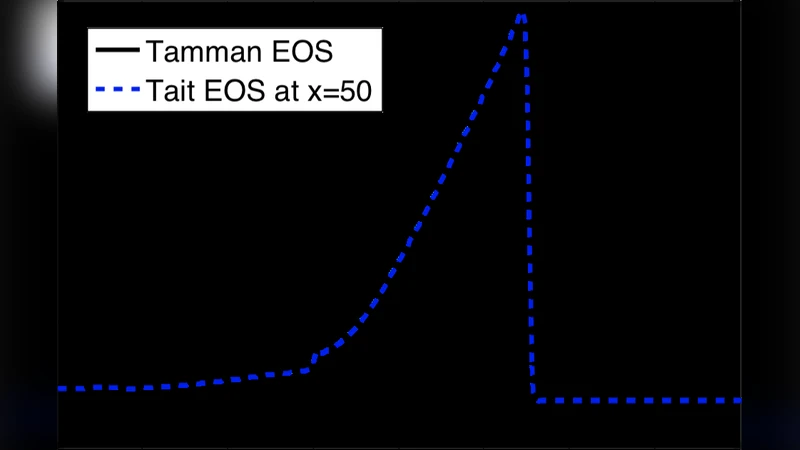
Model validation is performed by comparing simulated pressure waveforms and peak amplitudes with laboratory measurements and published acoustic data. The agreement confirms that the simplified isentropic‑fluid/linear‑elastic solid model captures the essential physics of ESWT, although the authors acknowledge limitations: neglect of viscosity, non‑linear elasticity, and temperature effects may introduce errors at very high pressures.
In conclusion, the study demonstrates that a coupled fluid‑solid finite‑volume/AMR approach can accurately reproduce shock‑wave propagation, interface mode conversion, and stress generation in complex bone structures. The framework provides a valuable tool for optimizing ESWT parameters, designing patient‑specific treatment plans, and guiding future experimental investigations that incorporate more sophisticated material models and biological response mechanisms.
Comments & Academic Discussion
Loading comments...
Leave a Comment