Coalitions and Cliques in the School Choice Problem
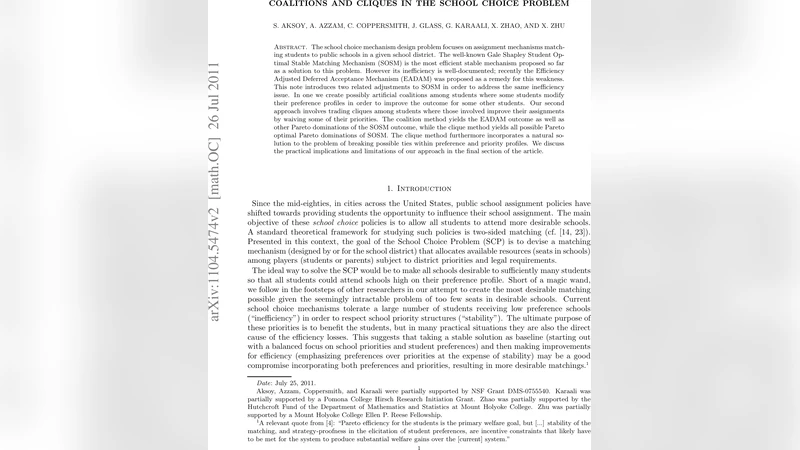
The school choice mechanism design problem focuses on assignment mechanisms matching students to public schools in a given school district. The well-known Gale Shapley Student Optimal Stable Matching Mechanism (SOSM) is the most efficient stable mechanism proposed so far as a solution to this problem. However its inefficiency is well-documented, and recently the Efficiency Adjusted Deferred Acceptance Mechanism (EADAM) was proposed as a remedy for this weakness. In this note we describe two related adjustments to SOSM with the intention to address the same inefficiency issue. In one we create possibly artificial coalitions among students where some students modify their preference profiles in order to improve the outcome for some other students. Our second approach involves trading cliques among students where those involved improve their assignments by waiving some of their priorities. The coalition method yields the EADAM outcome among other Pareto dominations of the SOSM outcome, while the clique method yields all possible Pareto optimal Pareto dominations of SOSM. The clique method furthermore incorporates a natural solution to the problem of breaking possible ties within preference and priority profiles. We discuss the practical implications and limitations of our approach in the final section of the article.
💡 Research Summary
The paper tackles the well‑known inefficiency of the Student‑Optimal Stable Matching (SOSM) mechanism that is widely used for public school assignments. While SOSM guarantees stability and strategy‑proofness for individual students, it often leaves many students assigned to low‑ranked schools because school priority structures dominate the outcome. To address this, the authors propose two complementary adjustments that start from the SOSM baseline and aim to improve Pareto efficiency.
The first adjustment is a coalition approach. Here a group of students deliberately modifies their reported preference lists so that the resulting SOSM outcome is Pareto‑dominated. By adapting Huang’s analysis of group manipulation in two‑sided matching, the authors show that SOSM is not coalition‑strategy‑proof: a coalition can be constructed that yields a strictly better matching for its members while preserving the overall feasibility of the assignment. Crucially, the set of possible coalition‑induced outcomes includes the Efficiency‑Adjusted Deferred Acceptance Mechanism (EADAM) introduced by Kesten, meaning that the coalition framework subsumes EADAM as a special case. The coalition method therefore provides a systematic way to generate many Pareto‑improving matchings beyond what EADAM alone can achieve.
The second adjustment is a clique (trading‑cycle) approach. After obtaining the SOSM assignment, students are allowed to waive certain priority rights, creating a directed graph where an edge from student i to school s indicates that i is willing to give up the priority that currently blocks a more preferred school. Strongly connected components of this graph correspond to trading cycles (cliques). By executing these cycles, each participant moves to a more preferred school while the sacrificed priority is transferred to another participant. This procedure is analogous to the Top Trading Cycles (TTC) algorithm but differs in that it starts from a stable SOSM baseline rather than from the empty assignment. The authors prove that the clique method can generate all Pareto‑optimal matchings that dominate SOSM, thereby providing a complete characterization of the efficiency frontier reachable from SOSM. Moreover, because the method explicitly handles priority ties within cliques, it offers a natural solution to the tie‑breaking problem that plagues standard two‑sided matching algorithms.
Both methods are examined for practical feasibility. Coalitions may be orchestrated by a school district (the “designer”) or arise spontaneously among students, but they require either consent forms or a policy that permits students to alter their preference lists in a coordinated way. The clique method relies on voluntary priority waivers and on the computational identification of cycles, which can be done efficiently but still demands a procedural infrastructure. The authors discuss how each approach balances the trade‑off between respecting school priorities (often motivated by diversity or equity goals) and maximizing student welfare.
In conclusion, the paper contributes two novel mechanisms that extend the SOSM framework toward greater Pareto efficiency. The coalition approach generalizes EADAM and demonstrates that group strategic behavior can be harnessed to improve outcomes. The clique approach provides a full Pareto‑optimal frontier and resolves the tie‑breaking issue inherent in many school‑choice implementations. The work opens avenues for empirical testing, policy design, and further theoretical exploration of efficiency‑focused school‑choice mechanisms.
Comments & Academic Discussion
Loading comments...
Leave a Comment