Laminations in the language of leaves
Thurston defined invariant laminations, i.e. collections of chords of the unit circle $S^1$ (called \emph{leaves}) that are pairwise disjoint inside the open unit disk and satisfy a few dynamical properties. To be directly associated to a polynomial,…
Authors: Alex, er M. Blokh, Debra Mimbs
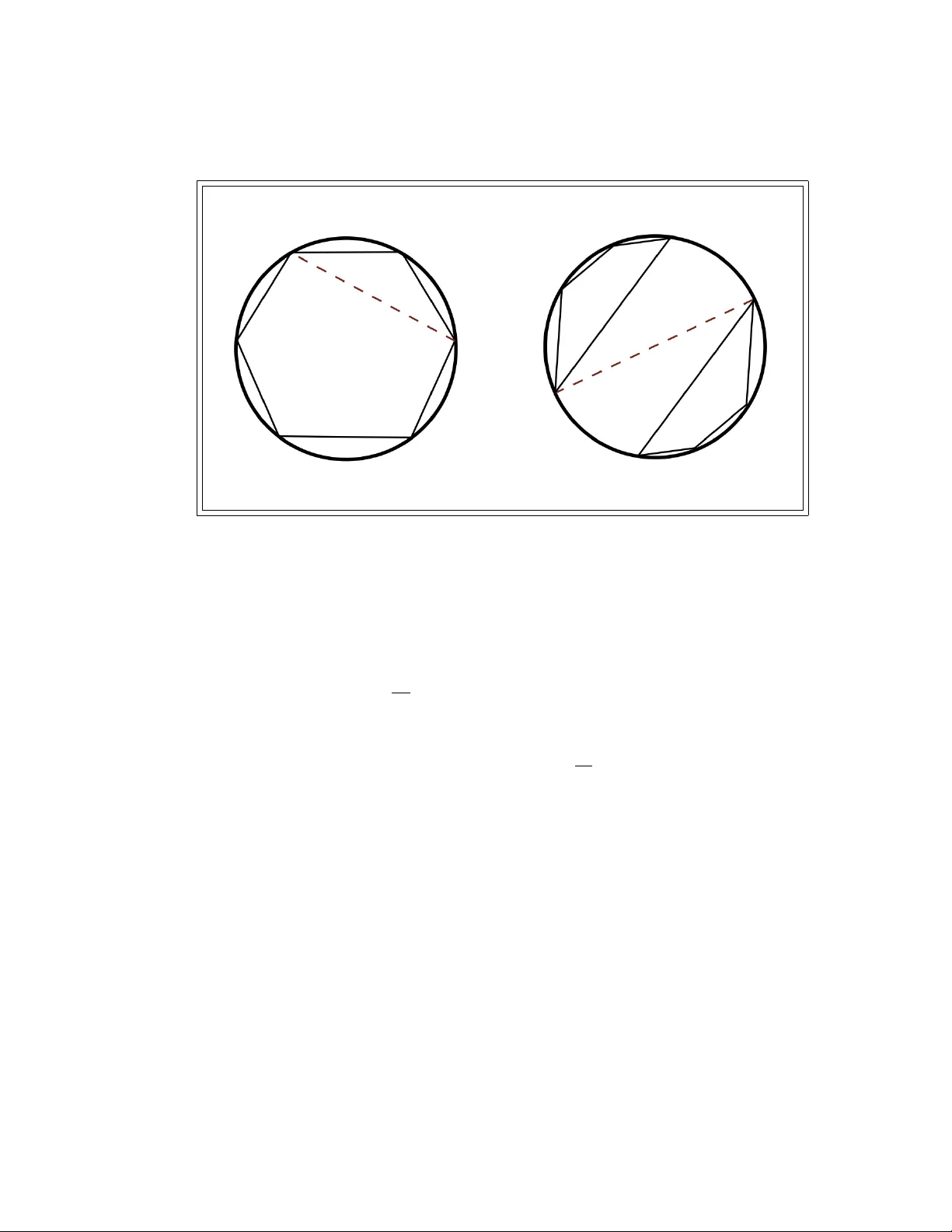
LAMINA TIONS IN THE LANGUA GE OF LEA VES ALEXANDER M. BLOKH, DEBRA MIMBS, LEX G. O VERSTEEGEN, AND KIRSTEN I. S. V ALKENBUR G Abstract. Th urston defined inv arian t laminations, i.e. collec- tions of c hords of the unit circle S (called le aves ) that are pairwise disjoin t inside the op en unit disk and satisfy a few dynamical prop- erties. T o b e directly asso ciated to a p olynomial, a lamination has to b e generated by an equiv alence relation with sp ecific prop erties on S ; then it is called a q-lamination . Since not all laminations are q-laminations, then from the p oint of view of studying p oly- nomials the most interesting are those of them which are limits of q-laminations. In this pap er w e in tro duce an alternative definition of an inv ariant lamination, which inv olves only conditions on the lea ves (and av oids gap inv ariance). The new class of laminations is sligh tly smaller than that defined by Thurston and is closed. W e use this notion to elucidate the connection betw een inv ariant laminations and in v arian t equiv alence relations on S . 1. Introduction In v ariant laminations, in tro duced by Thurston in the early 1980’s, are used to study the dynamics of individual p olynomials and the pa- rameter space of all p olynomials, the latter in the quadratic case (an expanded version of Thurston’s preprin t recen tly app eared [Th u09]). In v estigating the space of all quadratic inv arian t laminations pla y ed a crucial role in [Thu09]. An imp ortant idea of Th urston’s w as, as w e see it, similar to one of the main ideas of dynamics as a whole - to sug- gest a tool ( laminations ) allo wing one to model the dynamics under in v estigation on a top ologically/com binatorially nice ob ject (in case of [Th u09] one mo dels p olynomial dynamics on the Julia set b y so-called top olo gic al p olynomials , generated b y laminations). Date : January 18, 2011; in the revised form Decem b er 13, 2011. 2010 Mathematics Subje ct Classific ation. Primary 37F20; Secondary 37F10. Key wor ds and phr ases. Th urston lamination, complex p olynomial, Julia set. The first and third named authors w ere supported in part b y NSF-DMS-0901038 and NSF-DMS-0906316. The last named author was supp orted by the Netherlands Organization for Scien tific Research (NWO), under grant 613.000.551; she also thanks the Departmen t of Mathematics at UAB for its hospitality . 1 2 BLOKH, MIMBS, OVERSTEEGEN, AND V ALKENBUR G According to Th urston, a lamination L is a closed family of chords inside the op en unit disk D . These chords meet at most in a common endp oin t and satisfy some dynamical conditions; these c hords are called le aves (of the lamination) and union of all lea v es from L united with S is denoted b y L ∗ . A natural dir e ct w a y to associate a lamination to a p olynomial P of degree d with a lo cally connected Julia set is as follo ws: (1) define an equiv alence relation ∼ P on S b y identifying angles if their external ra ys land at the same point (observe that ∼ P on S is σ d - in v ariant); (2) consider the edges of con v ex hulls of equiv alence classes and declare them to b e the le aves of the corresp onding lamination L P . By [Kiw04, BCO08] more adv anced methods allo w one to associate a lamination to some p olynomials with non-lo cally connected Julia sets (b y declaring tw o angles equiv alent if impressions of their external rays are non-disjoin t and extending this relation b y transitivit y). W e call laminations, generated b y equiv alence relations similar to ∼ P ab o ve, q-laminations . They form an imp ortant class of laminations, many of whic h corresp ond to complex p olynomials with connected Julia sets. In all these cases the lamination is found through the study of the top ology of the Julia set of the p olynomial. The dra wback of this approac h is that it fails if the top ology of the Julia set is complicated (e.g., if a quadratic p olynomial has a fixed Cr emer p oint [BO06]). Thus, even though ultimately laminations are a to ol whic h allo ws one to study b oth individual p olynomials and their parameter space, in some cases it is not obvious as to what lamina- tions (or what equiv alence relations on the circle) can b e directly con- nected in a meaningful wa y to certain p olynomials. Hence one needs a non-direct w a y of asso ciating a lamination (or, more generally , some com binatorial structure) to a p olynomial with a complicated Julia set. A p ossibilit y here is as follo ws. F or a p olynomial P c ( z ) = z 2 + c , consider sequences of parameters c i → c with P c i = P i ha ving lo cally connected Julia sets and asso ciated lamination L P i . These laminations L P i (systems of chords of S ) ma y conv erge to another lamination (sys- tem of chords of S ) in the sense that the con tin ua L ∗ P i ma y con v erge to a sub contin uum of D in the Hausdorff sense, and the limit con tinuum L ∗ then comes from an appropriate lamination L ). In this case the lamination L is called the Hausdorff limit of laminations L P i ; one may asso ciate all such Hausdorff limit laminations to c . Using this notion of conv ergence one can define the Hausdorff clo- sures of sets of laminations. Hence the space of laminations useful for studying p olynomials could b e a closed set of laminations which con- tains the Hausdorff closure of the set of all q-laminations, but is not m uc h bigger. LAMINA TIONS IN THE LANGUA GE OF LEA VES 3 T o describ e a candidate set of laminations w e in troduce a new notion of a sibling invariant lamination whic h is sligh tly more restrictiv e than the one giv en by Th urston. The new definition is giv en intrinsically (i.e., b y only listing prop erties on the lea v es of the lamination). W e sho w that the family of all sibling inv arian t laminations is closed and con tains all q-laminations. The new definition significan tly simplifies the verification of the fact that a system of c hords of S is an in v ariant lamination. Th urston [Th u09] introduced the class of cle an lamina- tions. W e use our to ols to sho w that clean laminations are (up to a finite mo dification) q -laminations. In Section 6 we apply these ideas to the degree 2 case and sho w that in this case all clean Th urston in v ariant laminations are q -laminations. Ac kno wledgmen ts . The authors w ould lik e to thank the referee for useful suggestions and commen ts. 2. Lamina tions: classical definitions 2.1. Preliminaries. Let C b e the complex plane, S ⊂ C the unit circle iden tified with R / Z and let D ⊂ C b e the op en unit disk. Define a map σ d : S → S b y σ d ( z ) = dz mo d 1, d ≥ 2. By a chor d in the unit disk w e mean a segmen t of a straight line connecting tw o p oints of the unit circle. A pr elamination L is a collection of c hords in D , called le aves , suc h that an y t w o leav es of L meet at most in a p oin t of S . If all p oin ts of the circle are elemen ts of L (seen as degenerate lea v es) and S L = L ∗ is closed in C , then w e call L a lamination . Hence, one obtains a lamination by closing a prelamination and adding all p oin ts of S viewed as degenerate leav es. If ` ∈ L and ` ∩ S = { a, b } then we write ` = ab . W e use the term “leaf ” to refer to a non-degenerate leaf in the lamination, and sp ecify when a leaf ma y be degenerate, i.e. a p oin t in S . Giv en a leaf ` = ab ∈ L , let σ d ( ` ) b e the chord with endp oin ts σ d ( a ) and σ d ( b ). If σ d ( a ) = σ d ( b ), call ` a critic al le af and σ d ( a ) a critic al value . Let σ ∗ d : L ∗ → D b e the linear extension of σ d o v er all the lea ves in L . It is not hard to c hec k that σ ∗ d is contin uous. Also, σ d is lo cally one-to-one on S , and σ ∗ d is one-to-one on any given non-critical leaf. Note that if L is a lamination, then L ∗ is a contin uum. Definition 2.1 (Gap) . A gap G of a lamination L is the closure of a comp onen t of D \ L ∗ ; its b oundary lea v es are called e dges (of a gap) . W e also sa y that a leaf ` is an e dge of ` . F or each set A ⊂ D w e denote A ∩ S b y ∂ ( A ). If G is a leaf or a gap of L , it follows that G coincides with the con v ex hull of ∂ ( G ). If G is 4 BLOKH, MIMBS, OVERSTEEGEN, AND V ALKENBUR G a leaf or a gap of L w e let σ d ( G ) b e the conv ex hull of σ d ( ∂ ( G )). Also, b y Bd( G ) we denote the top ological b oundary of G . Notice that the top ological b oundary of G is a Jordan curv e whic h consists of leav es and p oin ts on S , so that Bd( G ) ∩ S = G ∩ S = ∂ ( G ). A gap G is called infinite if and only if ∂ ( G ) is infinite. A gap G is called critic al if σ d | ∂ G is not one-to-one. Observe that there are tw o types of degenerate leav es of L ∗ whic h are not endp oints of non-degenerate lea ves: (1) certain v ertices of gaps, (2) p oin ts of S , separated from other p oints of S by a sequence of leav es of L . 2.2. q-laminations. Let P b e a complex p olynomial with lo cally con- nected Julia set J . Then J is connected and there exists a conformal map ϕ : C ∗ \ D → C ∗ \ K , where K is the fil le d-in Julia set (i.e., the complemen t of the unbounded comp onen t of J in C ). One can c ho ose ϕ so that ϕ 0 (0) > 0 and P ◦ ϕ = ϕ ◦ σ d , where σ d ( z ) = z d and d is the degree of P . Since J is lo cally connected, ϕ extends ov er the b oundary S of D . W e denote the extended map also b y ϕ . Define an equiv alence relation ≈ P on S b y x ≈ P y if and only if ϕ ( x ) = ϕ ( y ). Since J is the b oundary of C ∗ \ K , then J is homeomorphic to S / ≈ P . Clearly , the map σ d induces a map f d : S / ≈ P → S / ≈ P and the maps P | J and f d are conjugate. It is known that all equiv alence classes of ≈ P are finite. The collection of b oundary edges of con vex h ulls of all equiv alences classes of ≈ P is a lamination denoted b y L P . Equiv alence relations analogous to ≈ P can b e in tro duced with no reference to polynomials [BL02]. Let ∼ be an equiv alence relation on S . Equiv alence classes of ∼ will be called ( ∼ -)classes and will be denoted by Gothic letters. Also, given a closed set A ⊂ C , let CH( A ) denote the conv ex hull of the set A in C . Definition 2.2. An equiv alence relation ∼ is a ( d -)invariant lamina- tional equiv alence relation if: (E1) ∼ is close d : the graph of ∼ is a closed set in S × S ; (E2) ∼ is unlinke d : if g 1 and g 2 are distinct ∼ -classes, then their con vex h ulls CH( g 1 ) , CH( g 2 ) in the unit disk D are disjoin t, (D1) ∼ is forwar d invariant : for a class g , the set σ d ( g ) is a class to o whic h implies that (D2) ∼ is b ackwar d invariant : for a class g , its preimage σ − 1 d ( g ) = { x ∈ S : σ d ( x ) ∈ g } is a union of classes; (D3) for an y ∼ -class g with more than t wo p oin ts, the map σ d | g : g → σ d ( g ) is a c overing map with p ositive orientation , i.e., for ev ery connected comp onent ( s, t ) of S \ g the arc in the circle ( σ d ( s ) , σ d ( t )) is a connected comp onent of S \ σ d ( g ); (D4) all ∼ -classes are finite. LAMINA TIONS IN THE LANGUA GE OF LEA VES 5 There is an imp ortan t connection b et ween laminations and (in v ariant laminational) equiv alence relations. Definition 2.3. Let L b e a lamination. Define the equiv alence re- lation ≈ L b y declaring that x ≈ L y if and only if there exists a finite concatenation of leav es of L joining x to y . No w w e are ready to define q-laminations . Definition 2.4. A lamination L is called a q-lamination if the equiv- alence relation ≈ L is an in v ariant laminational equiv alence relation and L consists exactly of b oundary edges of the conv ex hulls of all ≈ L -classes together with all p oin ts of S . If an in v ariant laminational equiv alence relation ∼ is given and L is formed by all edges from the con v ex hulls of all ∼ -classes together with all p oin ts of S then L is called the q-lamination (gener ate d by ∼ ) and is denoted by L ∼ . Clearly , if L is a q-lamination, then it is a q-lamination generated by ≈ L . Let ∼ b e a laminational equiv alence relation and p : S → J ∼ = S / ∼ b e the quotient map of S onto its quotient space J ∼ , let f ∼ : J ∼ → J ∼ b e the map induced b y σ d . W e call J ∼ a top olo gic al Julia set and the induced map f ∼ a top olo gic al p olynomial . It is easy to see from definition 2.2 that lea v es of L ∼ map to leav es of L ∼ under σ d ; moreo ver, the map σ d acting on lea v es and gaps of L ∼ has also other more sp ecific prop erties analogous to (D1) - (D4) ab ov e. This leads to the abstract notion of an inv arian t lamination [Thu09] that allo ws for laminations whic h are not directly asso ciated to a laminational equiv alence relation and, hence, do not corresp ond (directly) to a p olynomial. 2.3. In v arian t laminations due to Th urston. Definition 2.5 (Monotone Map) . Let X , Y b e top ological spaces and f : X → Y b e con tinuous. Then f is said to b e monotone if f − 1 ( y ) is connected for eac h y ∈ Y . It is kno wn that if f is monotone and X is a contin uum then f − 1 ( Z ) is connected for every connected Z ⊂ f ( X ). Definition 2.6 is due to Th urston [Thu09]; recall that gaps are defined in Definition 2.1. Definition 2.6 (Thurston Inv arian t Lamination [Thu09]) . A lamina- tion L is Thurston d -invariant if it satisfies the following conditions. (1) F orw ard d -inv ariance: for any leaf ` = pq ∈ L , either σ d ( p ) = σ d ( q ), or σ d ( p ) σ d ( q ) = σ d ( ` ) ∈ L . (2) Backw ard inv ariance: for any leaf pq ∈ L , there exists a collec- tion of d disjoint lea v es in L (this collection of leav es ma y not b e unique), each joining a pre-image of p to a pre-image of q . 6 BLOKH, MIMBS, OVERSTEEGEN, AND V ALKENBUR G (3) Gap in v ariance: F or any gap G , the conv ex h ull H of σ d ( G ∩ S ) is a gap, a leaf, or a single p oin t (of S ). If H is a gap, σ ∗ d | Bd( G ) : Bd( G ) → Bd( H ) must map as the com- p osition of a monotone map and a co v ering map to the boundary of the image gap, with p ositive orientation (the image of a p oin t moving clo c kwise around Bd( G ) m ust mo v e clockwise around the image Bd( H ) of G ). 3. Sibling Inv ariant Lamina tions 3.1. An alternativ e definition. Note that in Definition 3.1 w e do not require the in v ariance of gaps. Definition 3.1 (Sibling d -Inv arian t Lamination [Mim10]) . A (pre)la- mination L is sibling d -invariant if: (1) for each ` ∈ L either σ d ( ` ) ∈ L or σ d ( ` ) is a p oint in S , (2) for each ` ∈ L there exists a leaf ` 0 ∈ L such that σ d ( ` 0 ) = ` , (3) for each ` ∈ L suc h that σ d ( ` ) is a non-degenerate leaf, there exist d disjoin t leav es ` 1 , . . . , ` d in L suc h that ` = ` 1 and σ d ( ` i ) = σ d ( ` ) for all i . W e need to make a few remarks. Giv en a con tin uum or a p oint K ⊂ L ∗ whic h maps one-to-one onto σ ∗ d ( K ), we call a con tin uum or a p oin t T ⊂ L ∗ a sibling (of K ) if K ∩ T = ∅ and T maps on to σ ∗ d ( K ) in a one-to-one fashion to o (thus, siblings are homeomorphic and disjoin t). E.g., the lea ves ` 2 , . . . , ` d from Definition 3.1 are siblings of ` . The collection { `, ` 2 , . . . , ` d } of lea ves from Definition 3.1 is called a ful l sibling c ol le ction (of ` ) . In general, for a contin uum or a p oin t K ⊂ L ∗ whic h maps one-to-one on to σ ∗ d ( K ), a collection of d sets made up of K and its pairwise disjoin t siblings is called a ful l sibling c ol le ction (of K ) . Often w e talk ab out siblings without assuming the existence of a full sibling collection (e.g., in the context of Thurston d -in v ariant laminations). Let L be a sibling d -in v ariant lamination. Then b y Definition 3.1 (1) we see that Definition 2.6 (1) is satisfied. Now, let ` ∈ L b e a leaf. Then b y Definition 3.1 (2) and (3) there are d pairwise disjoin t leav es of L whic h map on to ` ; thus, Definition 2.6 (2) is satisfied. Therefore b oth sibling d -in v ariant laminations and Th urston d -in v ariant lamina- tions satisfy conditions (1) and (2) of Definition 2.6, i.e. are forwar d d -invariant and b ackwar d d -invariant . Both conditions deal with le aves and in that resp ect are in trinsic to L which is defined as a collection of lea v es. How ever having these conditions is not enough to define a LAMINA TIONS IN THE LANGUA GE OF LEA VES 7 meaningful dynamic collection of leav es; there are examples of lamina- tions satisfying conditions (1)-(2) of Definition 2.6 whic h are not gap in v ariant. Therefore one needs to add an extra condition to forw ard and backw ard inv ariance. The c hoice made in Definition 2.6 deals with gaps, i.e. closures of comp onen ts of the complement D \ L ∗ . This is a straigh tforw ard w a y to ensure that σ ∗ d has a nice extension o v er the plane. Ho w ev er a dra wbac k of this approac h is that while L otherwise is defined as a family of c hords of D (lea ve s), in gap in v ariance w e directly talk ab out other ob jects (gaps). One can argue that gap in v ariance of L under σ d is not sufficien tly in trinsic since L is defined as a collection of lea v es. As a consequence it is often more cum b ersome to verify gap in v ariance. This justifies the searc h for a similar definition of an in v arian t lamination whic h deals only with leav es. Abov e we prop ose the notion of a sibling ( d )-invariant lamination . 3.2. Sibling in v arian t laminations are gap inv ariant. Now we sho w that any sibling d -inv arian t lamination is a Th urston d -in v ariant lamination. Some complications b elow are caused b y the fact that we do not yet kno w that the lamination is gap inv arian t. E.g., extending the map σ ∗ o v er D to a suitably nice map (i.e., the comp osition of a monotone and op en map) is imp ossible if the lamination is not gap in v ariant. Theorem 3.2. Supp ose that G is a gap of a sibling d -invariant lami- nation L . Then either (1) σ d ( G ) is a p oint in S or a le af of L , or (2) ther e is a gap H of L such that σ d ( G ) = H , and the map σ ∗ d | Bd( G ) : Bd( G ) → Bd( H ) is the p ositively oriente d c omp osi- tion of a monotone map m : Bd( G ) → S , wher e S is a simple close d curve, and a c overing map g : S → Bd( H ) . Thus, any sibling d -invariant lamination is a Thurston d -invariant lamination. T o prov e Theorem 3.2 w e pro ve a few lemmas. Given a p oin t x , call an y p oin t ˆ x ∈ S with σ d ( ˆ x ) = x an x -p oint . If a lamination is given, b y an ˆ a ˆ b - le af , we mean a leaf that maps to ab . The w ord “c hord” is used in lieu of “leaf” in reference to a chord of D which ma y not b e a leaf of L . By [ a, b ] S , a, b ∈ S we mean the closed arc of S from a to b , and by ( a, b ) S w e mean the op en arc of S from a to b . The direction of the arc, clo c kwise ( ne gative ) or counterclockwise ( p ositive ), will b e clear from the con text; also, sometimes w e simply write [ a, b ] , ( a, b ) etc. By < we denote the p ositive (circular) order on S . If w e say 8 BLOKH, MIMBS, OVERSTEEGEN, AND V ALKENBUR G that p oints are or der e d on S we mean that they are either p ositiv ely or negativ ely ordered. Prop osition 3.3 is left to the reader; observe, that in Prop osition 3.3 we do not assume the existence of a lamination. Prop osition 3.3. Supp ose that a 1 < b 1 < a 2 < b 2 < · · · < a n < b n ar e 2 n p oints in the cir cle. Then for any p oint a i and b j either c omp onent of S \ { a i , b j } c ontains the same numb er of a -p oints and b -p oints. In p articular, if ˆ a, ˆ b ∈ S ar e such that a = σ d (ˆ a ) 6 = σ d ( ˆ b ) = b , then either c omp onent of S \ { ˆ a, ˆ b } c ontains the same numb er of a -p oints and b - p oints. Since 2-in v ariant laminations are in v ariant under the rotation b y 1 2 , then, given a 2-in v ariant lamination w e see that its siblings are rotations of eac h other. Even though this is not typically true for laminations of higher degree (see Figure 1), Lemma 3.6 states that sibling leav es must connect in the same order. T o state it we need Definition 3.4. ˆ a 1 ˆ b 1 ˆ x 1 ˆ x 2 ˆ a 2 ˆ b 2 ˆ x 3 ˆ a 3 ˆ b 3 Figure 1. Sibling “arcs” This is an example of sibling “arcs” under σ 3 . Notice that while the arcs connect p oints in differen t “patc hes” and are not found by rigid rotation, the manner in which the endp oints connect preserves order. Definition 3.4. Consider t w o disjoint sets A, B ⊂ S such that σ d ( A ) = σ d ( B ) = C is the one-to-one image of A and B under σ d . Then A, B and C are said to hav e the same orientation if for any three p oints x, y , z ∈ A their siblings x 0 , y 0 , z 0 ∈ B and their images σ d ( x ) , σ d ( y ) , σ d ( z ) hav e LAMINA TIONS IN THE LANGUA GE OF LEA VES 9 the same circular orientation as x, y , z . As w e walk along the circle in the p ositiv e direction from a p oint u ∈ A , its sibling u 0 ∈ B , and its image σ d ( u ), we will meet p oints of A , their siblings in B , and their images in C in the same order. An y t w o t w o-p oint sets ha v e the same orientation; this is not nec- essarily true for sets with more p oin ts. The fact that sets ha v e the same orientation sometimes implies “structural” conclusions. F or a set A ⊂ L ∗ w e write A @ L ∗ if A ∩ S is zero-dimensional. Definition 3.5. A trio d is a homeomorphic image of the simple trio d τ (the union of three arcs whic h share a common endpoint). Denote by B ( T ) the union of the endp oin ts and the v ertex of a trio d T . In what follo ws we always consider trio ds T ⊂ D with B ( T ) ⊂ S . The edge of T , whic h separates (inside D ) the endp oints of T non-b elonging to it, is called the c entr al e dge of T while the other edges of T are said to b e sides of T . Similarly , if A is the union (the concatenation) of t w o lea v es av ∪ v b we set B ( A ) = { a, v , b } . T o a v oid am biguit y w e call a subarc of S a cir cle ar c . By an ar c in L ∗ w e mean a top olo gic al ar c (a one-to-one image of an interv al). Given a set A ⊂ L ∗ w e sometimes need to consider a top ological arc in A with endp oin ts x, y (it will alwa ys b e clear which arc we actually consider); suc h an arc will b e denoted by [ x, y ] A . Thus, [ a, b ] S is alwa ys a circle arc. By default arcs [ a, b ] , ( a, b ) etc. are circle arcs. Lemma 3.6. (1) L et x 1 < a 1 < b 1 < x 2 < · · · < x n < a n < b n < x 1 b e 3 n p oints in S . If for e ach i ther e exists r ( i ) , m ( i ) ∈ { 1 , . . . , n } such that ar cs A i = x i a r ( i ) ∪ x i b m ( i ) ar e p airwise disjoint ( 1 ≤ i ≤ n ) then x i < a r ( i ) < b m ( i ) for e ach i . (2) L et x 1 < a 1 < b 1 < c 1 < x 2 < · · · < x n < a n < b n < c n < x 1 b e 4 n p oints in S . If for e ach i ther e exist r ( i ) , m ( i ) , l ( i ) ∈ { 1 , . . . , n } such that trio ds T i = x i a r ( i ) ∪ x i b m ( i ) ∪ x i c l ( i ) ar e p airwise disjoint ( 1 ≤ i ≤ d ) then x i < a r ( i ) < b m ( i ) < c l ( i ) for e ach i . Pr o of. (1) Let x 1 < b m (1) < a r (1) . Then the arc ( x 1 , b m (1) ) con tains m (1) − 1 p oin ts x 2 , . . . , x m (1) , m (1) − 1 p oints b 1 , . . . , b m (1) − 1 , but m (1) p oin ts a 1 , . . . , a m (1) . Clearly , this contradicts the existence of sets A j . (2) F ollo ws from (1) applied to parts of the trio ds T i . W e will mostly apply the follo wing corollary of Lemma 3.6. Corollary 3.7. L et L b e a sibling d -invariant lamination and T @ L ∗ b e an ar c c onsisting of two le aves with a c ommon endp oint v or a trio d 10 BLOKH, MIMBS, OVERSTEEGEN, AND V ALKENBUR G c onsisting of thr e e le aves with a c ommon endp oint v . Supp ose that S @ L ∗ is an ar c (trio d) such that σ ∗ d ( S ) = T and σ ∗ d | S is one-to-one. Then the cir cular orientation of the sets B ( T ) and B ( S ) is the same. Pr o of. Let the endp oin ts of T b e a, b ( a, b, c if T is a trio d). Then the set of all preimages of p oints of B ( T ) consists of d triples (if T is an arc) or quadruples (if T is a trio d) of p oin ts denoted by B 1 , . . . , B d and suc h that (1) each B i is contained in a circle arc J i so that these arcs are disjoin t, (2) the circular order of p oints in B i is the same as the circular order of σ d -images of these p oints. T ake the lea v es whic h comprise T (t wo lea ves if T is an arc and three lea v es if T is a triod). Consider the corresponding leav es comprising S . Eac h leaf of T giv es rise to its full sibling collection (here w e use the fact that L is sibling in v ariant). Then lea v es from those collections “gro w” out of p oints v 1 , . . . , v d whic h are preimages of v . This gives rise to d unlinked sets S 1 , . . . , S d where S i is a union of t wo (three) lea v es gro wing out of v i (indeed, no leaf of S i can coincide with a leaf of S j where i 6 = j while distinct lea v es must b e disjoint b y the prop erties of laminations). Moreov er, we may assume that S 1 = S . It no w follo ws from Lemma 3.6 and the ab ov e paragraph that all the sets B ( S i ) of endp oints of S i united with x i ha v e the same circular orien tation coinciding with the circular orientation of the set of their σ d -images, i.e. the set B ( T ). Corollary 3.7 shows that all pullbac ks of certain sets ha v e the same orien tation as the sets themselves. Ho wev er it also allows us to study images of some sets. Indeed, by Corollary 3.7, if S @ L ∗ is a trio d mapp ed b y σ ∗ d one-to-one in to T then the central edge of S maps in to the central edge of T . Lemmas 3.6 and Corollary 3.7 are useful in comparing the orien tation of arcs (trio ds) and their images in the absenc e of critic al le aves . In the case when there are critical leav es in the arcs and triods we need additional lemmas. In what follo ws by a pr eimage c ol le ction (of a chor d ab ) w e mean a collection A of sev eral p airwise disjoint c hords with the same non-de gener ate image-chord ab ; here we do not necessarily assume the existence of a lamination. How ever if w e deal with a lamination L then w e alwa ys assume that preimage collections consist of leav es of L and often call them pr eimage le af c ol le ctions . If there are d disjoint c hords in A we call it ful l . If X is a preimage collection of a c hord ab , w e denote the endp oin ts of chords of X by the same letters as for the endp oin ts of their images but with a hat and distinct subscripts, and call them corresp ondingly ( a -p oin ts, b -p oin ts etc). Finally , recall that ∂ ( X ) is the union of all endp oin ts of chords from X . LAMINA TIONS IN THE LANGUA GE OF LEA VES 11 Lemma 3.8. L et X b e a ful l pr eimage c ol le ction of a chor d ab and ˆ a 1 ˆ b 1 , ˆ a 2 ˆ b 2 b e two chor ds fr om X . Then the numb er of chor ds fr om X cr ossing the chor d ˆ a 1 ˆ a 2 inside D is even if and only if either ˆ a 1 < ˆ b 1 < ˆ a 2 < ˆ b 2 or ˆ a 1 < ˆ b 2 < ˆ a 2 < ˆ b 1 . In p articular, if ther e exists a c onc atenation Q of chor ds c onne cting ˆ a 1 and ˆ a 2 , disjoint with chor ds of X exc ept the p oints ˆ a 1 , ˆ a 2 , then either ˆ a 1 < ˆ b 1 < ˆ a 2 < ˆ b 2 or ˆ a 1 < ˆ b 2 < ˆ a 2 < ˆ b 1 . The fact that either ˆ a 1 < ˆ b 1 < ˆ a 2 < ˆ b 2 or ˆ a 1 < ˆ b 2 < ˆ a 2 < ˆ b 1 is equiv alent to the fact that ˆ a 1 ˆ a 2 separates ˆ a 1 ˆ b 1 \ { ˆ a 1 } from ˆ a 2 ˆ b 2 \ { ˆ a 2 } in D . Pr o of. See Figure 2. First let us show that if, say , ˆ a 1 < ˆ b 1 < ˆ a 2 < ˆ b 2 then the n um b er of chords from X crossing the chord ˆ a 1 ˆ a 2 inside D is ev en. Indeed, b y Prop osition 3.3 there are, sa y , k a -p oin ts and k b - p oin ts in ( ˆ b 1 , ˆ a 2 ). Suppose that among c hords of X there are m c hords with b oth endp oin ts in ( ˆ b 1 , ˆ a 2 ). Then there are 2 k − 2 m a - and b -p oints in ( ˆ b 1 , ˆ a 2 ) whic h are exactly all the endp oints of chords from X whic h cross ˆ a 1 ˆ a 2 . inside D . This implies that the num b er of c hords from X crossing the chord ˆ a 1 ˆ a 2 inside D is ev en. On the other hand, suppose that the n um b er of c hords from X cross- ing the chord ˆ a 1 ˆ a 2 inside D is ev en. As b efore, for definiteness assume that ˆ a 1 < ˆ b 1 < ˆ b 2 < ˆ a 1 . F or any Z ⊂ X consider a function ϕ ( I , Z ) of an arc I ⊂ S , defined as the difference b etw een the num ber of a -p oints in Z ∩ I and the num b er of b -p oints in Z ∩ I tak en mo dulo 2. Clearly , for some k the arc ( ˆ b 1 , ˆ b 2 ) contains k b -p oints and k + 1 a -p oints; sim- ilarly , for some l the arc (ˆ a 2 , ˆ a 1 ) contains l a -p oints and l + 1 b -p oints. Hence, ϕ (( ˆ b 1 , ˆ b 2 ) , X ) = ϕ (( ˆ a 2 , ˆ a 1 ) , X ) = 1. Remo v e the chords from X connecting the arcs ( ˆ b 1 , ˆ b 2 ) and (ˆ a 2 , ˆ a 1 ) from X to get a new set of c hords Y . As we remo v e one such c hord, we increase the v alue of ϕ on ( ˆ b 1 , ˆ b 2 ) by 1, and w e increase the v alue of ϕ on (ˆ a 2 , ˆ a 1 ) b y 1 as w ell. By the assumption, to get the set Y w e need to remo v e an even num b er of chords. Thus, we see that ϕ (( ˆ b 1 , ˆ b 2 ) , Y ) = ϕ ((ˆ a 2 , ˆ a 1 ) , Y ) = 1. Ho wev er, the remaining p oin ts of ∂ ( Y ) ∩ ( ˆ b 1 , ˆ b 2 ) are endp oints of a certain n um b er of c hords from X and hence there m ust b e an equal num ber of a -p oin ts and b -p oints among them, a con tradiction. If there exists a concatenation Q of chords connecting ˆ a 1 to ˆ a 2 so that Q ∩ X = { ˆ a 1 , ˆ a 2 } then no chord of X can cross the chord ˆ a 1 ˆ a 2 inside D . Hence the desired result follows from the first part. T o pro ve Lemma 3.10 we need more definitions. 12 BLOKH, MIMBS, OVERSTEEGEN, AND V ALKENBUR G ˆ a 1 ˆ b 1 ˆ a 2 ˆ b 2 Figure 2. Siblings and critical lea v es Siblings must b e on opp osite sides of the c hord ˆ a 1 ˆ a 2 whic h is not crossed by leav es from X . Definition 3.9. Let I @ L ∗ b e an arc (the image of a homeomorphism ϕ : [0 , 1] → I ). W e call I a monotone arc if its endp oints ϕ (0) , ϕ (1) b elong to S and there is a circle arc T = [ ϕ (0) , ϕ (1)] S whic h contains ∂ ( I ) (this implies that the map ϕ − 1 | ∂ ( I ) is monotone with resp ect to the circular order on T ). Likewise, a trio d T @ L ∗ is monotone if all its edges are monotone arcs. As an example of a monotone arc one can consider a single leaf of L or a subarc of the b oundary of a gap of L . W e are ready to prov e the follo wing lemma. Lemma 3.10. L et L b e a sibling d -invariant lamination. Supp ose that σ ∗ d monotonic al ly maps a monotone ar c I onto the union of the two sides of a monotone trio d T with vertex v whose c entr al e dge is a le af v m . Then ther e exists ˆ v ∈ ∂ ( I ) such that σ d ( ˆ v ) = v and ther e exists a le af Q = ˆ v ˆ m such that I ∪ Q is a monotone trio d with vertex u and c entr al e dge Q . Pr o of. Denote the endpoints of T distinct from m by a and b . Then the endp oints of I map to a and b ; denote them ˆ a and ˆ b , resp ectively . F or the sak e of definiteness assume that v ∈ ( a, b ). Consider σ d | ( ˆ b, ˆ a ) . Clearly , as w e mo v e from ˆ b to ˆ a w e first encoun ter sev eral semi-op en subarcs of ( ˆ b, ˆ a ) whic h wrap around the circle in the one-to-one fashion. Then the last arc which we encounter connects a b -p oint with an a -p oint LAMINA TIONS IN THE LANGUA GE OF LEA VES 13 and maps onto [ b, a ] in the one-to-one fashion. Hence there is one more m -p oin t in ( ˆ b, ˆ a ) than v -p oints in ( ˆ b, ˆ a ). This implies that one m -p oint b elonging to ( ˆ b, ˆ a ) (denote it by ˆ m ) must b e connected with a leaf to a v -p oin t b elonging to (ˆ a, ˆ b ) (denote it by ˆ v ). This completes the pro of. By a p olygon we mean a finite con v ex p olygon. In what follows by a c ol lapsing p olygon w e mean a p olygon P with edges whic h are c hords of D such that their images are the same non-de gener ate chord (th us as w e walk along the edges of P , their σ d -images walk back and forth along the same non-degenerate c hord). When we say that Q is a c ol lapsing p olygon of a lamination L , we mean that all edges of Q are lea v es of L ; we also sa y that L c ontains a c ol lapsing p olygon Q . Ho w ever, this do es not necessarily imply that Q is a gap of L as Q migh t b e further sub divided b y lea v es of L inside Q . W e often deal with c onc atenations of le aves , i.e. finite collections of pairwise distinct leav es whic h, when united, form a top ological arc in D . The concatenation of leav es ` 1 , . . . , ` k is denoted ` 1 · · · ` k . If the lea ves are giv en b y their endpoints x 1 , . . . , x k , w e denote the concatenation b y x 1 · · · x k . W e do not assume that p oints x 1 , . . . , x k are ordered on the circle; how ev er if they are, w e call x 1 · · · x k an or der e d concatenation. Lemma 3.11. Supp ose that L is a sibling d -invariant lamination which c ontains two distinct le aves ` 0 = v x and ` 1 = v y such that σ d ( ` 0 ) = σ d ( ` 1 ) = ` is a non-de gener ate le af. Then L c ontains a c ol lapsing p olygon P with e dges ` 0 and ` 1 such that σ d ( P ) = ` ; also, it c ontains a critic al gap G ⊂ P with vertex v such that σ d ( G ) = ` . Pr o of. First assume that x < v < y and that there are no lea v es ` 0 = v z ∈ L with y < z < x and σ d ( ` 0 ) = ` . Since L is a sibling d -invariant lamination , w e can c ho ose a full sibling collection A 0 ⊂ L of ` 0 . By Lemma 3.8 there exists u 1 ∈ ( y , x ) such that y u 1 ∈ A 0 and ` 0 are siblings. Similarly , there exists a full sibling collection A 1 ⊂ L of ` 1 and a p oint u 0 ∈ ( y , x ) suc h that u 0 x ∈ A 1 and ` 1 are siblings. Since y u 1 and u 0 x are disjoint inside D , then y < u 1 ≤ u 0 < x . Consider all p ossible c hoices of p oin ts u 0 , u 1 so that the ab o v e prop- erties hold: y u 1 and ` 0 are siblings, u 0 x and ` 1 are siblings, and y < u 1 ≤ u 0 < x . Observe that no w w e do not require that u 0 or u 1 b e obtained as endp oin ts of siblings of ` 0 or ` 1 coming from full sibling collections, but the existence of such collections sho ws that the set of the choices is non-empt y (see the first paragraph). Choose u 0 , u 1 so that the arc [ u 1 , u 0 ] is the shortest. 14 BLOKH, MIMBS, OVERSTEEGEN, AND V ALKENBUR G If u 0 = u 1 then w e obtain a collapsing p olygon P = CH( v y u 0 x ). Supp ose that u 0 6 = u 1 . Then b y the construction and by the c hoice of u 0 and u 1 no leaf of L which maps onto ` can cross the c hords v u 0 , v u 1 . By Lemma 3.8 applied to A 0 and ` 0 ∈ A 0 , and b ecause of the lo cation of the p oin ts found so far, there exists a sibling w 0 u 0 ∈ A 0 of ` 0 with w 0 ∈ ( u 1 , u 0 ). Similarly , there exists a sibling u 1 w 1 ∈ A 1 of ` 1 with w 1 ∈ ( u 1 , u 0 ). Since lea v es w 0 u 0 and u 1 w 1 do not in tersect inside D , w e see that u 1 < w 1 ≤ w 0 < u 0 . Similar to what we did before, w e can choose w 1 and w 0 so that w 0 u 0 is a sibling of ` 0 , w 1 u 1 is a sibling of ` 1 , and the arc ( w 1 w 0 ) is the shortest p ossible. W e can con tin ue in this manner and obtain a collapsing p olygon P with edges ` 0 and ` 1 . No w, supp ose that there are lea v es ` 0 b et ween ` 0 and ` 1 with σ d ( ` 0 ) = ` . Let K b e the collection of al l such lea v es ` 0 together with ` 0 and ` 1 . By the ab ov e w e can form collapsing p olygons for each pair of adjacent lea v es from K . If w e unite them and erase in that union all lea v es of K except for ` 0 and ` 1 , we will get a collapsing p olygon P with edges ` 0 and ` 1 (lea v es of K are diagonals of P ). This pro ves the main claim of the lemma. Let G b e an y gap of L con tained in P and with edge v x . Then σ ∗ ( G ) = σ d ( v x ) and, hence, G is critical. W e need the following definition. Definition 3.12. Given a leaf ` = xy , we define the corresp onding op en le af to b e ` ◦ = ` \ { x, y } . F or a lamination L , denote its critical lea v es by ¯ c i ( L ) = ¯ c i . Belo w we often consider the set ∪ i ¯ c ◦ i whic h is the union of al l op en critical lea ves of L . Lemma 3.13. L et L b e a sibling d -invariant lamination and ` = ab ∈ L b e a le af. If C is a c omp onent of { ( σ ∗ d ) − 1 ( ` ) \ ∪ i ¯ c ◦ i } and G is the c onvex hul l of ∂ ( C ) , then G is a le af or a c ol lapsing p olygon of L . Pr o of. If C is not a leaf then there exists x ∈ ∂ ( C ) whic h is a vertex of at least t wo lea v es from C . Cho ose leav es ` 0 and ` 00 in C which form an angle containing all other lea v es from C with the endp oint x . By Lemma 3.11 ` 0 and ` 00 are edges of a collapsing p olygon P . By prop erties of laminations all other lea ves of C with an endp oin t x (if any) are diagonals of P . Cho ose a collapsing polygon P , which is maximal by inclusion, with edges ` 0 and ` 00 . Let y be a v ertex of P and a leaf y z ⊂ C come out of y and is not con tained in P . By properties of a lamination then y z is in fact disjoin t from P (except for y ). Cho ose the edge ` 000 of P with an endp oint y so that the triangle formed by the con vex hull of ` 000 and y z is disjoint from the in terior of P . Then by Lemma 3.11 there exists a collapsing LAMINA TIONS IN THE LANGUA GE OF LEA VES 15 Figure 3. Placements of critical lea v es In each picture, the critical leaf is denoted by a dashed line. Notice that in the first example, removing the op en critical leaf do es not disconnect the p olygon, while in the second example, remo ving the op en critical leaf disconnects a previously connected set, resulting in t w o comp onents. p olygon P 0 with edges y z and ` 000 . It follo ws that P ∪ P 0 with ` 000 remo v ed is a collapsing p olygon strictly con taining P , a contradiction. Th us, P = G as desired. F rom no w on b y P 1 ( ` ) , . . . , P k ( ` ), with ` = ab non-degenerate, w e mean the { ( σ ∗ d ) − 1 ( ` ) \ ∪ i ¯ c ◦ i } (leav es or collapsing polygons) from Lemma 3.13. Note that all edges of the sets P i ( ` ) are leav es of L . W e view the set ( σ ∗ d ) − 1 ( ` ) as follo ws. By Definition 3.1, there is a full preimage collection L of ` . The endp oin ts of its lea ves are either a -p oints or b -p oin ts (dep ending on whether they map to a or b ). Often these are all the leav es mapped to ` . Y et, there might exist other leav es whic h map in to ` . Some of these leav es map onto ` ; a leaf like that connects an a -p oin t from one leaf of L to a b -p oint from another. Some of these lea v es are critical and map to a ( b ); a leaf like that connects tw o a - p oin ts ( b -p oin ts) b elonging to distinct lea v es from L . Consider the sets P 1 ( ` ) , . . . , P k ( ` ). There migh t exist leav es from ( σ ∗ d ) − 1 ( ` ) inside P i ( ` ), ho w ever we often ignore these leav es (whic h migh t b e either critical or not). There might also exist other lea ves connecting sets P i ( ` ) and P j ( ` ), i 6 = j . By Lemma 3.13 such leav es must b e critical. 16 BLOKH, MIMBS, OVERSTEEGEN, AND V ALKENBUR G Lemma 3.14. Supp ose that xv 0 · · · v k y = M is an or der e d c onc atena- tion of le aves of L such that σ d ( v i ) = w for al l i and σ d ( x ) = σ d ( y ) 6 = w . Then ther e exists a c ol lapsing p olygon P i ( σ ∗ d ( xv 0 )) which c ontains M . Pr o of. W e see that xv 0 and v k y hav e the same non-degenerate image while all leav es v 0 v 1 , v 1 v 2 , . . . are critical. Assume that x = x 0 < v 0 < · · · < v k < y = y 0 . Applying Lemma 3.8 to the leaf x 0 v 0 and its full sibling collection, we get a p oint x 1 , v 0 < x 1 < v 1 and a leaf x 1 v 1 whic h is a sibling of x 0 v 0 . Similarly we get p oin ts x 2 , . . . , x k lo cated b et ween p oin ts v 1 , v 2 , . . . , v k and leav es x i v i whic h are siblings of x 0 v 0 . No w, apply Lemma 3.11 to leav es x k v k and v k y 0 . Then there exists a collapsing p olygon P 0 with these leav es as edges. It follows that v k − 1 is a v ertex of P 0 and there is an ordered concatenation of siblings of y 0 v k whic h b egins with y 0 v k and ends with some leaf y 1 v k − 1 . W e can pair this leaf up with the leaf x k − 1 v k − 1 and apply the same argumen ts. In this manner we will discov er a “long” ordered concatenation of siblings whic h b egins with y 0 v k and ends with v 0 x 0 . By Lemma 3.13 there exists a collapsing p olygon P i ( σ ∗ d ( xv 0 )) from the collection of collapsing p olygons describ ed in Lemma 3.13 whic h contains this concatenation. It follows that M ⊂ P i ( σ ∗ d ( xv 0 )) as desired. A lamination is called gap-fr e e if it has no gaps. In the next few lemmas we study suc h laminations. Lemma 3.15 is left to the reader. Lemma 3.15. L do es not c ontain a c ol le ction of le aves with one c om- mon endp oint such that their other endp oints fil l up an ar c I ⊂ S . A con tinuous interv al map f : I → I is called a d -sawto oth map if it has d in terv als of monotonicity of length 1 d and the slop e on each suc h in terv al is ± d . Lemma 3.16. If L is gap-fr e e then it c onsists of a family of p airwise disjoint p ar al lel le aves which fil l up the entir e disk D exc ept for two diametric al ly opp ose d p oints a, b ∈ S . The factor map p which c ol lapses e ach le af to a p oint, semic onjugates σ d to a d -sawto oth map. Pr o of. Let ` 0 , ` 1 ∈ L b e leav es with a common endp oint. By Lemma 3.15 w e ma y assume that ` 0 , ` 1 form a wedge with no leav es of L in it. This implies that L is not gap-free, a con tradiction. Hence all leav es are pair- wise disjoint. Consider an equiv alence relation on D iden tifying ev ery leaf into one class. The absence of gaps implies that then the quotien t space is an in terv al I and that there are only t w o p oin ts a, b ∈ S whic h are not endp oints of lea ves from L . Moreo v er, if p : S → I is the corre- sp onding factor map then p ( a ) , p ( b ) are the endp oints of I . Moreov er, all leav es of L must cross the chord ab . Indeed, supp ose that uv is a LAMINA TIONS IN THE LANGUA GE OF LEA VES 17 leaf of L such that the circular arc I = [ u, v ] S con tains neither a nor b . Then there must b e a gap of L with vertices in I or a p oin t t ∈ ( u, v ) disjoin t from all leav es of L , a contradiction, Since L is in v ariant, then either σ d ( a ) = a, σ d ( b ) = b , or σ d ( a ) = b, σ d ( b ) = a , or σ d ( a ) = σ d ( b ) = a , or σ d ( a ) = σ d ( b ) = b . Consider the case when σ d ( a ) = a, σ d ( b ) = b (other cases are similar). Then b y con tin uity it follo ws that as w e tra v el from a to b along the leav es of L we meet critical leav es ¯ c 1 , ¯ c 2 , . . . , ¯ c d − 1 (in this order). Supp ose that a critical leaf ¯ c i maps to an endpoint of a leaf ` ∈ L . Then some preimage-leaf of ` will meet ¯ c i at one of its endpoints whic h is imp ossible as all lea v es are pairwise disjoin t. Hence all critical leav es of L map to a or b . On the other hand, all lea ves whose images are non-disjoin t from a or b , must b e critical. It follo ws from the first and second paragraphs of the pro of that the critical leav es ¯ c 1 = x 1 y 1 , . . . , ¯ c d − 1 = x d − 1 y d − 1 map alternately to b and a and their endp oin ts form the full preimages of a and b . Assume that the p ositiv e circular order is given by b, x d − 1 , . . . , x 1 , a, y 1 , . . . , y d − 1 . Then the arc [ x 2 , a ) maps one-to-one on to S and hence has length 1 d while the same applies to the arc ( a, y 2 ]. Con tin uing in the same manner w e will see that all critical lea v es are in fact p erp endicular to the chord ab whic h in fact is a diameter of D . By pulling critical lea v es back we complete the pro of in the case when σ d ( a ) = a, σ d ( b ) = b . Other cases can b e considered similarly . W e are ready to prov e the main result of this section. Pr o of of The or em 3.2: Let G b e a gap of L . If there are tw o adjacen t lea v es on the b oundary of G whic h hav e the same image, then by Lemma 3.11 the gap G maps to a leaf. Moreov er, if there are tw o lea v es in Bd( G ) which ha v e the same image and are connected with a finite concatenation of critical leav es in Bd( G ) then b y Lemma 3.14 again G maps to a leaf. Hence from now on w e ma y assume that the ab o ve t w o cases do not take place on the b oundary of G . In particular, this implies that the σ ∗ d -image of the b oundary of G is not an arc. Indeed, otherwise w e can c ho ose an endp oin t x of σ ∗ d (Bd( G )) and a point ˆ x ∈ Bd( G ) suc h that σ ∗ d ( ˆ x ) = x . Moreov er, clearly x must b elong to S and ˆ x can b e c hosen to b elong to S to o. It is easy to see that under the assumptions made in the first paragraph this is imp ossible. Let us show that the σ ∗ d -image of the b oundary of G is itself the b oundary of a gap. T o do so, first consider the map m whic h col- lapses all critical lea v es in Bd( G ) to points and is otherwise one-to-one. Clearly m (Bd( G )) is a simple closed curv e and there exists a map g 18 BLOKH, MIMBS, OVERSTEEGEN, AND V ALKENBUR G defined on m (Bd( G )) such that g ◦ m = σ ∗ d | Bd( G ) . Let us sho w that g is lo cally one-to-one. Clearly g is lo cally one-to-one on the image of every non-critical leaf, and by the first paragraph g is lo cally one-to-one at the common endp oint of t w o concatenated leav es in the b oundary of G . If x ∈ Bd( G ) is not the endp oin t of t wo concatenated lea v es, then it follo ws easily from the fact that σ d is locally one-to-one that g is lo cally one-to one at x as well. Set m (Bd( G )) = S . By Lemma 3.10, there is no monotone arc I ⊂ Bd( G ) whic h mono- tonically maps to sides of a monotone trio d T @ L ∗ (as opp osed to its cen tral edge, see Definition 3.5). Let us sho w that then σ ∗ d (Bd( G )) is the boundary of a gap. Cho ose a b ounded comp onent U of the comple- men t of σ ∗ d (Bd( G )). The b oundary Bd( U ) of U is a simple closed curve whic h con tains some lea ves. Let m ( ` ) ⊂ S b e the m -image of a leaf ` ⊂ Bd( G ) whic h maps b y g to a leaf σ d ( ` ) ⊂ Bd( U ). Since there exists no monotone arc I ⊂ Bd( G ) which monotonically maps to sides of a monotone trio d T @ L ∗ , then, as a p oint con tinues mo ving along S , its g -image must mov e along Bd( U ). Hence σ ∗ d (Bd( G )) coincides with the simple closed curve Bd( U ). Moreo ver, since g is lo cally one-to-one, σ ∗ maps subarcs of Bd( G ) monotonically on to subarcs of Bd( U ). Hence, b y Lemma 3.10, Bd( U ) is the b oundary of a gap of L . Let a gap H of L b e such that σ ∗ d (Bd( G )) = Bd( H ). T o sho w that L is gap-inv ariant it suffices to sho w that σ ∗ d | Bd( G ) can b e represen ted as the p ositiv ely oriented comp osition of a monotone map and a cov ering map. Consider the map m whic h collapses all critical lea v es in Bd( G ) to p oin ts and is otherwise one-to-one. Clearly , there exists a map g defined on m (Bd( G )) suc h that g ◦ m = σ ∗ d | Bd( G ) . W e can define a circular order on m (Bd( G )) b y c ho osing three p oin ts x i ∈ m (Bd( G )) suc h that m − 1 ( x i ) is a p oint. Then x 1 < x 2 < x 3 if and only if m − 1 ( x 1 ) < m − 1 ( x 2 ) < m − 1 ( x 3 ). Let us show that g preserv es orien tation. Consider a p oin t a ∈ ∂ ( G ) which is not an endp oin t of a critical leaf in Bd( G ). By Corollary 3.7 (if a is an endp oint of a leaf in Bd( G )) or b ecause of the fact that σ d preserv es lo cal orien tation (if a is not an endp oint of a leaf from Bd( G ) and is hence approac hed by p oints of ∂ ( G ) from the appropriate side) it follo ws that σ ∗ d (and hence g ) preserv es the lo cal orientation at all suc h p oin ts a . Let us now assume that C = x 1 x 2 · · · x k ⊂ Bd( G ) is a maximal b y inclusion concatenation of critical leav es in Bd) G ). Clearly , m ( C ) is a p oin t x of m (Bd( G )). Cho ose a monotone arc I ⊂ Bd( G ) with endp oin ts p, q suc h that p < x 1 < · · · < x k < q and C ⊂ I (w e can mak e these assumptions without loss of generalit y). If neither x 1 nor x k is an endp oint of a non-critical leaf from Bd( G ), it follo ws from the prop erties of σ d that g preserv es orien tation. Supp ose that there LAMINA TIONS IN THE LANGUA GE OF LEA VES 19 is a leaf ¯ a = x k a ⊂ I . Cho ose a full sibling collection of x k a and let x 1 a 0 b e a leaf from this collection. By Lemma 3.8, applied rep eatedly , x 1 < a 0 < x 2 . It is easy to see that the map σ ∗ d preserv es orientation on Q = B ∪ x 1 a 0 where B is a small subarc of Bd( G ) with an endp oin t x 1 otherwise disjoint from the leaf x 1 x 2 (as b efore, in the case when x 1 is an endp oin t of a leaf x 1 b ⊂ Bd( G ) it follo ws from Corollary 3.7, and in the case when x 1 is approached b y p oints of ∂ ( G ) it follo ws from the fact that σ d lo cally preserv es orientation). Therefore g preserv es orien tation at m ( x 1 ) as desired. The basic prop erty defining d -inv arian t sibling laminations is that ev ery non-critical leaf can b e extended to a collection of d pairwise dis- join t lea ves with the same image (a full sibling collection). W e conclude this subsection by sho wing that this implies the same result for arcs as long as their images are monotone arcs. Lemma 3.17. Supp ose that σ ∗ d homemorphic al ly maps an ar c A @ L ∗ to a monotone ar c B @ L ∗ . Then ther e ar e d p airwise disjoint ar cs A 1 = A, A 2 , . . . , A d such that for e ach i the map σ ∗ d homemorphic al ly maps the ar c A i to B . Pr o of. Supp ose that the endpoints of B are p, q and that B ⊂ [ p, q ] = I . Denote b y J 1 , . . . , J d circle arcs whic h map one-to-one to I . Since B is a monotone arc, there are no more than coun tably man y lea v es in B . W e can order them so that they form a sequence of lea v es ` n ⊂ B with diam( ` n ) → 0. Giv en a leaf ` n ⊂ B we can c ho ose its unique preimage ` 1 n ⊂ A , and then choose a full sibling collection of ` 1 n consisting of lea v es ` 1 n , ` 2 n , . . . , ` d n . In other w ords, we choose full preimage collection of lea v es for each leaf from B so that this preimage collection includes a leaf from A . Call ` n long if there exists a leaf ` j n with endp oin ts coming from distinct sets J r and J s . W e claim that here are no more than finitely man y long lea v es in B . Indeed, supp ose otherwise. By con tin uit y w e can then choose a subsequence for which we may assume that 1) there is a sequence of lea v es t n ⊂ B whic h conv erges to a p oint x ∈ S from one side, and 2) there is a sequence of their pullback-lea ves ˆ t n (i.e., σ ∗ d ( ˆ t n ) = t n ) whic h con v erges to a critical leaf ˆ x from one side. Clearly , this is imp ossible since B is a monotone arc. Supp ose that ` n 1 = a n 1 b n 1 , . . . , ` n k = a n k b n k are all long lea v es in B . Without loss of generalit y we ma y assume that a n 1 < b n 1 ≤ a n 2 < · · · < b n k . Denote closures of comp onents of B \ S ` n i b y S 1 , S 2 , . . . , S k +1 n um b ered in the natural order on the circle so that S 1 precedes a n 1 , S 2 20 BLOKH, MIMBS, OVERSTEEGEN, AND V ALKENBUR G is lo cated b et w een b n 1 and a n 2 , etc (some of these sets may b e empty , e.g. if p = a n 1 then S 1 is empty). Then each S j has d pullbac ks, eac h of whic h is a monotone arc b S r j suc h that ∂ ( b S r j ) ⊂ I r . Let us consider the union of all suc h pullbac ks with all lea v es from previously c hosen full preimage collections of all lea v es ` n 1 , . . . , ` n k (i.e., of all long lea v es in B ). Basically , we consider all preimage collections of leav es of B and then take the closure of their union, representing it in a con v enien t form. W e claim that each comp onen t of this union is a monotone arc whic h maps on to B in a one- to-one fashion. Indeed, b y the construction each suc h comp onen t X can b e extended b oth clo ckwise and counter-clockwise until it reaches p oin ts mapp ed to p and q resp ectiv ely . It follows from the construction that these components are pairwise disjoin t and that one of them is the originally given arc A = A 1 . This completes the pro of. 3.3. The space of all sibling inv ariant laminations. Our approach is to describ e laminations in the “language of lea v es”. The main idea is to use sibling inv arian t laminations for that purp ose. By Theorem 3.2 this do es not push us outside the class of Th urston inv arian t lamina- tions. According to the philosophy , explained in the In tro duction, no w w e need to v erify if the set of all sibling in v ariant laminations contains all q-laminations and is Hausdorff closed. The first step here is made in Lemma 3.18 in which w e relate sibling inv arian t laminations and q-laminations. Observ e that it is well-kno wn (and easy to prov e) that d -in v ariant q-laminations are Thurston d -inv ariant laminations. Lemma 3.18. d -invariant q-laminations ar e sibling d -invariant. Pr o of. Assume that ∼ is a d -inv arian t laminational equiv alence rela- tion. Conditions (1) and (2) of Definition 3.1 are immediate. T o c heck condition (3) of Definition 3.1, assume that ` is a non-critical leaf of L ∼ and v erify that there are d pairwise disjoin t lea v es ` = ` 1 , . . . , ` d with the same image. T o do so, consider the collection A of all ∼ -classes whic h map to the ∼ -class of σ d ( ` ). If a ∼ -class g ∈ A do es not con- tain ` and is not critical, then Bd( g ) con tains only a unique sibling of ` . If g is critical, it maps to the ∼ -class of σ d ( ` ), sa y , k -to-1, and w e can choose k pairwise disjoin t siblings lea v es of ` on the b oundary of CH( g ). If ` is an edge of the set CH( h ) where h is a critical class w e can still find the appropriate n um b er of its pairwise disjoint siblings in the b oundary of CH( h ). The endp oints of lea v es from the thus created list exhaust the list of all points whic h are preimages of endp oin ts of σ d ( ` ). Th us, w e get d siblings one of which is ` as desired. LAMINA TIONS IN THE LANGUA GE OF LEA VES 21 W e pro v e that all limits of q-laminations are sibling d -in v arian t. Th us, if there is a Th urston d -inv arian t lamination L which is not sibling d -inv arian t, then it is not a Hausdorff limit of q-laminations whic h sho ws that the class of Th urston d -in v ariant laminations is to o wide if we are interested in Hausdorff limits of q-laminations. This justifies our interest in the next example illustrated on Figure 4. Supp ose that p oints ˆ x 1 , ˆ y 1 , ˆ z 1 , ˆ x 2 , ˆ y 2 , ˆ z 2 are p ositiv ely ordered on S and H = CH( ˆ x 1 ˆ y 1 ˆ z 1 ˆ x 2 ˆ y 2 ˆ z 2 ) is a critical hexagon of an in v ariant q- lamination L suc h that σ ∗ d : H → T maps H in the 2-to-1 fashion on to the triangle T = CH( xy z ) with σ d ( ˆ x i ) = x, σ d ( ˆ y i ) = y , σ d ( ˆ z i ) = z . No w, add to the lamination L the lea v es ˆ x 1 ˆ z 1 and ˆ x 1 ˆ x 2 and all their pullbac ks along the backw ard orbit of H under σ ∗ d . Denote the thus created lamination L 0 . It is easy to see that L 0 is Th urston d -inv arian t but not sibling d -inv arian t b ecause ˆ x 1 ˆ z 1 = ` cannot b e completed to a full sibling collection (clearly , H do es not con tain siblings of ` ). ˆ x 1 ˆ y 1 ˆ z 1 ˆ x 2 ˆ y 2 ˆ z 2 x = σ d ( ˆ x i ) y = σ d ( ˆ y i ) z = σ d ( ˆ z i ) H T Figure 4. An example of a Th urston in v ariant lamina- tion whic h is not sibling inv arian t. The leaf ˆ x 1 ˆ z 1 has no siblings in H . Lemma 3.19. T ake se quenc es of d sibling le aves ˆ a j i ˆ b j i , 1 ≤ j ≤ d, i = 1 , 2 , . . . such that ˆ a 1 i ˆ b 1 i → ˆ a 1 ˆ b 1 = ` 1 , ˆ a 2 i ˆ b 2 i → ˆ a 2 ˆ b 2 = ` 2 , . . . , ˆ a d i ˆ b d i → ˆ a d ˆ b d = ` d and σ d ( ` 1 ) is not de gener ate. Then ` j , 1 ≤ j ≤ d ar e siblings with non-de gener ate image. Pr o of. By contin uity , σ d ( ` j ) = σ d ( ` 1 ) for all j . T o sho w that lea v es ` j , 1 ≤ j ≤ d are pairwise disjoint consider i 0 and ε > 0 such that for 22 BLOKH, MIMBS, OVERSTEEGEN, AND V ALKENBUR G eac h i ≥ i 0 and eac h j , 1 ≤ j ≤ d we hav e that | ˆ a j i ˆ b j i | ≥ ε . Then it follo ws that for a fixed i the pairwise distance b etw een p oints of sets { ˆ a j i , ˆ b j i } , for 1 ≤ j 6 = k ≤ d is bounded aw a y from 0 (ˆ a j i , ˆ a k i cannot b e to o close b ecause their images coincide and ˆ a j i , ˆ b k i cannot b e to o close b ecause their images are to o far apart). Hence the leav es ` j , 1 ≤ j ≤ d are disjoint as desired. Supp ose that L is a prelamination. Then b y its closure L we mean the set of chords in D whic h are limits of sequences of lea v es of L . It is easy to see that L is a closed lamination. Corollary 3.20 shows that it is enough to verify the prop erty of b eing sibling inv arian t on dense prelaminations. It immediately follows from Lemma 3.19 (so that it is giv en here without pro of ). Corollary 3.20. If L is a sibling d -invariant pr elamination, then its closur e L is a sibling d -invariant lamination. Theorem 3.21 follows from Lemma 3.18 and Lemma 3.19. Theorem 3.21. The Hausdorff limit of a se quenc e of sibling invariant laminations is a sibling invariant lamination. The sp ac e of al l sibling invariant laminations is close d in the Hausdorff sense and c ontains al l q-laminations. 4. Proper lamina tions Clearly , not all (sibling, Thurston) inv arian t laminations are q-lami- nations (e.g., a lamination with tw o finite gaps with a common edge is not a q-lamination). In this section we address this issue and describ e Th urston d -inv arian t laminations whic h almost coincide with appro- priate q-laminations. According to the adopted approach, w e use the “language of leav es” in our description. Definition 4.1 (Prop er lamination) . Two leav es with a common end- p oin t v and the same image whic h is a leaf (and not a p oin t) are said to form a critic al we dge (the p oin t v then is said to b e its vertex). A lamination L is pr op er if it contains no critical leaf with perio dic endp oin t and no critical wedge with p erio dic v ertex. Prop er laminations are instrumen tal for our description of lami- nations which almost coincide with q-laminations. Lemma 4.2. A ny q-lamination is pr op er. Pr o of. Supp ose that A is either a critical wedge or a critical leaf which con tains a p erio dic p oin t of p erio d n . Then A is con tained in a finite LAMINA TIONS IN THE LANGUA GE OF LEA VES 23 class g suc h that | σ d ( g ) | < | g | while on the other hand σ n d ( g ) must coincide with g , a con tradiction. The exact in v erse of Lemma 4.2 fails. Ho w ev er it turns out that prop er laminations are v ery close to q-laminations. T o show this w e need a few tec hnical definitions. Definition 4.3. Supp ose that A is a p olygon with v ertices in S . It is said to be d -wandering if for any m 6 = n we ha ve CH( σ m d ( A ∩ S )) ∩ CH( σ n d ( A ∩ S )) = ∅ . In Definition 4.3 w e do not require that A be a part of some lamina- tion or even that the circular orien tation of v ertices of A b e preserv ed under σ d . Still, Childers w as able to generalize Kiwi’s results [Kiw02] and prov e in [Chi07] that A cannot ha ve to o man y v ertices. Theorem 4.4 ([Kiw02, Chi07]) . Supp ose that A is a p olygon with mor e than d d vertic es. Then it is not d -wandering. In Definition 4.3 w e assume that images of A ha ve pairwise disjoin t con v ex h ulls. As Lemma 4.5 sho ws, one can slightly weak en this con- dition and still obtain useful conclusions. Lemma 4.5. Supp ose that one the fol lowing holds. (1) A is a p olygon, ∂ ( A ) ⊂ S , and for any m 6 = n the interiors of the c onvex hul ls CH( σ m d ( A ∩ S )) and CH( σ n d ( A ∩ S )) ar e disjoint; (2) A is a chor d of S and for any m 6 = n two image chor ds ( σ ∗ d ) m ( A ) and ( σ ∗ d ) n ( A ) ar e disjoint inside D . Then, if σ n d | ∂ ( A ) is one-to-one for al l n , then either A is wandering, or A is a chor d with a pr ep erio dic endp oint. Pr o of. Supp ose that A = pq is a non-w andering chord and p, q hav e infinite orbits. W e ma y assume that σ ∗ d ( A ) = q r and σ d ( p ) = q . Set A k = ( σ ∗ d ) k ( A ). T ak e closures of the t w o components of D \ A k . It follo ws from the assumptions that S i>k A i is contained in one of them. Hence A i con v erge to either a σ d -fixed p oint on S or a σ ∗ d -in v ariant c hord. How ever this con tradicts the fact that σ d is rep elling. Supp ose no w that A is an non-wandering p olygon. W e may assume that σ ∗ d ( A ) and A intersect either (1) at a common v ertex x , or (2) along a common edge ` = xy . Cho ose the v ertex u of A with σ d ( u ) = x and consider the chord ux . The chord ux satisfies the assumptions of the theorem and is non-wandering. Then b y the ab o v e u is preperio dic. W e may assume that u is fixed. Consider the tw o edges uv 0 and uw 0 of A and the arc [ v 0 , w 0 ] in S not containing u . Similarly , for each n set v n = σ n d ( v 0 ) and w n = σ n d ( w 0 ). Since the interiors of the conv ex hulls 24 BLOKH, MIMBS, OVERSTEEGEN, AND V ALKENBUR G of σ n d ( A ) are pairwise disjoin t, the op en arcs ( v n , w n ) are also pairwise disjoin t and hence their diameter m ust conv erge to zero, a con tradiction with the fact that σ d is expanding. Lemma 4.6. Supp ose that L is a Thurston invariant lamination. Then ther e ar e at most finitely many p oints x such that ther e is a critic al le af with an endp oint x or a critic al we dge with a vertex x . Pr o of. Clearly there are at most finitely man y critical leav es. Hence w e ma y supp ose that there are infinitely man y points x i suc h that there are leav es a i x i , b i x i with σ d ( a i ) = σ d ( b i ) 6 = σ d ( x i ); we ma y assume that the sets σ d ( a i ) σ d ( x i ) are all distinct and the p oin ts σ d ( x i ) are all distinct. Clearly , the c hords a i b i and a j b j are disjoin t inside D . Since eac h suc h chord is critical, w e ha v e a contradiction. Let E ( v ) b e the set of al l endp oin ts of lea v es with a common endp oint v (if E ( v ) accumulates up on v we include v in E ( v )). Then E ( v ) is a closed set. Let C ( v ) b e the family of al l lea v es connecting v and a p oin t of E ( v ) (it might include { v } as a degenerate leaf ). Lemma 4.7. Supp ose that v is a p oint with infinite orbit and L is a Thurston d -invariant lamination. Then ther e ar e at most finitely many le aves with an endp oint v . Pr o of. Let E ( v ) b e infinite. By Lemma 4.6, w e may assume that v and all its images are not endp oints of critical lea v es or vertices of critical w edges. If v ev er maps to E ( v ) then b y Lemma 4.5 v is prep erio dic, a con tradiction. Cho ose A ⊂ E ( v ) consisting of d d p oin ts. Consider CH( A ∪ { v } ). By the ab o ve for any n 6 = m , the in teriors of CH( σ n d ( A ∪ { v } )) and CH( σ m d ( A ∪ { v } )) are disjoint. Then b y Lemma 4.5 CH( A ∪ { v } ) is w andering, con tradicting Lemma 4.4. Lemma 4.8. Supp ose that L is a Thurston d -invariant lamination and A is a c onc atenation of le aves A = S x i x i +1 , i = 0 , 1 , . . . , with x i x i +1 ∈ L (the set ∂ ( A ) is infinite). Then A has pr ep erio dic vertic es. Pr o of. Consider the con vex h ulls of sets ∂ ( A ) = B 0 , ∂ ( σ d ( A )) = B 1 , . . . . Supp ose that all suc h con vex hulls ha v e disjoin t in teriors. There are n um b ers n suc h that σ d | B n is not one-to-one. This means that there is a critical chord ` n inside the conv ex h ull of B n . Since w e assume that it is the interiors of sets CH( B n ) whic h are disjoint, one critical chord can corresp ond to at most tw o sets B n ; otherwise t w o critical c hords ` n and ` m cannot in tersect. It follo ws that there are at most finitely man y critical c hords ` i constructed as abov e and that for large enough n the map σ d | B i is one-to-one. By Lemma 4.5 this is imp ossible. Hence LAMINA TIONS IN THE LANGUA GE OF LEA VES 25 con v ex h ulls of sets B n ha v e non-disjoin t in teriors whic h implies that w e can mak e the follo wing assumption: there exists m, n such that σ m d ( x 0 ) = x n . W e may also assume that x n 6 = x 0 . Denote the concatenation of lea v es x 0 x 1 , . . . , x n − 1 x n b y C . Then σ d ( C ) is a concatenation of leav es attached to C etc. If for some k w e ha v e that σ k d ( C ) is a p oin t we can c ho ose the minimal such k whic h implies that σ k − 1 d ( C ) is a concatenation of lea v es whose image is one of its o wn v ertices y . Hence y is p erio dic as desired. Otherwise w e may assume that the n umber of vertices of C do es not drop under applica- tion of the map σ d . Observe that C ma y ha ve self in tersections. In this case w e ma y refine C to get a concatenation with no self-intersections still connecting x 0 and x n . W e can optimize the situation even more. Indeed, it is not necessarily so that C only in tersects itself when σ d ( C ) gets concatenated to C at σ d ( x 0 ) = x n . Thus w e ma y assume that C is the shortest sub c hain of lea v es in C whic h ev er in tersects itself. This implies that if there are no prep erio dic vertices of C then the only wa y images of C ma y intersect is b y b eing concatenated to eac h other at their ends. It now follows that lim σ n d ( C ) is either a leaf in L or a p oin t of S . In either case this con tradicts that σ d is expanding. Recall that ≈ L w as the equiv alence relation defined b y x ≈ L y if and only if there exists a finite concatenation of leav es of L connecting x and y . Theorem 4.9 sp ecifies prop erties of ≈ L . Theorem 4.9. L et L b e a pr op er Thurston invariant lamination. Then ≈ L is an invariant laminational e quivalenc e r elation. Pr o of. Let us sho w that an y p oint v ∈ S is the endpoint of at most finitely many lea v es of L . Otherwise b y Lemma 4.7 w e ma y assume that v is fixed. T ake the infinite inv arian t set E 0 = E ( v ) ∪ { v } . Since σ d is expanding, E 0 con tains p oin ts x, x 0 with σ d ( x ) = σ d ( x 0 ) con tradicting the fact that L is prop er. Supp ose next that A is an infinite concatenation of lea v es A = S x i x i +1 , i = 0 , 1 , . . . , with x i x i +1 ∈ L . By Lemma 4.8 w e may as- sume that x 0 = x is fixed. Let us sho w that if ` 1 = xe 1 , . . . , ` k = xe k are al l the lea v es with the endp oint x then σ d ( e i ) = e i for all i . Since L is prop er, the leav es ` 1 , . . . , ` k ha v e distinct non-degenerate σ ∗ d -images. Hence all p oin ts e i , 1 ≤ i ≤ k are p erio dic. If k = 1 then e 1 is fixed and w e are done. If k = 2 then ` 1 , ` 2 are edges of some gap G and the fact that the orien tation is preserv ed under σ d implies that b oth ` 1 , ` 2 are fixed. Supp ose that k ≥ 3. W e ma y assume that e 1 < e 2 < · · · < e k . Since gaps map to gaps and the orien tation is preserv ed on them, the 26 BLOKH, MIMBS, OVERSTEEGEN, AND V ALKENBUR G fact that x is fixed implies that then σ d ( e 1 ) < σ d ( e 2 ) < · · · < σ d ( e k ) and hence in fact σ d ( e i ) = e i , 1 ≤ i ≤ k . Th us, the leaf x 0 x 1 is fixed, the leaf x 1 x 2 is fixed and, by induction, all the lea v es x i x i +1 are fixed, a contradiction. By the ab o ve L con tains no infinite cones and no infinite concatena- tions of leav es. Let us sho w that all ≈ L -classes are finite (and hence closed). Otherwise let E b e an infinite ≈ L -class and let x 0 ∈ E . F or eac h y ∈ E fix a concatenation of lea v es L y from x 0 to y containing the least n umber of leav es. Then there are infinitely many sets L y , y ∈ E . Since there are only finitely many lea v es of L with an endp oin t x 0 , we can c ho ose x 1 ∈ E so that there are infinitely man y sets L y , y ∈ E whose first leaf is x 0 x 1 . Since there only finitely many leav es of L with an endp oint x 1 w e can c ho ose x 2 ∈ E so that there are infinitely may sets L y , y ∈ E whose second leaf is x 1 x 2 . Contin uing in this manner we will find an infinite concatenation of lea ves of L , a contradiction (by the choice of sets L y , y ∈ E the p oints x 0 , x 1 , . . . are all distinct). T ake con v ex hulls of ≈ L -classes. Clearly , these con v ex hulls are pair- wise disjoin t. It follows that if a non-constant sequence of ≈ L -classes con v erges, then it con v erges to a leaf of L or a point. Hence ≈ L is a closed equiv alence relation. T o show that ≈ L is inv arian t and lam- inational w e ha v e to prov e that ≈ L -classes map onto ≈ L -classes in a co v ering wa y (i.e., w e need to chec k conditions (D1) and (D3) of Def- inition 2.2). Let us show that for an y x ∈ S the ≈ L -class maps on to the ≈ L -class of σ d ( x ). Indeed, let y b elong to the ≈ L -class of σ d ( x ). Cho ose a finite concatenation ` 1 ` 2 . . . ` k of lea v es connecting σ d ( x ) and y (here x is an endp oin t of ` 1 and y is an endp oint of ` k ). T ak e a pullbac k-leaf xx 1 of ` 1 with an endp oint x , then a pullbac k-leaf x 1 x 2 of ` 2 , etc until we get a finite concatenation of leav es connecting x and some p oint y 0 with σ d ( y 0 ) = y . This implies that the ≈ L -class maps on to the ≈ L -class of σ d ( x ) as desired. It remains to prov e that ≈ L satisfies condition (D3) from Defini- tion 2.2 (i.e., that σ is cov ering on ≈ L -classes). Observ e that if L is sibling in v arian t, this immediately follows from Corollary 3.7. In the case when L is Thurston inv arian t w e need an extra argument. So, supp ose that g is a ≈ L -class. Some edges of CH( g ) may w ell b e leav es of L . If ` is an edge of CH( g ) whic h is not in L then on the side of ` , opp osite to that where g is lo cated, there must lie an infinite gap of L . It is easy to see that if w e no w add ` with its grand orbit, we will get a Th urston inv arian t lamination. Hence w e ma y assume from the very b eginning, that all edges of CH( g ) are lea ves of L . If | g | = 2 then (D3) is automatically satisfied. Otherwise let ` b e an edge of CH( g ). Then either (1) ` is approac hed from the outside of LAMINA TIONS IN THE LANGUA GE OF LEA VES 27 CH( g ) b y leav es ` i of L , or (2) there is an infinite gap G on the other side of ` , opp osite to the side where CH( g ) is lo cated. Below we refer to these as cases (1) and (2). Let us now sho w that if one of the edges of CH( g ) is critical, then all are critical. Indeed, let ` = ab b e a critical edge of CH( g ). In case (1) images of ` i separate σ d ( ` ) from the rest of the circle, hence all p oin ts of g map to the same p oint. In case (2) b oth endp oints of ` are limit p oin ts of v ertices of G b ecause otherwise w e could extend the ≈ L class g . Since L is Th urston inv arian t w e conclude that σ d ( ` ) is a v ertex of an infinite gap σ d ( G ), approached from either side on S by vertices of σ d ( G ). Hence no leav es can come out of σ d ( ` ) and again all p oints of g map to the same p oin t. Clearly , in this case (D3) from Definition 2.2 is satisfied. Supp ose now that all edges of CH( g ) are non-critical. W e claim that if ` is an edge of CH( g ) then σ d ( ` ) is an edge of CH( σ d ( g )). Indeed, in the case (1) σ d ( ` ) is approached b y lea v es of L from one side and in the case (2) it b orders an infinite gap of L from one side. In either case it cannot b e a diagonal of the gap CH( σ d ( g )), and the claim is prov ed. It remains to sho w that as we w alk along the b oundary of CH( g ), the σ d -image of the p oin t w alks in the p ositiv e direction along the b oundary of CH( σ d ( g )). Indeed, supp ose first that σ d ( g ) consists of tw o p oin ts. Then b y the abov e there are no critical edges of CH( g ), and the condition we wan t to c heck is automatically satisfied. Otherwise let CH( σ d ( g )) b e a gap. Let ab b e an edge of CH( g )) suc h that moving from a to b along ab tak es place in the p ositive direction on the b oundary of CH( g ). Supp ose that mo ving from σ d ( a ) to σ d ( b ) along σ d ( a ) σ d ( b ) tak es place in the ne gative direction on the b oundary of CH( σ d ( g )). Then the prop erties of Thurston laminations imply that in the case (1) images of lea v es ` i will hav e to cross CH( σ d ( g )), a con tradiction. On the other hand, in the case (2) they would imply that the image of the infinite gap G con tains CH( σ d ( g )), a con tradiction again. Hence the map is p ositively oriented on Bd(CH( g )) as desired. Theorem 4.9 sho ws that, up to a “finite” restructuring, a lamination is a q-lamination if and only it is prop er; the appropriate claim is made in Corollary 4.10 whose pro of is left to the reader. Corollary 4.10. A pr op er Thurston invariant lamination L is a q- lamination if and only if for e ach ≈ L -class g the e dges of its c onvex hul l CH( g ) b elong to L while no le af of L is c ontaine d in the interior of CH( g ) . 28 BLOKH, MIMBS, OVERSTEEGEN, AND V ALKENBUR G 5. Clean lamina tions Th urston defined clean laminations. In this section w e sho w that ev ery clean Th urston in v ariant lamination is a prop er sibling in v ariant lamination; thus, up to a minor mo dification ev ery clean Thurston in v ariant lamination is a q -lamination. W e show in the next section that every clean Th urston 2-in v ariant lamination is a q -lamination. Definition 5.1. Let L b e a lamination. Then L is cle an if no p oin t of S is the common endp oin t of three distinct lea ves of L . Theorem 5.2. L et L b e a Thurston d -invariant cle an lamination. Then L is a pr op er sibling d -invariant lamination. Pr o of. Let L b e a clean Thurston d -in v arian t lamination. Supp ose first that L con tains a critical leaf xy with a p erio dic endpoint. Assume that x is fixed. Then there must exist d disjoin t lea v es which map to xy . One of these must hav e x as an endpoint. Label this leaf xz (since σ ∗ d ( xy ) = x , y 6 = z ). Similarly there m ust exist d lea v es whic h map to xz one of whic h m ust b e xw (and, as ab ov e, all three leav es are distinct). Hence L is not clean, a con tradiction. The case when L con tains a critical wedge is similar. Th us, L is prop er. Supp ose next that ` = xy ∈ L and σ d ( ` ) is non-degenerate. T o sho w that L is sibling d -in v ariant we need to sho w that there are d − 1 siblings of ` . Since L is a Thurston d -inv ariant lamination, there exists a collection B of d pairwise disjoint leav es ` 1 , . . . , ` d so that σ d ( ` i ) = σ d ( ` ) for all i . If ` = ` i for some i w e are done. Otherwise there exist i 6 = j so that ` i ∩ ` 6 = ∅ 6 = ` j ∩ ` . Let ` i = xz , ` j = y t and consider tw o cases. (1) P oints z and t are lo cated in distinct components of S \ { x, y } . Then ` i and ` are edges of a certain gap G b ecause L is clean. Since σ ∗ d | Bd( G ) is p ositively orien ted in case CH( σ d ( ∂ G )) is a gap, G m ust b e a finite gap of L , collapsing to a leaf. Hence there exists an edge of G with an endp oint y , contradicting the assumption that L is clean. (2) Poin ts z and t b elong to the same comp onent of S \ { x, y } . Similar to (1), there exists a gap G with edges ` i , `, ` j (and p ossibly other edges), collapsed onto σ d ( ` ) under σ d . Since L is clean, every leaf of L , whic h intersects G , is contained in Bd( G ). Hence Bd( G ) consists of 2 n lea v es all of which map to σ d ( ` ), and, p ossibly , some critical lea ves. Let us sho w that there are no critical edges of G . Supp ose that uv is a critical edge of G such that all v ertices of G are con tained in the circle arc I = [ v , u ]. Eac h leaf of L close to uv and with endp oint from ( u, v ) will ha ve the image whic h crosses σ d ( ` ). Hence there are no such lea v es and uv is an edge of a gap H whose v ertices b elong to [ u, v ]. Since L is clean, there are no edges of H through u or v except for uv . Hence there LAMINA TIONS IN THE LANGUA GE OF LEA VES 29 exist sequences u i ∈ ∂ ( H ) con v erging to u and v i ∈ ∂ ( H ) con v erging to v . Then p oints σ d ( u i ) and σ d ( v i ) are on opp osite sides of σ d ( u ). It follo ws that the leaf σ d ( ` ) cuts the image of H , a con tradiction with the assumption that L is a Thurston d -inv arian t lamination. Th us, Bd( G ) consists of 2 n lea ves all of which map to σ d ( ` ). This implies that in the collection { ` 1 , . . . , ` d } = B there are exactly n edges of G ; denote their collection b y A . Since L is clean, for eac h k either ` k ∩ G = ∅ or ` k ⊂ Bd( G ); hence there are d − n leav es in the collection ` 1 , . . . , ` d whic h are disjoint from G . Now, starting with ` , select n disjoin t siblings of ` from Bd( G ) and unite them with lea v es from B \ A to get a full set of siblings of ` . As this can b e done for an y ` , we see that L is sibling d -in v ariant. Supp ose that L is a clean Thurston d -in v ariant lamination and let ≈ L b e the equiv alence relation defined in Definition 2.3; b y Theorem 5.2 ≈ L is a d -inv arian t laminational equiv alence relation. By Corollary 4.10 and since L is clean, L is a q -lamination if and only if ev ery c hord in the b oundary of the conv ex h ull of an equiv alence class of ≈ L is a leaf of L . W e further study the p ossible difference b et w een the t wo laminations. F or an equiv alence class g , denote by A g the union of all lea v es of L whic h join points of g . Since L is clean, eac h A g is either a p oint, a simple closed curv e, a single leaf, or a an arc whic h contains at least t w o lea v es. In all but the last case all leav es of L which are contained in A g are also lea ves of L ≈ L . It follows that [ L \ L ≈ L ] ∪ [ L ≈ L \ L ] is contained in the countable union of the con v ex h ulls of equiv alence classes g i so that A g i is an arc con taining at least tw o lea v es. W e further sp ecify this set in Corollary 5.3. Corollary 5.3. L et L b e a cle an Thurston d -invariant lamination and g an e quivalenc e class of ≈ L such that A g is an ar c which c ontains at le ast two le aves of L . Supp ose that ab ⊂ CH( g ) . Then if ` = ab ∈ L ≈ L \ L , then ther e exists an infinite gap U of L so that ` \ { a, b } is c ontaine d in the interior of U and the sub ar c of A which c onne cts a and b is a maximal c onc atenation of le aves in Bd( U ) . Vic e versa, if ` = ab ∈ L \ L ≈ L , then ` \ { a, b } is c ontaine d in the interior of CH( g ) and ` is the interse ction of two infinite gaps of L . Pr o of. Supp ose that ab ⊂ CH( g ). and ` = ab ∈ L ≈ L \ L . Since g is finite, no leaf of L can in tersect the c hord ` inside D and there exists a gap U of L such that ` \ { a, b } is con tained in the interior of U . If U is finite, then Bd( U ) ⊂ A g , a contradiction. Since L is clean, the subarc [ a, b ] A g of A g is con tained in the b oundary of U . Moreo ver, since ` is an edge of CH( g ), [ a, b ] A g is a maximal concatenation of leav es in Bd( U ). 30 BLOKH, MIMBS, OVERSTEEGEN, AND V ALKENBUR G Con v ersely , suppose that ` = ab ∈ L \ L ≈ L . Then ` \ { a, b } is con tained in the interior of CH( g ). Hence ` is isolated and there exist t w o gaps U, V of L so that ` = U ∩ V . If one of these gaps is finite, then its b oundary is a subset of A g , a contradiction. 6. Quadra tic inv ariant lamina tions In this section we study quadratic laminations. First w e sho w that Corollary 4.10 can b e made more precise in the quadratic case. If a 2-in v ariant q-lamination L has a finite critical gap L then one can insert a critical diameter connecting t wo vertices of L and then pull it bac k along the bac kward orbit of L . Also, if L has six vertices or more, one can insert a critical (collapsing) quadrilateral inside L and then pull it bac k along the backw ard orbit of L ; one can also insert in L a quadrilateral whic h itself splits into t wo triangles b y a diameter and then pull it bac k along the bac kw ard orbit of L . In this w a y one can create prop er sibling inv arian t laminations whic h are not q-laminations. In fact, a lamination ma y already exhibit the ab ov e describ ed phenomena. Th us, if a lamination con tains a finite critical p olygon L which contains a critical leaf (collapsing quadrilateral) in the in terior of its con vex h ull, then w e sa y that it has a critic al splitting by a le af (resp. quadrilater al ). Corollary 6.1 sho ws that these t w o mec hanisms are the only w a ys a prop er quadratic lamination can b e a non-q-lamination. Corollary 6.1. A quadr atic sibling invariant lamination is a q-lamination if and only if it is pr op er and do es not have a critic al le af (quadrilater al) splitting. Pr o of. Clearly ev ery q -lamination is proper and has no critical split- ting (leaf or quadrilateral). Assume next that L is a prop er sibling in v ariant lamination whic h do es not hav e a critical splitting (leaf or quadrilateral). Define ≈ L as in Definition 2.3. Let us show that for eac h ≈ L -class g the edges of its con vex h ull CH( g ) b elong to L . Sup- p ose that for a ≈ L -class g there is an edge of CH( g ) not included in L . By definition, there are finite concatenations of edges of L , connecting all p oints of g . Hence CH( g ) cannot be a leaf and g consists of more than tw o p oints. Then b y Thurston’s No W andering T riangles The- orem [Th u09] g is either (pre)p erio dic or (pre)critical (observe that g can first map in to a critical class of ≈ L and then into a p erio dic class of ≈ L , but not vice v ersa b ecause L is prop er). Consider cases. Supp ose that g is (pre)p erio dic but not (pre)critical. Then for some n the ≈ L -class σ n 2 ( g ) is p erio dic. By an imp ortant LAMINA TIONS IN THE LANGUA GE OF LEA VES 31 result of [Thu09] the edges of CH( σ n 2 ( g )) form one p erio dic orbit of edges. Since at least one of them is in L , they all are in L . Since g maps on to σ n 2 ( g ) one-to-one b y our assumptions, and b ecause L is a sibling (and hence, by Theorem 3.2, a Th urston) inv ariant lamination, then all edges of CH( g ) are in L as desired. No w, supp ose that g is precritical and σ n 2 ( g ) is critical. Again, w e ma y assume that CH( g ) is not a leaf. Since σ n 2 ( g ) is a critical ≈ L -class, it must ha v e 2 k -edges and must map on to its image tw o-to-one. It follo ws that the edges of σ n 2 ( g ) are limits of sequences of ≈ L -classes. Indeed, otherwise there are gaps of ≈ L sharing common edges with σ n 2 ( g ). By construction this w ould mean that these gaps are infinite and hence a forw ard image of one of these gaps is a critical ≈ L -class. Since w e deal with quadratic laminations and g is also critical, it is easy to see that this is imp ossible. Thus, the edges of σ n 2 ( g ) are limits of sequences of ≈ L -classes whic h implies that edges of σ n 2 ( g ) are lea ves of L . As b efore, since L is a Thurston in v ariant lamination, then all edges of g are leav es of L . Th us, in any case if g is a ≈ L -class then its edges are leav es of L . It remains to sho w that CH( g ) cannot contain an y leav es of L in its in terior. Indeed, supp ose otherwise. W e ma y assume that g has at least 4 vertices. Supp ose that g is (pre)critical and σ n 2 ( g ) is critical. Let us sho w that an y leaf inside σ n 2 ( g ) m ust hav e the image which is an edge or a v ertex of σ n +1 2 ( g ). Indeed, it suffices to consider the case when σ n 2 ( g ) has at least six v ertices and σ n +1 2 ( g ) is a gap. By No W andering T rian- gles Theorem [Th u09] it is (pre)p erio dic and σ n + m 2 ( g ) is p erio dic. By the ab o ve quoted result of [Thu09] the edges of CH( σ n + m 2 ( g )) form one p erio dic orbit of edges. Hence if there is a leaf of L inside CH( σ n + m 2 ( g )), it will cross itself under the appropriate p ow er of σ 2 , a contradiction. Th us, any leaf inside σ n 2 ( g ) must ha v e the image whic h is an edge or a v ertex of σ n +1 2 ( g ). W e sho w next that such a leaf cannot exist. In other words, since L do es not admit a critical leaf (quadrilateral) splitting, w e need to sho w that no other splitting of CH( σ n 2 ( g )) by lea ves of L is p ossible either. Indeed, suppose that there are lea v es of L inside CH( σ n 2 ( g )). It cannot b e just one critical leaf as then L w ould admit a critical leaf splitting. Neither can it b e a quadrilateral or a quadrilateral with a critical leaf inside (because L does not admit a critical quadrilateral splitting). No w, supp ose that there is a unique leaf ` of L inside σ n 2 ( g ) suc h that σ 2 ( ` ) is an edge of σ n +1 2 ( g ). Then it has to ha v e a sibling leaf whic h will also b e a leaf inside σ n 2 ( g ). Hence σ n 2 ( g ) con tains a collapsing quadrilateral, a contradiction. As these p ossibilities exhaust 32 BLOKH, MIMBS, OVERSTEEGEN, AND V ALKENBUR G all p ossibilities for leav es inside CH( σ n 2 ( g )), it follows that there are no lea v es inside CH( σ n 2 ( g )) and hence no leav es inside CH( g ) as desired. Corollary 6.2. Supp ose that L is a cle an Thurston 2 -invariant lami- nation. Then L is a q -lamination. Pr o of. Supp ose that L is a clean, Th urston 2-in v arian t lamination. By Theorem 5.2, L is proper and sibling in v ariant. Moreov er, since L is clean, it do es not hav e a critical leaf (quadrilateral) splitting. Hence the result follows from Corollary 6.1. References [BCO08] A. Blokh, C. Curry , and L. Oversteegen, L o c al ly c onne cte d mo dels for Julia sets , Adv ances in Mathematics, 226 (2011), 1621–1661. [BL02] A. Blokh and G. Levin, Gr owing tr e es, laminations and the dynamics on the Julia set , Ergo dic Theory and Dynamical Systems 22 (2002), 63–97. [BO06] A. Blokh and L. Ov ersteegen, The Julia sets of quadr atic Cr emer p olyno- mials , T opology and its Applications, 153 (2006), 3038–3050. [Chi07] D. Childers, Wandering p olygons and r e curr ent critic al le aves , Ergo d. Th. and Dynam. Sys., 27 (2007), no. 1, 87–107. [Dou93] A. Douady , Descriptions of c omp act sets in C , T op ological Methods in Mo dern Mathematics, Publish or P erish (1993), 429–465. [Kiw02] J. Kiwi, Wandering orbit p ortr aits , T rans. Amer. Math. So c. 354 (2002), 1473-1485. [Kiw04] J. Kiwi, R e al laminations and the top olo gic al dynamics of c omplex p olyno- mials , Adv ances in Math. 184 (2004), no. 2, 207-267. [Mim10] D. Mimbs, L aminations: a top olo gic al appr o ach , PhD thesis, Universit y of Alabama at Birmingham, 2010. [Nad92] S. Nadler, Continuum The ory: An Intr o duction , Marcel Dekker: NY, 1992. [Th u09] W. Thurston, Polynomial dynamics fr om Combinatorics to T op olo gy , p. 1–109 in Complex Dynamics: F amilies and F riends , ed. Dierk Schleic her, A K P eters: W ellesley , MA, 2009. E-mail addr ess : ablokh@math.uab.edu E-mail addr ess : dmimbs@uab.edu E-mail addr ess : overstee@math.uab.edu (A. Blokh, D. Mim bs and L. Oversteegen) Dep ar tment of Ma thema tics, University of Alabama a t Birmingham, Birmingham, AL 35294-1170, USA F a cul teit der Exacte Wetenschappen, Afdeling Wiskunde, Vrije Universiteit, De Boelelaan 1081a, 1081 HV Amsterdam, The Nether- lands E-mail addr ess : kirstenvalkenburg@gmail.com Curr ent addr ess : Department of Mathematics and Statistics, Universit y of Sask atchew an, 106 Wiggins Road, Sask ato on, SK, S7N 5E6, Canada
Original Paper
Loading high-quality paper...
Comments & Academic Discussion
Loading comments...
Leave a Comment