On commutativity of Backus and Gazis averages
We show that the Backus (1962) equivalent-medium average, which is an average over a spatial variable, and the Gazis et al. (1963) effective-medium average, which is an average over a symmetry group, do not commute, in general. They commute in special cases, which we exemplify.
💡 Research Summary
The paper investigates whether the Backus (1962) spatial averaging of layered elastic media and the Gazis et al. (1963) symmetry‑group averaging commute. Backus averaging replaces a stack of thin layers with an equivalent homogeneous medium appropriate for long‑wavelength wave propagation, while Gazis averaging projects any elasticity tensor onto the subspace of a prescribed symmetry by minimizing the Frobenius distance. Because the two operations act on different domains—space versus symmetry group—the order of application may affect the result.
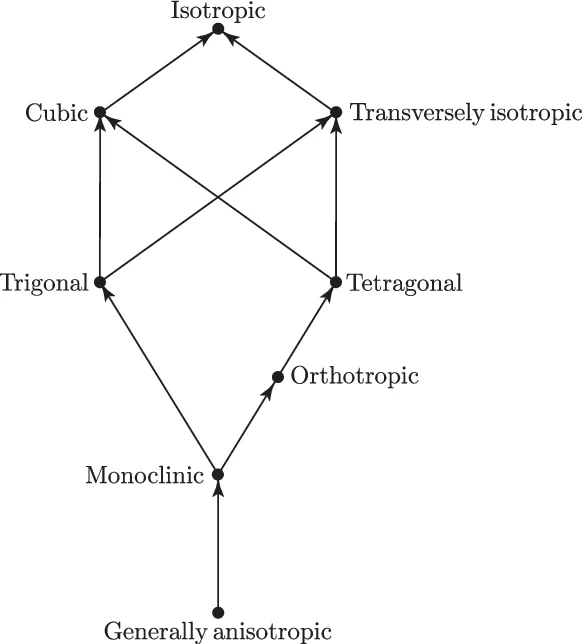
The authors formalize this question with diagrams showing two possible paths: (1) Backus → Gazis and (2) Gazis → Backus. They prove a general non‑commutativity proposition and illustrate it with explicit calculations for several symmetry classes: general anisotropy, monoclinic, orthotropic, tetragonal, and transversely isotropic media. For each case they derive the effective elasticity components after each path, using lemmas that describe Gazis averaging as simply zero‑ing the components that are forbidden by the target symmetry. The resulting expressions differ in most situations, confirming that the two averages do not commute.
Special cases where commutativity holds are identified. For monoclinic layers, commutation occurs only if the off‑diagonal components (c_{2313}) and (c_{3312}) vanish. For orthotropic layers leading to a tetragonal medium, commutation requires (c_{1133}=c_{2233}) and (c_{2323}=c_{1313}). In the transversely isotropic example, the two paths even produce different symmetry classes (isotropic versus transversely isotropic), underscoring the lack of commutation.
The discussion emphasizes that the analysis assumes all tensors share a common coordinate orientation; otherwise additional complications arise (as noted in earlier works). The authors conclude that, apart from mathematically contrived special parameter choices, there is no physical justification for the averages to commute. This result highlights the distinct mathematical nature of spatial and symmetry‑group averaging and cautions against treating them as interchangeable operations in seismological modeling.
Comments & Academic Discussion
Loading comments...
Leave a Comment