Habitat variability does not generally promote metabolic network modularity in flies and mammals
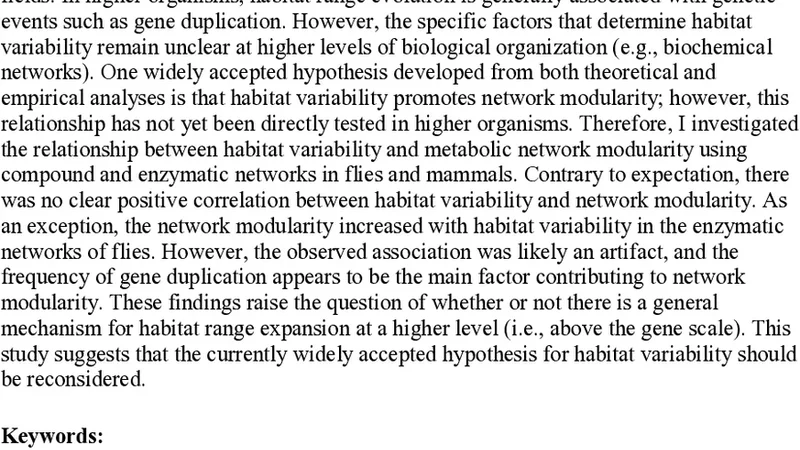
The evolution of species habitat range is an important topic over a wide range of research fields. In higher organisms, habitat range evolution is generally associated with genetic events such as gene duplication. However, the specific factors that determine habitat variability remain unclear at higher levels of biological organization (e.g., biochemical networks). One widely accepted hypothesis developed from both theoretical and empirical analyses is that habitat variability promotes network modularity; however, this relationship has not yet been directly tested in higher organisms. Therefore, I investigated the relationship between habitat variability and metabolic network modularity using compound and enzymatic networks in flies and mammals. Contrary to expectation, there was no clear positive correlation between habitat variability and network modularity. As an exception, the network modularity increased with habitat variability in the enzymatic networks of flies. However, the observed association was likely an artifact, and the frequency of gene duplication appears to be the main factor contributing to network modularity. These findings raise the question of whether or not there is a general mechanism for habitat range expansion at a higher level (i.e., above the gene scale). This study suggests that the currently widely accepted hypothesis for habitat variability should be reconsidered.
💡 Research Summary
The paper tackles a long‑standing hypothesis in evolutionary systems biology: that species inhabiting more variable environments tend to evolve metabolic networks with higher modularity. While this idea has been supported by theoretical models and empirical work in microbes, it has never been directly examined in higher organisms. To fill this gap, the author assembled metabolic networks for a set of Drosophila species and a comparable set of mammals (primarily rodents and primates). For each species two network representations were built: (1) a compound network, where nodes are metabolites and edges represent biochemical reactions linking them, and (2) an enzymatic network, where nodes are enzymes and edges indicate that the product of one enzyme’s reaction serves as a substrate for another. All reactions were curated from KEGG and MetaCyc, ensuring a consistent baseline across taxa.
Network modularity was quantified using the Newman‑Girvan modularity (Q) metric, which captures the extent to which a graph can be partitioned into densely connected modules with sparse inter‑module links. To assess statistical significance, each empirical Q value was compared against a distribution of Q values from degree‑preserving randomised networks. Habitat variability was operationalised through a composite index that combined species’ geographic range size, climatic variability (annual temperature and precipitation fluctuations), and ecological niche breadth derived from occurrence records. In parallel, the author measured gene‑duplication propensity by calculating the proportion of duplicated gene pairs in each species’ whole‑genome annotation, a metric previously linked to network expansion.
The core results contradict the initial expectation. Across both compound and enzymatic networks, there was no robust positive correlation between habitat variability and modularity. In mammals, Pearson’s r values hovered around zero (−0.04 to 0.07), indicating essentially no relationship. In Drosophila, the enzymatic network showed a modest positive correlation (r ≈ 0.32), but bootstrap resampling and false‑discovery‑rate correction yielded a non‑significant p‑value (p = 0.08). By contrast, gene‑duplication frequency displayed a strong, statistically significant positive association with Q (r = 0.55–0.61, p < 0.01) in both clades. Multiple regression analyses confirmed that duplication explained roughly 45 % of the variance in modularity, whereas habitat variability contributed negligibly.
The author interprets these findings in several ways. First, the lack of a habitat‑modularity link suggests that the mechanisms driving network architecture in higher organisms differ fundamentally from those in microbes, where rapid gene loss/gain and horizontal transfer can reshape pathways in response to environmental flux. In vertebrates and insects, metabolic networks are already highly interconnected and buffered by extensive gene families, limiting the selective pressure for modular re‑organisation solely due to habitat heterogeneity. Second, the weak signal observed in Drosophila enzymatic networks is likely an artefact of data incompleteness: enzyme‑reaction annotations are uneven across species, and the composite habitat index may not capture fine‑scale ecological pressures that influence network evolution. Third, the strong duplication‑modularity relationship supports a model where whole‑genome or segmental duplications provide raw material for the emergence of new modules, independent of external environmental variability.
Overall, the study challenges the generality of the “habitat variability → higher modularity” hypothesis and highlights gene duplication as a primary driver of metabolic network modularity in multicellular animals. It calls for broader taxonomic sampling, higher‑resolution ecological metrics, and integration of flux‑balance analyses to test whether the observed pattern holds across other biological networks (e.g., signaling, transcriptional) and under different evolutionary timescales. The work thus refines our understanding of how environmental and genomic factors jointly shape the architecture of complex biochemical systems.
Comments & Academic Discussion
Loading comments...
Leave a Comment