Open challenges in understanding development and evolution of speech forms: The roles of embodied self-organization, motivation and active exploration
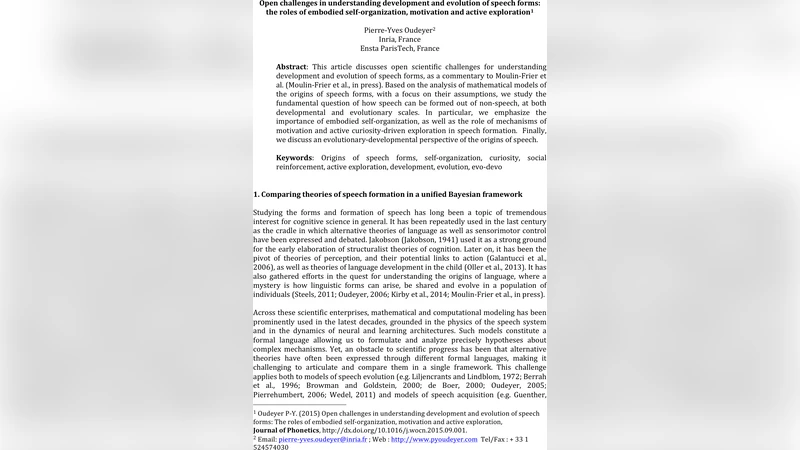
This article discusses open scientific challenges for understanding development and evolution of speech forms, as a commentary to Moulin-Frier et al. (Moulin-Frier et al., 2015). Based on the analysis of mathematical models of the origins of speech forms, with a focus on their assumptions , we study the fundamental question of how speech can be formed out of non–speech, at both developmental and evolutionary scales. In particular, we emphasize the importance of embodied self-organization , as well as the role of mechanisms of motivation and active curiosity-driven exploration in speech formation. Finally , we discuss an evolutionary-developmental perspective of the origins of speech.
💡 Research Summary
The paper tackles the longstanding puzzle of how speech forms emerge from non‑speech behaviors, addressing both developmental and evolutionary timescales. It begins by reviewing traditional theories that posit an innate, language‑specific module, arguing that such assumptions fail to account for the gradual, embodied processes observed in infants and non‑human vocal learners. The authors then turn to mathematical and computational models that foreground two complementary mechanisms: embodied self‑organization and motivation‑driven active exploration.
Embodied self‑organization refers to the way the physical properties of the vocal tract, respiratory system, auditory feedback loops, and environmental interactions spontaneously generate structured patterns. In simulated robotic agents, random articulatory attempts are filtered through a sensory‑motor loop; successful auditory matches are reinforced, leading to the emergence of stable phoneme‑like attractors without any pre‑programmed linguistic knowledge. This demonstrates that the coupling of motor dynamics and perceptual feedback can give rise to a nascent speech code.
Motivation and curiosity‑driven exploration constitute the second pillar. The authors incorporate intrinsic reward signals—analogous to dopaminergic bursts—that increase when novel or informative auditory outcomes are produced. This intrinsic motivation biases the system toward exploratory actions that reduce uncertainty, rather than random wandering. As a result, agents preferentially sample vocal gestures that yield informative feedback, accelerating the convergence toward a richer repertoire of vocalizations.
The paper then integrates these mechanisms into an evo‑devo perspective. At the individual level, self‑organization plus curiosity‑driven learning explains how a child can bootstrap a functional phonetic inventory from sensorimotor contingencies. At the population level, the vocal patterns generated by many learners are transmitted socially, subjected to cultural selection, and cumulatively refined across generations. Thus, the developmental processes of exploration and reinforcement become the raw material for evolutionary change, bridging the gap between ontogeny and phylogeny.
Finally, the authors identify three major research gaps: (1) the lack of unified multi‑scale models that simultaneously capture embodied dynamics, intrinsic motivation, and cultural transmission; (2) the scarcity of robotic experiments that test active curiosity in realistic vocal learning scenarios; and (3) the need for computational frameworks that model how socially shared speech forms emerge from individually learned repertoires. Addressing these challenges, they argue, will move the field toward a comprehensive theory of speech origins that respects both the body’s physical constraints and the mind’s drive to explore.
Comments & Academic Discussion
Loading comments...
Leave a Comment