On closure operators and reflections in Goursat categories
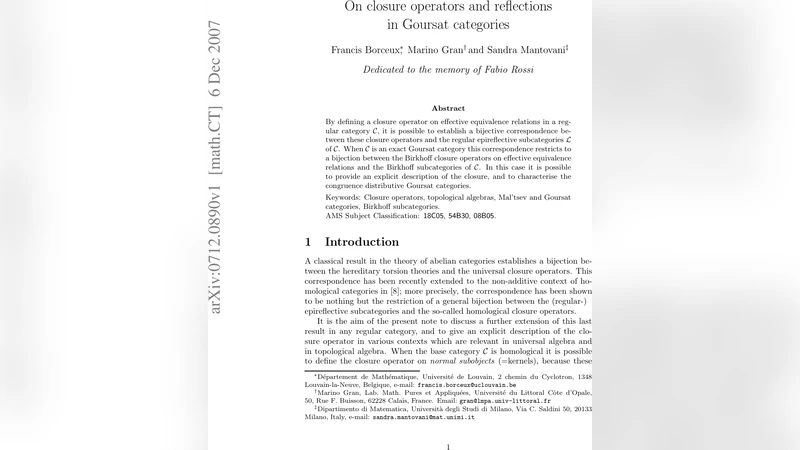
By defining a closure operator on effective equivalence relations in a regular category $C$, it is possible to establish a bijective correspondence between these closure operators and the regular epireflective subcategories $L$ of $C$. When $C$ is an exact Goursat category this correspondence restricts to a bijection between the Birkhoff closure operators on effective equivalence relations and the Birkhoff subcategories of $C$. In this case it is possible to provide an explicit description of the closure, and to characterise the congruence distributive Goursat categories.
💡 Research Summary
**
The paper investigates the relationship between closure operators on effective equivalence relations and regular epireflective subcategories within a regular category (C). It begins by recalling that an effective equivalence relation in a regular category can be represented as the kernel pair of a regular epimorphism, and then defines a closure operator (c) on such relations. The operator is required to satisfy the usual four axioms—extensivity, monotonicity, idempotency, and regularity—adapted to the categorical setting.
The first major result establishes a bijective correspondence between these closure operators and regular epireflective subcategories (L) of (C). Given a closure operator (c), one constructs (L) as the full subcategory consisting of objects whose associated equivalence relations are (c)-closed; conversely, for a regular epireflective subcategory (L), the associated closure operator sends an effective equivalence relation (R) to the smallest (L)-closed relation containing (R). The proof relies on the stability of regular epis under pullback and on the fact that every effective equivalence relation is the kernel pair of a regular epi, ensuring that the construction is well‑defined and mutually inverse.
The discussion then specializes to exact Goursat categories—regular categories in which every equivalence relation is effective and where the 3‑permutability condition (the Goursat property) holds. In this context the authors introduce Birkhoff closure operators, which, besides the four basic axioms, satisfy two additional conditions: congruence preservation (the closure of a congruence is again a congruence) and directedness (the closure of a directed join equals the join of the closures). They also define Birkhoff subcategories, i.e., regular epireflective subcategories closed under subobjects and regular quotients.
A second bijection is proved: Birkhoff closure operators on effective equivalence relations correspond exactly to Birkhoff subcategories of an exact Goursat category. The authors give an explicit description of the closure of an equivalence relation (R): it is the intersection of all Birkhoff‑closed relations containing (R), equivalently the smallest relation having the same kernel and regular image as (R) that lies in the chosen subcategory. This description makes the closure computable in concrete examples.
The paper further characterises congruence‑distributive Goursat categories, i.e., those where the lattice of equivalence relations is distributive. In such categories the Birkhoff closure operator distributes over both joins and meets, so that (c(R\vee S)=c(R)\vee c(S)) and (c(R\wedge S)=c(R)\wedge c(S)). This property distinguishes these categories from merely modular or abelian ones and provides a clear structural criterion.
To illustrate the theory, the authors work out several examples. In the category of sets, effective equivalence relations are ordinary partitions, and the closure operator simply refines a partition to the one required by the chosen reflective subcategory (for instance, the subcategory of finite sets). In the category of groups, effective equivalence relations correspond to normal subgroups; the closure of a normal subgroup is the smallest normal subgroup belonging to the reflective subcategory (e.g., the smallest solvable normal subgroup containing it). Additional examples involve algebraic lattices and Latin squares, showing that the framework applies beyond classical algebraic categories.
The concluding section reflects on the significance of the results. By linking closure operators with reflective subcategories, the paper provides a categorical analogue of the classical Birkhoff theorem for varieties of algebras, now valid in the broader setting of exact Goursat categories. The explicit description of closures opens the way to algorithmic computations in categorical algebra, and the characterisation of congruence‑distributive Goursat categories suggests new avenues for classifying categories with well‑behaved equivalence‑relation lattices. Future work is proposed to extend the framework to multi‑regular or higher‑order equivalence relations and to explore applications in computer‑science domains such as type theory, database theory, and formal verification, where reflective subcategories often model notions of abstraction or specification.
Comments & Academic Discussion
Loading comments...
Leave a Comment