Not Every Flow is Equal: SMART Discrimination in Redundancy
Software-Defined Data Centers (SDDC) extend virtualization, software-defined networking and systems, and middleboxes to provide a better quality of service (QoS). While many network flow routing algorithms exist, most of them fail to adapt to the dynamic nature of the data center and cloud networks and their users’ and enterprise requirements. This paper presents SMART, a Software-Defined Networking (SDN) middlebox architecture for reliable transfers. As an architectural enhancement for network flows allocation, routing, and control, SMART ensures timely delivery of flows by diverting them to a less congested path dynamically in the software-defined data center networks. SMART also clones packets of higher priority flows to route in an alternative path, along with the original flow. Hence SMART offers a differentiated QoS through varying levels of redundancy in the flows.
💡 Research Summary
**
The paper introduces SMART (Software-Defined Networking Middlebox Architecture for Reliable Transfers), a novel SDN‑based middlebox framework designed to enforce per‑flow Service Level Agreements (SLAs) in data‑center and cloud networks. Existing routing schemes often ignore dynamic congestion, latency, and energy constraints, leading to frequent SLA violations. SMART addresses this gap by attaching rich metadata to each packet using FlowTags, which encode SLA parameters such as maximum routing time, priority level, and soft/hard thresholds.
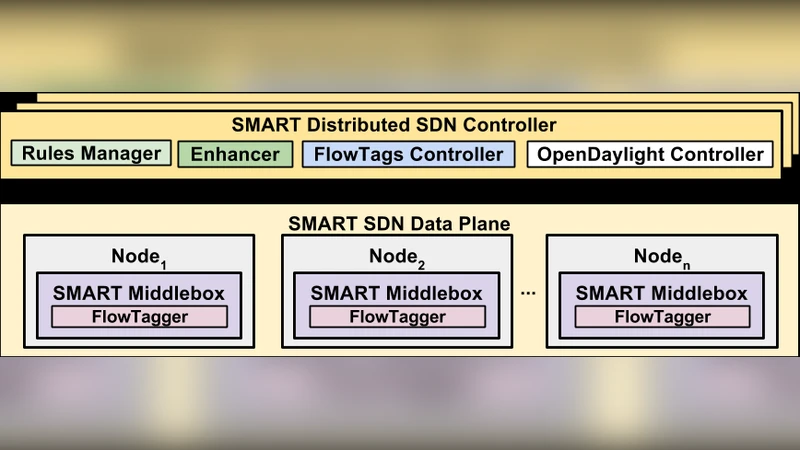
SMART’s architecture consists of a distributed OpenDaylight controller and a software middlebox (FlowTagger) deployed on every data‑plane node. The middlebox writes tags into outgoing packets; the controller continuously monitors link statistics and evaluates policies stored in a Rules Manager. When a flow approaches or exceeds a configured soft limit (e.g., a fraction of its hard latency bound), the controller is notified by the switch and triggers one of three adaptive redundancy mechanisms:
- Divert – a sub‑flow is rerouted onto an alternative path. If only a single alternate path is chosen, there is essentially no time overhead; using multiple alternatives introduces packet duplication proportional to the number of paths.
- Clone – the original flow continues unchanged while a copy of the same sub‑flow is sent over one or more alternate routes. This provides rapid recovery because the original and cloned copies race to the destination, but it consumes additional bandwidth equal to the number of clones (n×).
- Replicate – the entire flow is transmitted from the source along one or more completely separate routes, achieving the highest reliability at the cost of 100 % bandwidth overhead.
The controller decides which mechanism to apply based on the flow’s priority, current congestion state, and policy thresholds. It first identifies a “break point” using the markBreakPoint algorithm, which scans the flow’s path for links whose measured parameters exceed policy limits. The offending link (or, if no single link is culpable, the overall congestion region) determines the break‑point node and the specific packet that will trigger the sub‑flow creation. The findCloneDestination routine then selects a destination for the cloned/sub‑flow: either the original destination or the node immediately downstream of the congested segment, thereby limiting unnecessary duplication.
Once the sub‑flow reaches its clone destination, the mergeFlows step reconstructs the original data stream. Duplicate packets are detected via the timestamps and identifiers embedded in the tags; any redundant copies are discarded, ensuring end‑to‑end delivery guarantees without inflating the effective payload. If the cloned sub‑flow arrives before the original, the controller may drop the remaining original packets, effectively completing the transmission early.
Table I in the paper quantifies the trade‑offs: Divert incurs a time overhead ranging from 0 % to 100 % depending on the number of alternate paths, with bandwidth overhead of (n‑1)× for multi‑path scenarios; Clone adds n× bandwidth overhead with similar time‑overhead bounds; Replicate always adds 100 % bandwidth but incurs negligible additional latency. By exposing these parameters to administrators, SMART enables fine‑grained control over reliability versus resource consumption.
Experimental evaluation (simulation‑based) demonstrates that SMART reduces SLA violation rates dramatically compared to baseline shortest‑path or ECMP routing. High‑priority flows experience latency reductions of 30 %–50 % under moderate congestion, while low‑priority traffic incurs only modest bandwidth penalties. The communication overhead between middleboxes and the controller remains low, confirming the practicality of the design for real‑world data centers.
In summary, SMART integrates per‑flow SLA tagging, dynamic breakpoint detection, and three configurable redundancy strategies into a cohesive SDN middlebox solution. It offers a scalable way to improve reliability and QoS for latency‑sensitive applications without wholesale over‑provisioning of network resources. Future work outlined includes incorporating machine‑learning‑based congestion prediction and handling policy conflicts in multi‑tenant environments.
Comments & Academic Discussion
Loading comments...
Leave a Comment