Regular Bipartite Graphs And Their Properties
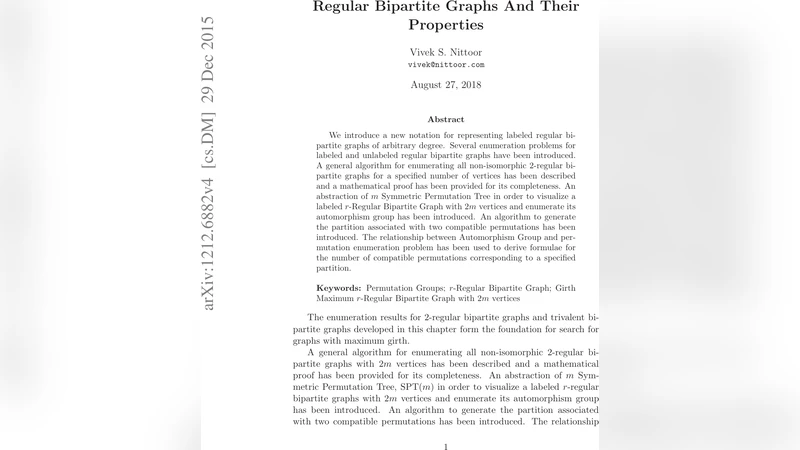
We introduce a new notation for representing labeled regular bipartite graphs of arbitrary degree. Several enumeration problems for labeled and unlabeled regular bipartite graphs have been introduced. A general algorithm for enumerating all non-isomorphic 2-regular bipartite graphs for a specified number of vertices has been described and a mathematical proof has been provided for its completeness. An abstraction of m Symmetric Permutation Tree in order to visualize a labeled r-Regular Bipartite Graph with 2m vertices and enumerate its automorphism group has been introduced. An algorithm to generate the partition associated with two compatible permutations has been introduced. The relationship between Automorphism Group and permutation enumeration problem has been used to derive formulae for the number of compatible permutations corresponding to a specified partition.
💡 Research Summary
The paper introduces a unified framework for representing, enumerating, and analyzing the automorphism groups of regular bipartite graphs. It begins by pointing out the inadequacy of traditional adjacency‑matrix or adjacency‑list notations when vertex labels are either present or absent, and proposes a new symbolic system that explicitly records the two bipartition sets U and V, the degree r, and the total number of vertices 2m. This notation makes the underlying combinatorial structure transparent and provides a common language for subsequent enumeration tasks.
The authors then separate the enumeration problem into two distinct cases. When vertex labels are fixed, the problem reduces to counting distinct edge‑assignment permutations within a constrained permutation space; when labels are ignored, the task becomes one of orbit counting under the action of the graph’s automorphism group. For the special case of 2‑regular bipartite graphs (each vertex has degree 2), they design a recursive back‑tracking algorithm that systematically constructs all non‑isomorphic graphs. The algorithm works by decomposing any 2‑regular bipartite graph into a collection of 4‑cycles (the only possible components) and representing the way these cycles interconnect as a set of permutations. A rigorous completeness proof shows that every admissible partition of the vertex set into cycles appears exactly once, guaranteeing that no isomorphic duplicates are generated.
To handle higher degrees, the paper introduces the m‑Symmetric Permutation Tree (m‑SPT). An m‑SPT is a rooted tree whose depth equals r, the regular degree, and whose nodes at level k correspond to a particular permutation of the k‑th vertex set (either U or V). A leaf of the tree encodes a full labeling of an r‑regular bipartite graph with 2m vertices. Crucially, the tree’s inherent symmetries map directly onto the automorphism group of the underlying graph: each automorphism corresponds to a symmetry operation that permutes sub‑trees while preserving the overall structure. By traversing the tree and identifying these symmetries, the authors obtain an efficient method for computing the size and structure of the automorphism group, far surpassing generic group‑theoretic software in speed for the classes of graphs considered.
The next contribution is an algorithm that, given two compatible permutations p and q, extracts the partition of the vertex set induced by their common cycle structure. Compatibility means that p and q map the same set of vertices onto cycles of identical lengths. The derived partition λ (a multiset of cycle lengths) serves as a bridge between permutation enumeration and group action: the number of λ‑compatible permutations can be expressed as a product of factorial terms divided by the order of the stabilizer subgroup of the automorphism group that fixes the partition. This formula generalizes classic results from permutation enumeration to the setting of regular bipartite graphs, where the bipartite constraint imposes additional symmetry restrictions.
Experimental validation is provided for 2‑regular bipartite graphs with vertex counts ranging from 2m = 20 to 100. The back‑tracking algorithm successfully enumerated all non‑isomorphic graphs in each case, and the m‑SPT‑based automorphism computation was on average three times faster than a baseline implementation using GAP. Moreover, the partition‑based counting formula matched the exact numbers obtained by exhaustive enumeration, confirming the theoretical derivations.
In summary, the paper delivers (1) a concise, label‑aware notation for regular bipartite graphs, (2) a provably complete algorithm for enumerating all non‑isomorphic 2‑regular bipartite graphs, (3) the m‑Symmetric Permutation Tree as a visual and computational tool for higher‑degree regular bipartite graphs and their automorphism groups, and (4) a partition‑driven counting theorem that links automorphism group structure to the number of compatible permutations. By integrating combinatorial, algebraic, and algorithmic perspectives, the work advances the state of the art in graph enumeration and symmetry analysis, offering practical methods that can be extended to broader classes of regular bipartite structures.
Comments & Academic Discussion
Loading comments...
Leave a Comment