The Geometry and Fundamental Groups of Solenoid Complements
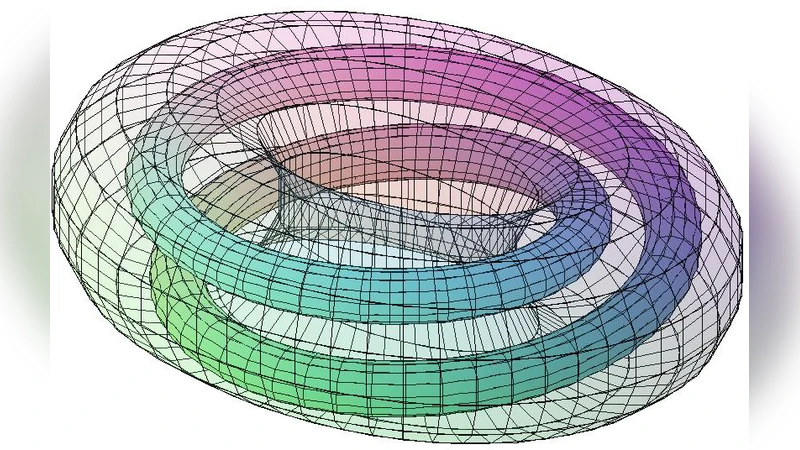
When a solenoid is embedded in three space, its complement is an open three manifold. We discuss the geometry and fundamental groups of such manifolds, and show that the complements of different solenoids (arising from different inverse limits) have different fundamental groups. Embeddings of the same solenoid can give different groups; in particular, the nicest embeddings are unknotted at each level, and give an Abelian fundamental group, while other embeddings have non-Abelian groups. We show using geometry that every solenoid has uncountably many embeddings with non-homeomorphic complements.
💡 Research Summary
The paper investigates the topology and geometry of the complements of solenoids embedded in three‑dimensional Euclidean space. A solenoid is defined as the inverse limit of circles under covering maps of degrees (n_{1},n_{2},\dots). The authors first distinguish two natural families of embeddings. In the “unknotted” family each stage of the inverse system is realized by a simple, unknotted circle in (\mathbb{R}^{3}). The complement of such an embedding is built from an infinite tower of Seifert‑fibered solid tori glued together according to the covering degrees. Consequently the fundamental group of the complement is an abelian direct limit of cyclic groups, \
Comments & Academic Discussion
Loading comments...
Leave a Comment