Many-one reductions and the category of multivalued functions
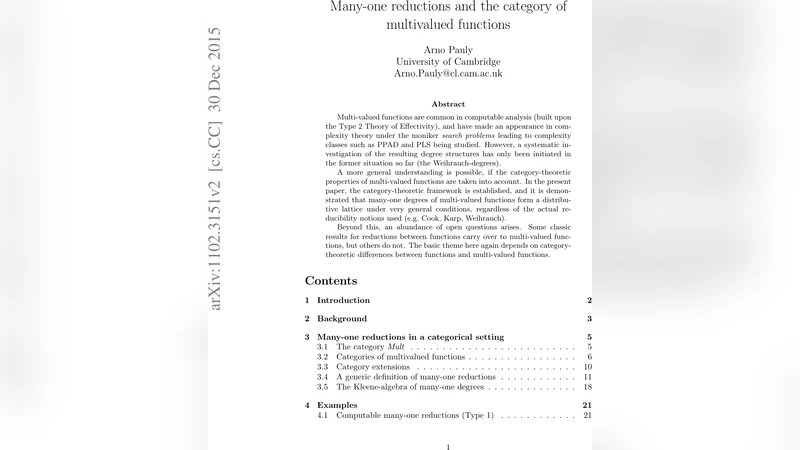
Multi-valued functions are common in computable analysis (built upon the Type 2 Theory of Effectivity), and have made an appearance in complexity theory under the moniker search problems leading to complexity classes such as PPAD and PLS being studied. However, a systematic investigation of the resulting degree structures has only been initiated in the former situation so far (the Weihrauch-degrees). A more general understanding is possible, if the category-theoretic properties of multi-valued functions are taken into account. In the present paper, the category-theoretic framework is established, and it is demonstrated that many-one degrees of multi-valued functions form a distributive lattice under very general conditions, regardless of the actual reducibility notions used (e.g. Cook, Karp, Weihrauch). Beyond this, an abundance of open questions arises. Some classic results for reductions between functions carry over to multi-valued functions, but others do not. The basic theme here again depends on category-theoretic differences between functions and multi-valued functions.
💡 Research Summary
The paper develops a unified, category‑theoretic framework for many‑one reductions between multivalued functions, and shows that under very mild assumptions the resulting degree structures always form a distributive lattice, independent of the concrete reduction notion (Cook‑type, Karp‑type, Weihrauch‑type, etc.).
The authors begin by observing that multivalued functions—relations f ⊆ A×B that may associate several outputs with a single input—appear naturally in computable analysis, game theory, fixed‑point theorems, and in complexity classes such as PPAD, PLS, and FIXP. While these classes have been studied via “search problems”, a systematic investigation of their degree structures has been limited to the Weihrauch degrees.
Section 2 introduces the category Mult, whose objects are sets and whose morphisms are partial relations equipped with a composition rule that requires the image of the first function to lie inside the domain of the second. This rule differs from ordinary relational composition and makes Mult non‑self‑dual, a fact that later influences the asymmetry of degree comparisons.
Section 3 lifts the well‑known notion of p‑categories (categories equipped with a product ×, diagonal Δ, and projections π₁, π₂) to the setting of multivalued functions. The authors define a “domain” operation dom(f) = π₁ ∘ (id×f) ∘ Δ, which behaves like a partial identity on the part of the source where f is defined. Using dom they introduce the preorder “easier‑than” (denoted ⊑):
f ⊑ g ⇔ dom(f) ⊆ dom(g) ∧ g|dom(f) ⊆ f.
Intuitively, any algorithm solving g also solves f. The preorder is shown to be compatible with composition, product, and arbitrary infima, turning each hom‑set into a complete meet‑semilattice. The authors formalize this as a poset‑enriched p‑category satisfying a list of natural axioms (closure under composition, product, and infinite coproducts).
With this structure in place, a generic many‑one reduction is defined: for morphisms f, g, we write f ≤ₘ g iff there exist morphisms h, k belonging to a chosen computational class (e.g., computable, polynomial‑time, continuous) such that f = k ∘ g ∘ h. The choice of the class determines the concrete reduction notion (Cook‑type, Karp‑type, Weihrauch‑type). Crucially, the definition uses only the categorical operations already present, so it works uniformly across all settings.
The central technical result (Theorem 5.1) proves that the set of many‑one degrees, ordered by ≤ₘ, is always a distributive lattice. The proof exploits the fact that ⊑ gives each hom‑set a complete lattice structure and that composition, product, and coproducts distribute over meets and joins. Consequently, the degree lattice admits the usual lattice operations ∧ (greatest lower bound) and ∨ (least upper bound). Moreover, the authors define additional operations—multiplication (·) and star (*)—that turn the degree lattice into a Kleene algebra, mirroring constructions known from the Weihrauch lattice.
Section 4 illustrates the general theory with six concrete families of reductions:
- Type‑1 computable many‑one reductions (classical Turing‑computable functions).
- Polynomial‑time many‑one reductions (Karp reductions).
- Set‑theoretic many‑one reductions (classical many‑one reducibility between subsets of ℕ).
- Weihrauch reductions (Type‑2 continuous reductions).
- Parameterized search problems (where an additional parameter influences the complexity).
- Medvedev reductions (comparisons of informational content of subsets of Baire space).
In each case the authors verify that the required categorical axioms hold, and therefore the corresponding degree structures are distributive lattices equipped with Kleene‑algebra operations. Notably, the distributivity explains why the intersection PPAD ∩ PLS possesses complete problems—a fact previously observed only empirically.
The final section outlines open problems: the lack of self‑duality in Mult suggests limitations on inverse reductions; the impact of adding further operations (e.g., fixed‑point or inverse operators) on the lattice structure remains unclear; alternative preorders (information‑theoretic, measure‑theoretic) could yield different enriched categories; and the practical relevance of these abstract degree lattices for algorithm design is an inviting direction for future work.
Overall, the paper provides a powerful, abstraction‑driven perspective that unifies many‑one reductions across computability, complexity, and analysis. By showing that the essential algebraic properties arise from very general categorical conditions, it opens the door to systematic study of degree structures for a wide variety of multivalued computational problems.
Comments & Academic Discussion
Loading comments...
Leave a Comment