Quantum Mechanical Modeling of Nanoscale Light Emitting Diodes
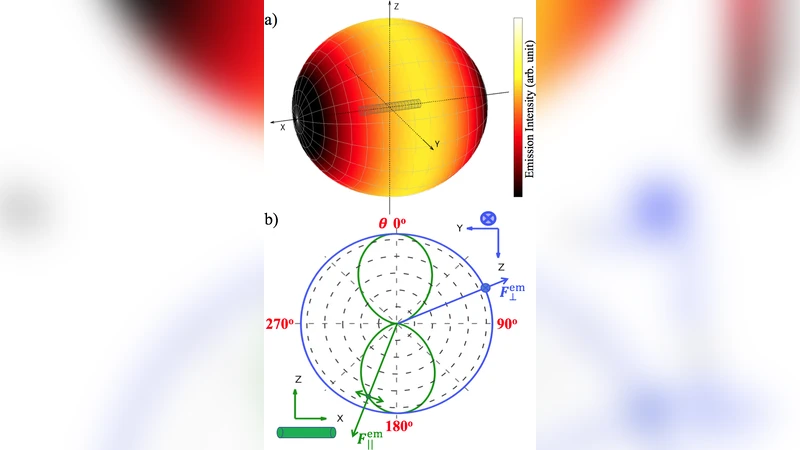
Understanding of the electroluminescence (EL) mechanism in optoelectronic devices is important for further optimization of their efficiency and effectiveness. Here, a quantum mechanical approach is formulated for modeling EL processes in nanoscale light emitting diodes (LED). Based on nonequilibrium Green’s function quantum transport equations, interactions with electromagnetic vacuum environment is included to describe electrically driven light emission in the devices. Numerical studies of a silicon nanowire LED device are presented. EL spectra of the nanowire device under different bias voltages are simulated and, more importantly, propagation and polarization of emitted photon can be determined using the current approach.
💡 Research Summary
The paper presents a quantum‑mechanical framework for modeling electroluminescence (EL) in nanoscale light‑emitting diodes (LEDs) by integrating electron‑photon interactions into the nonequilibrium Green’s function (NEGF) formalism. Starting from the Keldysh‑NEGF approach, the authors derive a self‑energy term Σ<,> ep that captures coupling between charge carriers and the electromagnetic vacuum. Within the self‑consistent Born approximation (SCBA), the electron‑photon coupling matrix M q is expressed in terms of the electronic wavefunctions, the momentum operator, photon frequency, and the device volume, thereby encoding the selection rules for radiative transitions. By setting the photon occupation number N q to zero, only spontaneous emission from the vacuum is considered, which is appropriate for the low‑intensity regime of nanoscale devices.
The photon modes are parametrized by their wave vector direction (θ, φ) and two orthogonal polarization vectors (k̂ and ⊥̂). Angle‑dependent self‑energies Σ< k̂> and Σ< ⊥̂> are obtained, allowing the calculation of not only the total emission rate but also the angular distribution and polarization state of the emitted photons. The electronic Green’s functions G<,> and G>, required for the current and emission formulas, are computed from the Keldysh equation G<,> = Gʳ Σ<,> Gᵃ, where Σ<,> includes contributions from the contacts and the electron‑photon interaction.
To demonstrate the method, the authors simulate a silicon nanowire LED. The nanowire has a 1.5 nm diameter, 9.5 nm length, and is oriented along the
Comments & Academic Discussion
Loading comments...
Leave a Comment