Data Driven SMART Intercontinental Overlay Networks
This paper addresses the use of Big Data and machine learning based analytics to the real-time management of Internet scale Quality-of-Service Route Optimisation with the help of an overlay network. Based on the collection of large amounts of data sampled each $2$ minutes over a large number of source-destinations pairs, we show that intercontinental Internet Protocol (IP) paths are far from optimal with respect to Quality of Service (QoS) metrics such as end-to-end round-trip delay. We therefore develop a machine learning based scheme that exploits large scale data collected from communicating node pairs in a multi-hop overlay network that uses IP between the overlay nodes themselves, to select paths that provide substantially better QoS than IP. The approach inspired from Cognitive Packet Network protocol, uses Random Neural Networks with Reinforcement Learning based on the massive data that is collected, to select intermediate overlay hops resulting in significantly better QoS than IP itself. The routing scheme is illustrated on a $20$-node intercontinental overlay network that collects close to $2\times 10^6$ measurements per week, and makes scalable distributed routing decisions. Experimental results show that this approach improves QoS significantly and efficiently in a scalable manner.
💡 Research Summary
**
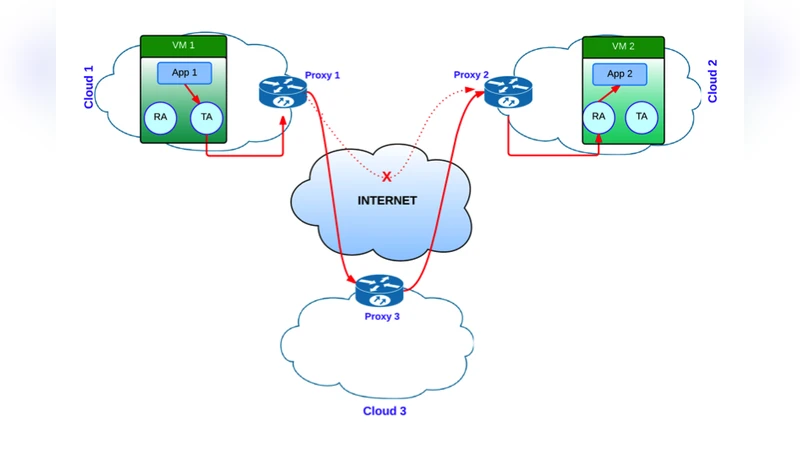
The paper presents a novel intercontinental overlay network, called SMART, that leverages massive, fine‑grained measurements and machine‑learning techniques to improve Quality‑of‑Service (QoS) routing beyond what traditional IP routing can provide. The authors first demonstrate, using a two‑minute sampling interval across a large set of source‑destination pairs, that Internet paths are often far from optimal with respect to round‑trip delay (RTT). To address this, they design an overlay composed of software proxies deployed on cloud virtual machines worldwide. Each proxy hosts five agents: a Transmission Agent (TA), a Reception Agent (RA), a Monitoring Agent, a Routing Agent, and a Forwarding Agent. The TA encapsulates outgoing packets with a SMART header that contains the complete list of intermediate overlay nodes; the Routing Agent decides which intermediate nodes to use; the Forwarding Agent forwards packets according to the header; and the Monitoring Agent periodically measures RTT, bandwidth, and loss to all other proxies.
The core of the routing decision engine is a Random Neural Network (RNN) combined with reinforcement learning. Each possible overlay path is represented by a neuron; the neuron’s excitation probability (q_i) reflects the estimated quality of that path. At every decision epoch (every two minutes), the Routing Agent selects the K neurons with the highest (q_i) values, probes the corresponding K paths, and records the actual RTTs. The path with the lowest measured delay is used for data traffic, and the observed delay is transformed into a reward that updates the RNN’s parameters via a reinforcement‑learning rule. This process is framed as a multi‑armed bandit problem, balancing exploration of new routes against exploitation of known good routes while keeping probing overhead linear in the number of nodes (O(N)) rather than quadratic (O(N²)) as in earlier overlay systems such as RON.
In a 20‑node experimental deployment spanning several continents, the system collects up to 2 × 10⁶ measurements per week, amounting to roughly 2.7 × 10⁵ data points per day. Even with a modest number of probed paths (K ≈ 3–5), SMART achieves a substantial reduction in average RTT—over 30 % compared with native IP routing—and in the worst‑case scenarios the improvement exceeds 60 %. The authors also show that the probing load remains manageable, confirming the scalability of the approach.
The paper concludes that SMART demonstrates a practical, scalable method for real‑time, data‑driven QoS routing without requiring changes to the underlying Internet infrastructure. Limitations include the current focus on latency only (other QoS metrics such as bandwidth and loss are not jointly optimized) and sensitivity to RNN hyper‑parameters. Future work is suggested on multi‑objective reinforcement learning, adaptive probing intervals, and integration with Software‑Defined Networking controllers to further enhance flexibility and performance.
Comments & Academic Discussion
Loading comments...
Leave a Comment