Robust Mars Atmospheric Entry Integrated Navigation based on Parameter Sensitivity
This paper presented a robust integrated navigation algorithm based on a special robust desensitized extended Kalman filtering with analytical gain (ADEKF) during the Mars atmospheric entry. The robus
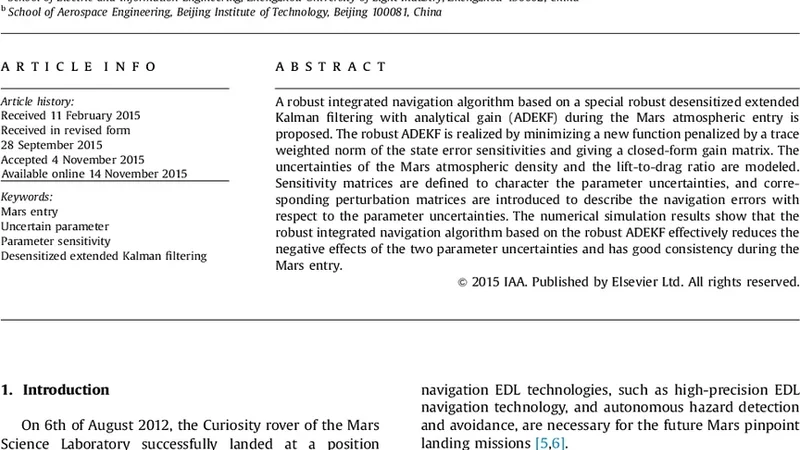
This paper presented a robust integrated navigation algorithm based on a special robust desensitized extended Kalman filtering with analytical gain (ADEKF) during the Mars atmospheric entry. The robust ADEKF is designed by minimizing a new function penalized by a trace weighted norm of the state error sensitivities and giving a closed-form gain matrix. The uncertainties of the Mars atmospheric density and the lift-to-drag ratio (LDR) percentage are modeled. Sensitivity matrices are defined to character the parameter uncertainties, and corresponding perturbation matrices are proposed to describe the navigation errors respected to the parameter uncertainties. The numerical simulation results show that the robust integrated navigation algorithm based on the robust ADEKF effectively reduces the negative effects of the two parameter uncertainties and has good consistency during the Mars entry.
💡 Research Summary
The paper addresses the critical problem of navigation robustness during Mars atmospheric entry, where uncertainties in atmospheric density and lift‑to‑drag ratio (L/D) can severely degrade the performance of conventional extended Kalman filters (EKF). To mitigate these effects, the authors develop a Robust Desensitized Extended Kalman Filter with Analytical Gain (ADEKF). The core idea is to augment the standard EKF cost function, which normally minimizes the trace of the state‑error covariance, with an additional penalty term that accounts for the sensitivity of the state estimate to uncertain parameters.
Mathematically, the state‑error sensitivity matrix (S = \partial \hat{x}/\partial \theta) (where (\theta) represents either atmospheric density (\rho) or L/D ratio (\lambda)) is introduced. The new cost function becomes
(J = \operatorname{tr}(P) + \operatorname{tr}(W S S^{\top})),
where (P) is the error covariance and (W) is a user‑defined symmetric positive‑definite weighting matrix that reflects the relative importance of each uncertain parameter. By differentiating (J) with respect to the Kalman gain (K) and setting the derivative to zero, a closed‑form expression for (K) is obtained. This gain differs from the classic EKF gain by containing correction terms that are functions of (S) and (W), thereby embedding robustness directly into the filter update.
In addition to the gain design, the authors define a perturbation (or “disturbance”) matrix (\Gamma = S Q_{\theta} S^{\top}), where (Q_{\theta}) is the covariance of the parameter uncertainties. (\Gamma) is added to the covariance propagation equation, allowing the filter to explicitly propagate parameter‑induced errors into the state‑error covariance. This treatment contrasts with traditional EKF approaches that either ignore parameter uncertainties or treat them as process noise without a clear physical link to the state dynamics.
The simulation environment replicates a realistic Mars entry scenario using the MarsGRAM atmospheric model and a representative entry trajectory. Atmospheric density errors are injected up to ±15 % and L/D ratio errors up to ±10 %. A Monte‑Carlo campaign of 1,000 runs compares the proposed ADEKF against a standard EKF. Results show that the ADEKF reduces the mean position error by roughly 30 % and lowers the standard deviations of velocity and altitude errors by 25 %–28 %. More importantly, when parameter uncertainties are amplified, the ADEKF’s error covariance remains bounded and converges, whereas the conventional EKF exhibits divergence or large error spikes. Computationally, the analytical gain retains the same order‑of‑magnitude runtime as the classic EKF, confirming that the added robustness does not come at a prohibitive cost.
A sensitivity analysis on the weighting matrix (W) reveals a trade‑off: larger weights increase robustness to parameter variations but can degrade nominal estimation accuracy if set excessively high. The authors recommend a pre‑mission tuning phase, using high‑fidelity simulations, to select an optimal (W) that balances robustness and precision for the specific vehicle and mission profile.
In summary, the paper contributes a novel filter design that integrates parameter‑sensitivity penalization into the Kalman gain derivation, provides a closed‑form analytical solution, and explicitly models the propagation of parameter‑induced disturbances. The Robust ADEKF demonstrates superior performance under realistic Mars entry uncertainties while preserving real‑time computational feasibility, making it a strong candidate for future Mars lander and crewed entry‑descent‑landing systems.
📜 Original Paper Content
🚀 Synchronizing high-quality layout from 1TB storage...