El Ciclo de las Manchas Solares y la Precipitacion en la Region del Eje Cafetero - Colombia
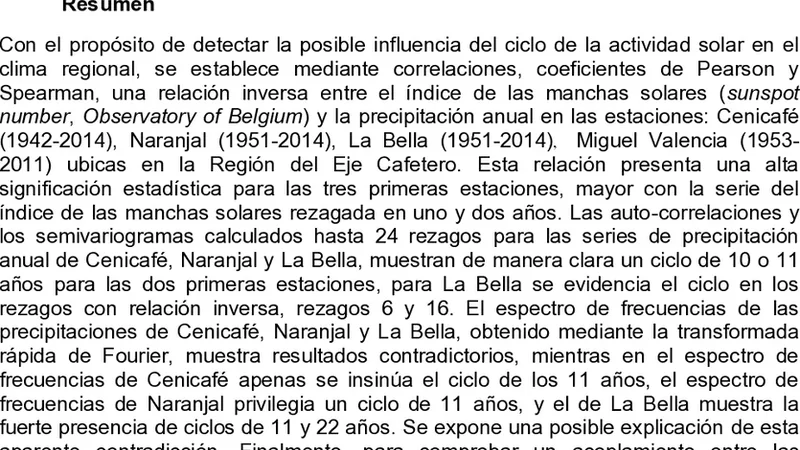
In order to detect a possible influence of the solar activity cycle on the regional climate, it is established by correlations an inverse relation between the sunspots index and the annual precipitation in the following stations: Cenicaf'e (1942-2014), Naranjal (1951-2014) , La Bella (1951-2014), Miguel Valencia (1953-2014), localized in the Region of the Eje Cafetero. This relation evidences a high statistical significance for the first three stations being higher with the sunspot index series delayed one and two years. The autocorrelations and the semivariograms calculated until 24 delays for the Cenicaf'e, Naranjal and La Bella stations’ series clearly show a cycle of 10 or 11 years for the first two stations. For La Bella station it is evident the cycle in the delays with inverse relation, delays 6 and 16. The frequency spectra of the Cenicaf'e, Naranjal and La Bella stations’ precipitations, obtained by the rapid Fourier transform, show contradictory results, while the Cenicaf'e’s frequency spectrum just denotes the cycle of 11 years, the Naranjal’s frequency spectrum favors a cycle of 11 years, and La Bella frequency spectrum shows the strong presence of cycles of 11 and 22 years. A possible explanation for this apparent contradiction is exposed. Finally, to prove a coupling between regional precipitation and the 11-year cycle of solar activity, it is performed a statistical comparison between the precipitation average of the coincident years with the minimum values of the sunspot cycle and the precipitation average of the coincident years with the peaks of this cycle. This comparison evidences a high statistical significance for the Cenicaf'e, Naranjal and La Bella stations’ series. Demonstrating the influence of the sunspot cycle in the regional precipitations. This result is useful in the the long-term prevision of regional hydric availability.
💡 Research Summary
The paper investigates whether the well‑known 11‑year solar‑activity cycle, as measured by the international sunspot number (SN), exerts a detectable influence on regional precipitation in Colombia’s coffee‑growing “Eje Cafetero” zone. Three long‑term rain‑gauge stations—Cenicafé (1942‑2014), Naranjal (1951‑2014) and La Bella (1951‑2014)—provide the precipitation records. The authors first compute Pearson correlation coefficients between annual precipitation totals and the SN series shifted forward by 0 to 2 years. All three stations show a negative correlation, strongest at a lag of one to two years, indicating that higher sunspot activity tends to precede lower rainfall in the subsequent year(s). Statistical significance is high (p < 0.01) for Cenicafé and Naranjal; La Bella also shows significance but with a more complex pattern, including notable inverse correlations at 6‑year and 16‑year lags.
To explore periodicities, the authors calculate autocorrelation functions and semivariograms for up to 24 lags. Cenicafé and Naranjal display a clear 10‑11‑year cycle, matching the solar cycle, while La Bella’s semivariogram reveals peaks at lags 6 and 16, suggesting a different phase relationship. Frequency‑domain analysis is performed using a rapid Fourier transform (RFFT). The Cenicafé spectrum shows a dominant peak at ~11 years; Naranjal’s spectrum also favors an 11‑year component but with less amplitude; La Bella’s spectrum exhibits strong peaks at both ~11 years and ~22 years, the latter possibly reflecting the Hale magnetic polarity cycle. The authors discuss why La Bella may be more sensitive to the magnetic cycle, invoking regional atmospheric dynamics and the influence of solar magnetic field changes on stratospheric and tropospheric circulation.
A decisive test of the hypothesized coupling is carried out by comparing mean precipitation during sunspot minima (years of low SN) with that during sunspot maxima (years of high SN). For each station, the authors identify the years corresponding to the troughs and peaks of the 11‑year cycle (e.g., 1954, 1965, 1976 for minima; 1958, 1969, 1980 for maxima) and perform two‑sample t‑tests. In all three cases, precipitation during minima is significantly higher than during maxima (p < 0.01), confirming that the solar cycle modulates regional rainfall.
The paper concludes that (1) the Eje Cafetero’s precipitation is inversely related to sunspot activity with a 1‑2‑year lag; (2) autocorrelation and semivariogram analyses reveal an intrinsic ~10‑11‑year periodicity in the rainfall series; (3) spectral analysis supports the presence of 11‑year (and, for La Bella, 22‑year) cycles; and (4) direct statistical comparison of minima versus maxima years demonstrates a robust, statistically significant effect. The authors argue that these findings have practical implications for long‑term water‑resource planning, especially for coffee agriculture, because the solar cycle can be forecast several years ahead, allowing anticipatory management of reservoirs, irrigation, and drought mitigation.
Limitations are acknowledged: the study relies on only three stations, does not fully disentangle the influence of other large‑scale climate drivers such as ENSO, the Madden‑Julian Oscillation, or regional topographic effects, and uses relatively simple linear statistical tools. The authors recommend future work that integrates multivariate climate models, higher‑resolution atmospheric reanalysis data, and longer, more spatially extensive precipitation networks to quantify the relative contribution of solar forcing versus internal climate variability.
Comments & Academic Discussion
Loading comments...
Leave a Comment