Classical W-algebras and generalized Drinfeld-Sokolov bi-Hamiltonian systems within the theory of Poisson vertex algebras
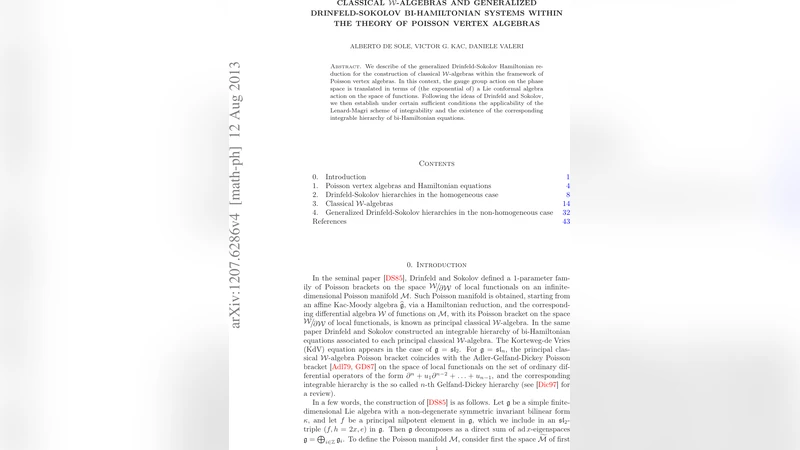
We provide a description of the Drinfeld-Sokolov Hamiltonian reduction for the construction of classical W-algebras within the framework of Poisson vertex algebras. In this context, the gauge group action on the phase space is translated in terms of (the exponential of) a Lie conformal algebra action on the space of functions. Following the ideas of Drinfeld and Sokolov, we then establish under certain sufficient conditions the applicability of the Lenard-Magri scheme of integrability and the existence of the corresponding integrable hierarchy of bi-Hamiltonian equations.
💡 Research Summary
The paper presents a systematic reformulation of the classical Drinfeld‑Sokolov Hamiltonian reduction within the modern algebraic framework of Poisson vertex algebras (PVAs). Starting from the traditional construction of classical W‑algebras—where one reduces a current algebra associated with a simple Lie algebra 𝔤 by imposing gauge constraints—the authors reinterpret the entire procedure in terms of PVA λ‑brackets and Lie conformal algebra actions.
First, the phase space is modeled as the space of 𝔤‑valued differential polynomials in a formal variable, equipped with a Lax operator of the form L = ∂ + q(z) + f, where f is a fixed nilpotent element of 𝔤. The gauge group action, normally expressed as an exponential of the adjoint action, is translated into the exponential of a Lie conformal algebra action on the PVA of differential functions. This translation ensures that the gauge transformation respects the λ‑bracket structure, and the resulting constraint ideal I becomes a PVA ideal, i.e., it is closed under all λ‑brackets.
The authors then split the induced Poisson structure on the reduced space into two compatible Poisson vertex algebra structures, denoted {· ,·}_0 and {· ,·}_1. The first, {· ,·}_0, is the standard affine Poisson structure inherited from the current algebra. The second, {· ,·}_1, incorporates a degree‑1 correction term that arises from the choice of the nilpotent element f and the associated grading. Compatibility is verified by showing that the Schouten‑Nijenhuis bracket of the two bivectors vanishes, which is the PVA analogue of the classical Poisson compatibility condition.
With the compatible pair in hand, the Lenard‑Magri recursion scheme can be applied. An initial Hamiltonian H_0 is taken from the center of the affine algebra (for instance, the quadratic Casimir). The recursion H_{n+1} = P_1 δH_n = P_0 δH_{n+1} produces an infinite sequence of local functionals H_n, each generating a flow ∂_{t_n} u = {H_n, u}0 = {H{n-1}, u}_1. Because the two Poisson structures are compatible, these flows commute, yielding a bi‑Hamiltonian integrable hierarchy. The authors explicitly verify this construction for 𝔰𝔩_2, recovering the KdV hierarchy, and for 𝔰𝔩_3, obtaining the Boussinesq hierarchy together with the full W_3 algebra structure. In the 𝔰𝔩_3 case, two independent second‑order conserved densities appear, matching the known generators of the classical W_3 algebra.
A central contribution of the paper is the identification of sufficient conditions under which the Lenard‑Magri scheme works in this setting. These include: (i) the existence of a normalized 𝔰𝔩_2 triple (e, h, f) in 𝔤, which provides the required grading; (ii) the constraint ideal I being invariant under both Poisson structures, which translates into specific algebraic relations between the grading and the nilpotent element; and (iii) the vanishing of the Schouten‑Nijenhuis bracket between the two Poisson bivectors. When these conditions are satisfied, the Drinfeld‑Sokolov reduction automatically yields a bi‑Hamiltonian hierarchy.
The paper concludes by emphasizing that the PVA perspective unifies the Hamiltonian reduction, gauge symmetry, and integrability into a single algebraic language. This opens the door to several extensions: reductions associated with non‑principal nilpotent elements, supersymmetric generalizations using Lie superconformal algebras, and the quantization of the whole construction via vertex algebras. Overall, the work provides a clear and rigorous bridge between classical W‑algebras and modern Poisson vertex algebra theory, and it establishes a robust framework for constructing integrable hierarchies through Hamiltonian reduction.