Poisson vertex algebras in the theory of Hamiltonian equations
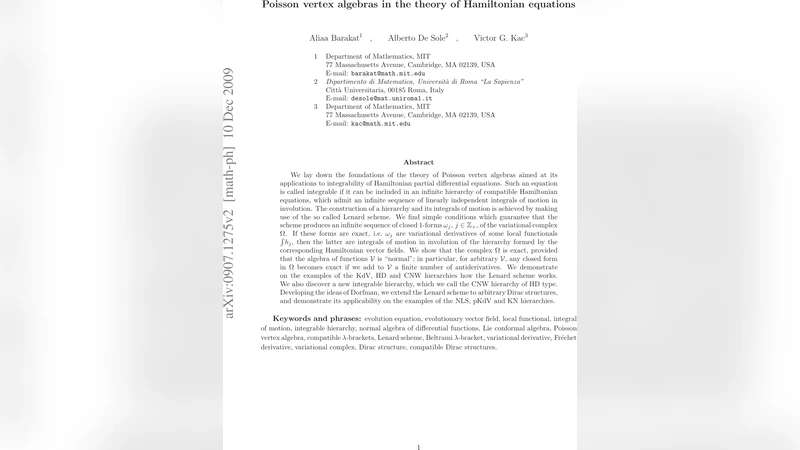
We lay down the foundations of the theory of Poisson vertex algebras aimed at its applications to integrability of Hamiltonian partial differential equations. Such an equation is called integrable if it can be included in an infinite hierarchy of compatible Hamiltonian equations, which admit an infinite sequence of linearly independent integrals of motion in involution. The construction of a hierarchy and its integrals of motion is achieved by making use of the so called Lenard scheme. We find simple conditions which guarantee that the scheme produces an infinite sequence of closed 1-forms \omega_j, j in Z_+, of the variational complex \Omega. If these forms are exact, i.e. \omega_j are variational derivatives of some local functionals \int h_j, then the latter are integrals of motion in involution of the hierarchy formed by the corresponding Hamiltonian vector fields. We show that the complex \Omega is exact, provided that the algebra of functions V is “normal”; in particular, for arbitrary V, any closed form in \Omega becomes exact if we add to V a finite number of antiderivatives. We demonstrate on the examples of KdV, HD and CNW hierarchies how the Lenard scheme works. We also discover a new integrable hierarchy, which we call the CNW hierarchy of HD type. Developing the ideas of Dorfman, we extend the Lenard scheme to arbitrary Dirac structures, and demonstrate its applicability on the examples of the NLS, pKdV and KN hierarchies.
💡 Research Summary
The paper establishes a comprehensive algebraic framework for Poisson vertex algebras (PVAs) and demonstrates how this framework can be employed to study the integrability of Hamiltonian partial differential equations (PDEs). It begins by recalling that a PDE is called integrable when it can be embedded in an infinite hierarchy of mutually compatible Hamiltonian flows, each possessing an infinite sequence of independent integrals of motion that are in involution. The central tool for constructing such hierarchies is the Lenard scheme, which requires two compatible Poisson structures.
The authors first give a rigorous definition of a PVA, introducing the λ‑bracket, the translation operator ∂, and the notion of a Poisson structure H on a differential algebra V. They show how a PVA naturally yields a variational complex Ω, whose 1‑forms ω can be acted upon by the Poisson structures. The Lenard recursion is then formulated: given compatible Poisson structures H₁ and H₂ and an initial closed 1‑form ω₀, one defines a sequence of 1‑forms ω_j by the relation H₁·δh_{j+1}=H₂·δh_j, where δh_j denotes the variational derivative of a local functional ∫h_j. The paper proves simple sufficient conditions guaranteeing that each ω_j is closed in Ω.
A major technical contribution is the proof that the variational complex Ω is exact whenever the underlying algebra V is “normal”. For arbitrary V, the authors show that any closed form becomes exact after adjoining a finite number of antiderivatives to V. Consequently, if each ω_j is exact, i.e., ω_j=δh_j for some local functional, then the functionals ∫h_j constitute an infinite family of commuting integrals of motion for the hierarchy generated by the Hamiltonian vector fields associated with H₁ and H₂.
The abstract theory is illustrated through several classical and new examples. For the Korteweg–de Vries (KdV) hierarchy, the well‑known pair of Poisson structures (the Gardner‑Zakharov‑Faddeev and Magri brackets) is used to reproduce the standard infinite sequence of KdV conserved densities via the Lenard recursion. The authors then treat the Harry Dym (HD) hierarchy and the Cauchy–Nehari–Wang (CNW) hierarchy, showing that the same scheme works in these contexts. Importantly, they discover a previously unknown integrable hierarchy, which they name the CNW hierarchy of HD type; this hierarchy arises from a novel combination of Poisson structures and yields an infinite set of commuting Hamiltonians.
Building on Dorfman’s theory of Dirac structures, the paper extends the Lenard scheme to arbitrary Dirac structures, thereby encompassing constrained systems and non‑local Poisson brackets. The generalized scheme is applied to the nonlinear Schrödinger (NLS) hierarchy, the potential KdV (pKdV) hierarchy, and the Kaup–Newell (KN) hierarchy, demonstrating that the method produces the expected infinite families of conserved quantities in each case.
In the concluding section, the authors summarize their results, emphasizing that the exactness of the variational complex and the flexibility of the Lenard scheme within the PVA/Dirac framework provide a powerful, unifying approach to integrability. They suggest that the new CNW‑HD hierarchy and the Dirac‑based Lenard recursion open avenues for studying more intricate models, including those with constraints, non‑local interactions, or higher‑order Hamiltonian structures. Overall, the work offers both a solid theoretical foundation for Poisson vertex algebras in the context of Hamiltonian PDEs and concrete computational tools that can be applied to a wide range of integrable systems.
Comments & Academic Discussion
Loading comments...
Leave a Comment