A Quantitative Investigation of CO2 Sequestration by Mineral Carbonation
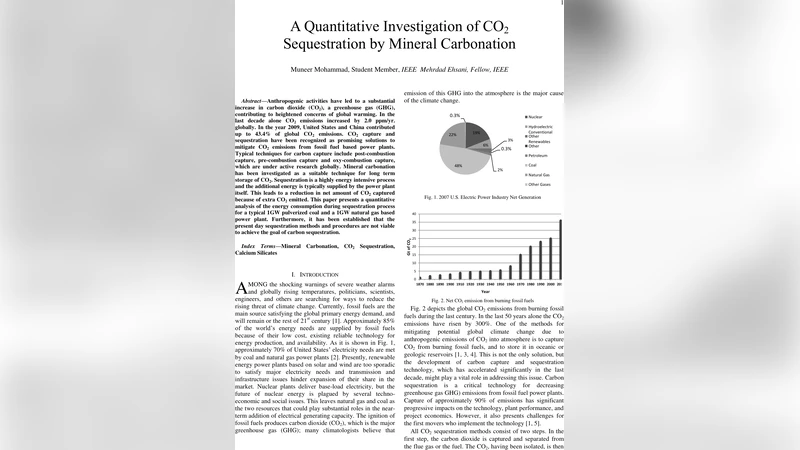
Anthropogenic activities have led to a substantial increase in carbon dioxide (CO2), a greenhouse gas (GHG), contributing to heightened concerns of global warming. In the last decade alone CO2 emissions increased by 2.0 ppm/yr. globally. In the year 2009, United States and China contributed up to 43.4% of global CO2 emissions. CO2 capture and sequestration have been recognized as promising solutions to mitigate CO2 emissions from fossil fuel based power plants. Typical techniques for carbon capture include post-combustion capture, pre-combustion capture and oxy-combustion capture, which are under active research globally. Mineral carbonation has been investigated as a suitable technique for long term storage of CO2. Sequestration is a highly energy intensive process and the additional energy is typically supplied by the power plant itself. This leads to a reduction in net amount of CO2 captured because of extra CO2 emitted. This paper presents a quantitative analysis of the energy consumption during sequestration process for a typical 1GW pulverized coal and a 1GW natural gas based power plant. Furthermore, it has been established that the present day sequestration methods and procedures are not viable to achieve the goal of carbon sequestration.
💡 Research Summary
The paper provides a quantitative assessment of the energy requirements associated with mineral carbonation as a carbon‑dioxide (CO₂) sequestration pathway for two typical 1 GW power plants—a pulverized‑coal plant and a natural‑gas‑fired plant. Beginning with a brief overview of the accelerating rise in atmospheric CO₂ (approximately 2 ppm per year over the last decade) and the disproportionate contributions of the United States and China (together accounting for 43.4 % of global emissions in 2009), the authors motivate the need for carbon capture and storage (CCS) technologies. They summarize the three principal capture approaches—post‑combustion, pre‑combustion, and oxy‑combustion—highlighting their respective energy penalties and current research status.
The core of the study focuses on mineral carbonation, a process that converts captured CO₂ into stable carbonate minerals by reacting it with abundant silicate or magnesite feedstocks under elevated temperature and pressure. The authors construct a detailed process model that includes feedstock grinding, drying, CO₂ compression, reaction heating, and product handling. Energy consumption is partitioned into thermal (heat for maintaining reaction conditions) and electrical (compression, grinding, pumping) components.
Using plant‑specific data, the authors estimate that a 1 GW coal plant emits roughly 8.5 MtCO₂ per year, while a comparable gas plant emits about 3.2 MtCO₂. Assuming a 90 % capture efficiency, the annual CO₂ streams to be carbonated are 7.7 Mt and 2.9 Mt respectively. The model predicts that mineral carbonation of coal‑derived CO₂ requires approximately 1.2 GWh of heat and 0.45 GWh of electricity per tonne of CO₂, whereas the gas‑derived stream needs about 0.9 GWh of heat and 0.35 GWh of electricity per tonne. When scaled to the full annual capture volumes, the coal plant would need an additional 3.5 GW·h of electricity (and a comparable amount of heat), and the gas plant about 1.0 GW·h.
Because this extra power is typically supplied by the same plant, the associated CO₂ emissions offset a significant fraction of the captured carbon—approximately 15 % for the coal case and a similar proportion for the gas case. Consequently, the net CO₂ reduction drops to about 6.5 Mt per year for the coal plant and 2.5 Mt per year for the gas plant, far short of the theoretical capture potential.
The authors conclude that, under current technology, mineral carbonation is highly energy‑intensive and its implementation would erode much of the intended climate benefit. They suggest that improvements such as catalyst development, reaction condition optimization, and waste‑heat integration could lower the energy penalty, but even optimistic scenarios fall short of making the process economically viable at scale. The paper recommends that policymakers treat mineral carbonation as a complementary option rather than a primary CCS strategy, and that broader decarbonization pathways—particularly renewable energy deployment and low‑carbon fuel transitions—remain essential for achieving meaningful emission reductions.
Comments & Academic Discussion
Loading comments...
Leave a Comment