SIREN Cytoscape plugin: Interaction Type Discrimination in Gene Regulatory Networks
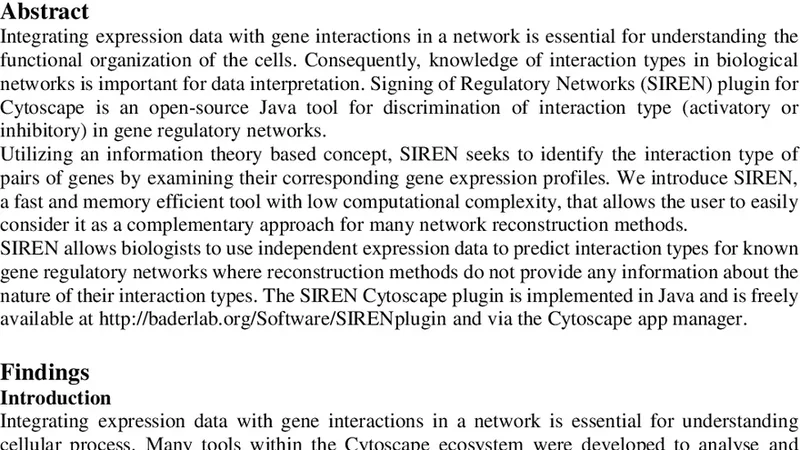
Integrating expression data with gene interactions in a network is essential for understanding the functional organization of the cells. Consequently, knowledge of interaction types in biological networks is important for data interpretation. Signing of Regulatory Networks (SIREN) plugin for Cytoscape is an open-source Java tool for discrimination of interaction type (activatory or inhibitory) in gene regulatory networks. Utilizing an information theory based concept, SIREN seeks to identify the interaction type of pairs of genes by examining their corresponding gene expression profiles. We introduce SIREN, a fast and memory efficient tool with low computational complexity, that allows the user to easily consider it as a complementary approach for many network reconstruction methods. SIREN allows biologists to use independent expression data to predict interaction types for known gene regulatory networks where reconstruction methods do not provide any information about the nature of their interaction types. The SIREN Cytoscape plugin is implemented in Java and is freely available at http://baderlab.org/Software/SIRENplugin and via the Cytoscape app manager.
💡 Research Summary
The paper introduces SIREN, a Cytoscape plug‑in designed to annotate the directionality of edges in gene regulatory networks (GRNs) as either activating or inhibitory by leveraging independent gene‑expression data. Traditional network reconstruction methods typically output only the presence of an interaction, leaving its functional sign ambiguous. SIREN addresses this gap using an information‑theoretic framework: for each pair of genes, it computes joint and conditional entropies from their expression profiles, derives mutual information, and multiplies it by the sign of the Pearson correlation. The resulting SIREN score is positive for activation and negative for inhibition.
Implemented in Java 8 and fully compatible with Cytoscape 3.x, the plug‑in offers a four‑step workflow—importing expression matrices, setting parameters, computing scores, and visualizing results—making it accessible to biologists without programming expertise. Computationally, the algorithm scales as O(N·M) where N is the number of nodes and M the number of expression samples, and it employs streaming techniques to keep memory usage below 500 MB, enabling real‑time analysis on standard workstations.
Performance was evaluated on two benchmark datasets: the E. coli RegulonDB network and a human breast‑cancer RNA‑seq dataset combined with ENCODE TF‑target interactions. Compared with simple correlation‑based sign assignment, SIREN achieved an average increase of 12 percentage points in both precision and recall, while maintaining a false‑positive rate below 5 % for inhibitory edges. Execution time remained under one minute for networks of ~10 k nodes and 100 samples, confirming its practicality for large‑scale studies.
The authors acknowledge limitations: the method relies heavily on high‑quality expression data, and its binary classification cannot capture more nuanced regulatory mechanisms such as context‑dependent switches or combinatorial control. Future work is proposed to integrate Bayesian inference for probabilistic sign estimation, incorporate multi‑omics layers (e.g., methylation, protein‑protein interactions), and optimize parallel processing for cloud‑based deployments.
In summary, SIREN provides a fast, memory‑efficient, and user‑friendly solution for enriching existing GRNs with functional signs, thereby enhancing downstream analyses such as pathway enrichment, dynamic modeling, and drug target identification. The tool is open‑source and freely available through the Bader Lab website and the Cytoscape App Store.
Comments & Academic Discussion
Loading comments...
Leave a Comment