Conditions for Normative Decision Making at the Fire Ground
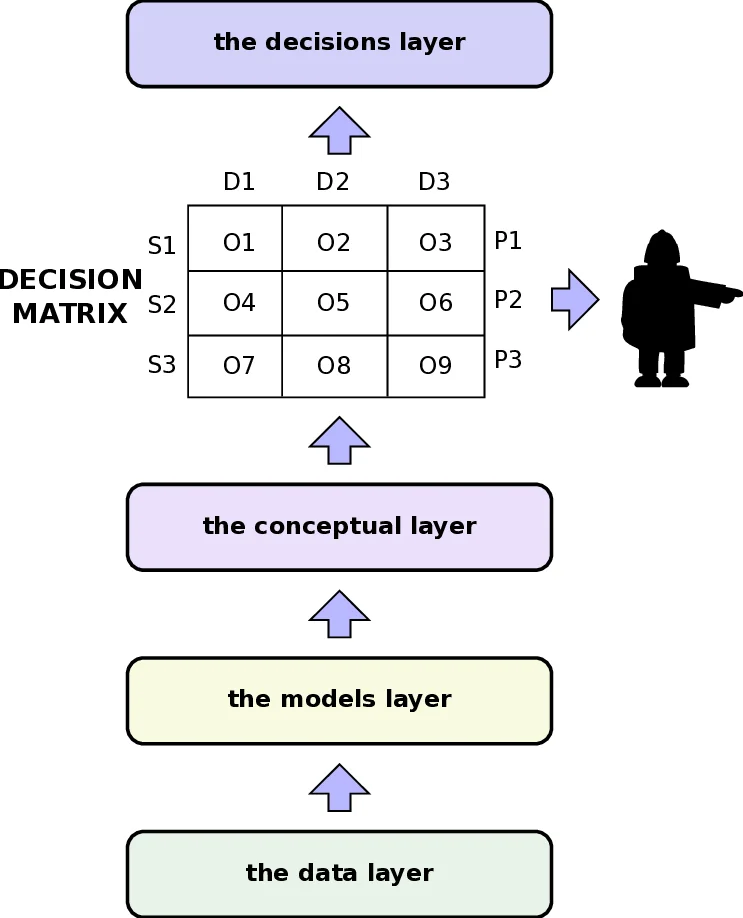
We discuss the changes in an attitude to decision making at the fire ground. The changes are driven by the recent technological shift. The emerging new approaches in sensing and data processing (under common umbrella of Cyber-Physical Systems) allow for leveling off the gap, between humans and machines, in perception of the fire ground. Furthermore, results from descriptive decision theory question the rationality of human choices. This creates the need for searching and testing new approaches for decision making during emergency. We propose the framework that addresses this need. The primary feature of the framework are possibilities for incorporation of normative and prescriptive approaches to decision making. The framework also allows for comparison of the performance of decisions, between human and machine.
💡 Research Summary
The paper examines the longstanding reliance on naturalistic decision making (NDM) in fire‑ground command, where experienced incident commanders use intuition, pattern recognition, and domain knowledge to act under extreme uncertainty and time pressure. While human expertise excels in perception, ethical judgment, and flexible problem structuring, it is also vulnerable to cognitive biases, limited computational capacity, fatigue, and the need for rapid quantitative assessments (e.g., water volume, resource allocation). Recent advances in cyber‑physical systems (CPS), the Internet of Things, big‑data analytics, and machine learning have dramatically expanded the amount and fidelity of situational data that can be gathered from a fire scene. The authors illustrate this with the ICRA project, which integrates Building Information Modeling (BIM), environmental sensors (temperature, CO, CO₂, optical density, IR/Vis imaging), mobile robot measurements, civilian and firefighter localization (via phone tracking and dead‑reckoning), wearable biosensors (ECG, respiration, skin conductance), equipment status monitors, incident reporting databases, and domain ontologies together with “what‑if” scenario libraries.
Building on this rich data foundation, the authors propose a four‑layer decision‑support framework:
- Data Layer – raw sensor streams, BIM geometry, and historical incident records.
- Model Layer – physics‑based fire dynamics models, evacuation simulations, finite‑element analyses, and machine‑learning classifiers that transform low‑level measurements into higher‑level variables.
- Conceptual Layer – ontologies and what‑if knowledge bases that abstract the model outputs into actionable concepts (e.g., “high respiratory risk”).
- Decision Layer – a formal Decision Matrix (DM) that enumerates possible states of nature (fire evolution scenarios), decision alternatives (tactics, resource deployments), and outcomes with associated probabilities.
The DM enables the application of normative and prescriptive decision‑theoretic methods (expected utility, multi‑criteria analysis, Bayesian updating) to derive a rational, optimal choice for the emergency. The framework can either present processed information to the human commander in an intuitive visual form or autonomously recommend the optimal decision package, thereby supporting human‑machine collaboration. Crucially, because the same DM is used for both human and machine choices, performance can be quantitatively compared across a range of scenarios, allowing researchers to assess when machine‑derived recommendations outperform expert intuition.
The paper argues that the surge in CPS‑enabled perception narrows the gap between human and machine situational awareness, while findings from descriptive decision theory expose systematic flaws in human judgment. Consequently, moving toward normative, algorithmic decision support is both feasible and desirable. The authors conclude that their framework opens a new research direction: systematic evaluation of human versus computer‑aided decisions in real fire incidents, with the long‑term prospect of either augmenting commanders or, where appropriate, fully automating certain tactical decisions.
Comments & Academic Discussion
Loading comments...
Leave a Comment