Localisation of antifreeze proteins in Rhagium mordax using immunofluorescence
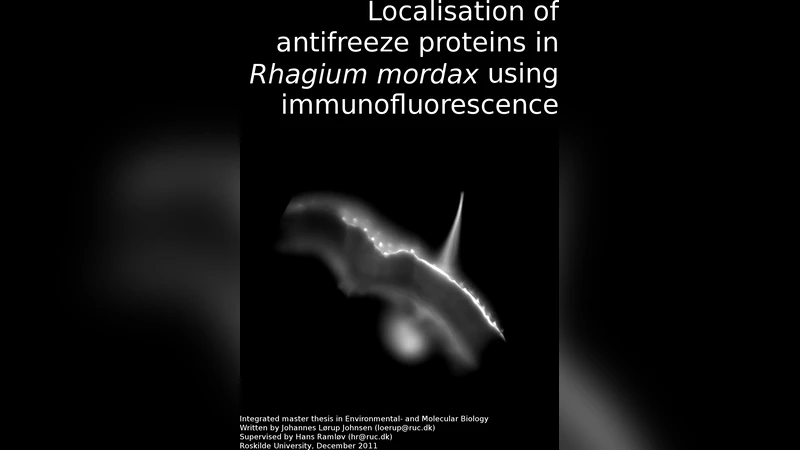
Larvae of the blackspotted pliers support beetle, Rhagium mordax, express antifreeze proteins in their haemolymph during temperate climate winter. It is believed that they also express antifreeze proteins in their cuticle as a means of preventing inoculative freezing. Larvae of Rhagium mordax were collected during winter (March) and summer (May) of 2011. Larvae were fixated, embedded in paraffin wax, sectioned on a microtome, incubated with custom made anti-AFP antibodies and isualised on a fluorescence microscope. The larvae of both winter and summer showed AFP activity in their cuticle, gut lumen and -epithelium. Due to the long synthesis process of AFPs, the larvae contain them all year round. The distribution of these AFPs change during summer, possibly relocating to vesicles in the cuticle and gut lumen/epithelium.
💡 Research Summary
The study investigates the spatial distribution of antifreeze proteins (AFPs) in the larvae of the black‑spotted longhorn beetle, Rhagium mordax, across winter and summer seasons using immunofluorescence microscopy. The authors collected larvae in March (winter) and May (summer) of 2011, immediately fixed them in 4 % paraformaldehyde, embedded the specimens in paraffin, and cut 5 µm sections on a microtome. After deparaffinization and blocking with 5 % BSA, the sections were incubated with a custom‑made polyclonal anti‑AFP primary antibody (1:200) at 4 °C for 90 minutes, followed by a FITC‑conjugated secondary antibody (1:500) for 1 hour at room temperature. Nuclei were counterstained with DAPI. Fluorescence imaging (excitation ≈ 488 nm, emission ≈ 520 nm) revealed strong green fluorescence throughout the cuticle, gut lumen, and gut epithelium in winter specimens, indicating a widespread presence of AFPs in these tissues. In summer specimens, overall fluorescence intensity was reduced, but distinct punctate signals—interpreted as vesicle‑like structures—were observed within the cuticle and gut lumen/epithelium. This pattern suggests that during the warmer months AFPs are stored in intracellular vesicles rather than being uniformly distributed.
The authors conclude that R. mordax larvae synthesize and retain AFPs year‑round, likely because the biosynthetic pathway is lengthy and continuous production ensures protection against inoculative freezing. Moreover, the seasonal shift from a diffuse tissue distribution in winter to a vesicular storage mode in summer implies a regulated relocation mechanism that may optimize resource allocation and readiness for sudden temperature drops.
Critical appraisal highlights several strengths: the use of a species‑specific antibody enables direct visualization of AFPs in situ; the side‑by‑side seasonal comparison provides novel insight into dynamic protein localization; and the methodological workflow (fixation, paraffin embedding, immunofluorescence) is robust and reproducible. However, limitations are evident. The specificity of the custom antibody was not validated with complementary techniques such as Western blotting or mass spectrometry, leaving open the possibility of cross‑reactivity. Quantification relied on visual assessment of fluorescence intensity; rigorous image analysis (e.g., pixel intensity histograms) would be required for statistical comparison. The study examined only two time points in a single year, precluding assessment of inter‑annual variability or intermediate seasonal stages (e.g., autumn). Additionally, functional assays linking observed AFP localization to actual freezing resistance were absent.
Future work should address these gaps by confirming antibody specificity, employing quantitative immunofluorescence or ELISA to measure AFP concentrations, and integrating transcriptomic data (RNA‑seq) to correlate protein distribution with gene expression. Functional experiments—such as controlled cooling trials combined with pharmacological inhibition of vesicular trafficking—could elucidate whether vesicle‑bound AFPs are mobilized during rapid temperature declines. Comparative studies across related beetle species or populations inhabiting different climatic regimes would further illuminate the evolutionary plasticity of antifreeze strategies. Overall, this paper provides a valuable foundation for understanding how insects spatially manage antifreeze proteins throughout the year, opening avenues for deeper mechanistic and ecological investigations.
Comments & Academic Discussion
Loading comments...
Leave a Comment