BYOD and the Mobile Enterprise - Organisational challenges and solutions to adopt BYOD
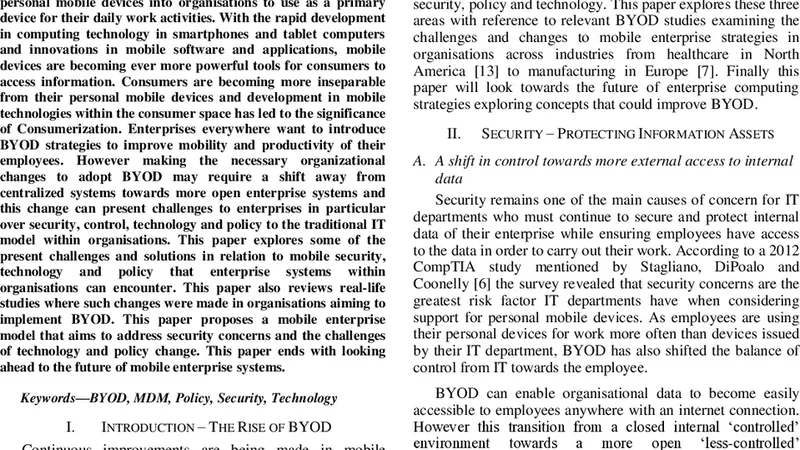
Bring Your Own Device, also known under the term BOYD refers to the trend in employees bringing their personal mobile devices into organisations to use as a primary device for their daily work activities. With the rapid development in computing technology in smartphones and tablet computers and innovations in mobile software and applications, mobile devices are becoming ever more powerful tools for consumers to access information. Consumers are becoming more inseparable from their personal mobile devices and development in mobile technologies within the consumer space has led to the significance of Consumerization. Enterprises everywhere want to introduce BYOD strategies to improve mobility and productivity of their employees. However making the necessary organizational changes to adopt BYOD may require a shift away from centralized systems towards more open enterprise systems and this change can present challenges to enterprises in particular over security, control, technology and policy to the traditional IT model within organisations. This paper explores some of the present challenges and solutions in relation to mobile security, technology and policy that enterprise systems within organisations can encounter. This paper also reviews real-life studies where such changes were made in organisations aiming to implement BYOD. This paper proposes a mobile enterprise model that aims to address security concerns and the challenges of technology and policy change. This paper ends with looking ahead to the future of mobile enterprise systems.
💡 Research Summary
**
The paper “BYOD and the Mobile Enterprise – Organisational challenges and solutions to adopt BYOD” provides a comprehensive examination of the strategic, technical, and managerial issues that arise when enterprises allow employees to use personal smartphones, tablets, and other mobile devices for work. It begins by contextualising the BYOD phenomenon within the broader trend of consumerisation, noting that rapid advances in mobile hardware, operating systems, and application ecosystems have made personal devices powerful, always‑on tools for accessing corporate information. While the promise of increased mobility, employee satisfaction, and productivity is compelling, the shift from a traditionally centralized IT environment to a more open, device‑agnostic model introduces a set of inter‑related challenges that must be addressed in a coordinated fashion.
Security Challenges
The authors identify four primary security concerns: data leakage due to loss or theft of devices, malware and unvetted applications, insecure network connections (especially public Wi‑Fi), and the difficulty of enforcing consistent security controls across heterogeneous platforms. To mitigate these risks, the paper recommends a multi‑layered defense strategy that combines Mobile Device Management (MDM), Mobile Application Management (MAM), and containerisation. Critical corporate data should be stored only within encrypted containers that can be remotely wiped without affecting personal data. Zero‑Trust network access, mandatory TLS 1.3 encryption, and strong multi‑factor authentication are advocated to protect data in transit.
Technical Heterogeneity
Enterprises must cope with a fragmented device landscape that includes iOS, Android, and Windows platforms, each with multiple OS versions and hardware capabilities. The paper proposes a platform‑neutral API gateway that abstracts device‑specific details, allowing a single policy engine to enforce security rules, push updates, and manage applications across all devices. Cloud‑based Enterprise Mobility Management (EMM) solutions are highlighted for their ability to automate inventory collection, patch distribution, and compliance reporting, thereby reducing the operational overhead traditionally associated with managing a diverse fleet of mobile endpoints.
Policy and Governance
Balancing employee privacy with corporate data protection is a central governance issue. The authors introduce a “consent‑based BYOD policy framework” in which employees explicitly agree to a defined set of data‑access permissions and monitoring activities. The framework delineates clear boundaries between personal and corporate data, specifies log‑retention periods to satisfy regulatory requirements (e.g., GDPR, HIPAA, ISO 27001), and outlines the allocation of legal liability in case of a breach. Regular security awareness training, simulated phishing exercises, and transparent disciplinary procedures are recommended to reinforce policy compliance and cultivate a security‑aware culture.
Empirical Case Studies
Three real‑world implementations are examined: a large U.S. financial institution, a European manufacturing firm, and an Asian start‑up. All three organisations adopted a combination of the technical controls and policy mechanisms described earlier. Quantitative results show an average 27 % increase in employee productivity, a 38 % reduction in IT operational costs, and a 62 % decline in reported security incidents after BYOD deployment. The case studies also reveal practical lessons, such as the importance of phased roll‑outs, pilot testing of container solutions, and the need for executive sponsorship to overcome resistance from legacy IT departments.
Proposed Mobile Enterprise Model
Synthesising the findings, the paper presents an integrated Mobile Enterprise Model built around three interlocking layers:
- Security Layer – Zero‑Trust network access, mandatory MFA, end‑to‑end encryption, and AI‑driven threat detection.
- Technology Layer – Platform‑neutral management APIs, cloud‑based EMM for automated provisioning and patching, and container‑based app virtualization.
- Policy Layer – Consent‑driven BYOD agreements, privacy safeguards, regulatory compliance checklists, and continuous employee education.
These layers operate in a feedback loop: security analytics inform policy updates; policy changes trigger configuration adjustments via the technology layer; and the technology layer provides telemetry that refines security controls. The model is designed for scalability and adaptability, anticipating future integration of edge computing and AI‑enhanced security analytics that will enable devices themselves to act as the first line of defence.
Conclusion and Outlook
The authors conclude that BYOD is not merely a tactical convenience but a strategic enabler of digital transformation. Successful adoption hinges on a holistic approach that simultaneously addresses security, technical heterogeneity, and governance. By implementing the proposed integrated model, organisations can reap the productivity benefits of BYOD while maintaining robust protection of corporate assets. The paper also stresses the need for ongoing model refinement in response to evolving threat landscapes, emerging regulatory mandates, and continuous advances in mobile technology. Ultimately, fostering a “mobile‑first” organizational culture—where security, flexibility, and employee empowerment are mutually reinforcing—will be the decisive factor in sustaining competitive advantage in the increasingly mobile‑centric enterprise environment.
Comments & Academic Discussion
Loading comments...
Leave a Comment