Test of two hypotheses explaining the size of populations in a system of cities
Two classical hypotheses are examined about the population growth in a system of cities: Hypothesis 1 pertains to Gibrat’s and Zipf’s theory which states that the city growth-decay process is size independent; Hypothesis 2 pertains to the so called Yule process which states that the growth of populations in cities happens when (i) the distribution of the city population initial size obeys a log-normal function, (ii) the growth of the settlements follows a stochastic process. The basis for the test is some official data on Bulgarian cities at various times. This system was chosen because (i) Bulgaria is a country for which one does not expect biased theoretical conditions; (ii) the city populations were determined rather precisely. The present results show that: (i) the population size growth of the Bulgarian cities is size dependent, whence Hypothesis 1 is not confirmed for Bulgaria; (ii) the population size growth of Bulgarian cities can be described by a double Pareto log-normal distribution, whence Hypothesis 2 is valid for the Bulgarian city system. It is expected that this fine study brings some information and light on other, usually considered to be more pertinent, city systems in various countries.
💡 Research Summary
The paper investigates two classical hypotheses concerning the growth of city populations using official data from Bulgarian cities between 2004 and 2011. Hypothesis 1 combines Gibrat’s law with Zipf’s rank‑size rule, asserting that the growth rate of a city’s population is independent of its size. Under this assumption, the rescaled city size S_i(t)=N_i(t)/N(t) should follow a simple power‑law relationship with rank, ln r = α − β ln S, with β≈1 across the entire system. Hypothesis 2 is based on the Yule process: the initial distribution of city sizes is log‑normal, and subsequent growth follows a stochastic process akin to geometric Brownian motion. This leads to a double Pareto‑log‑normal (dPLN) distribution for the non‑rescaled city sizes.
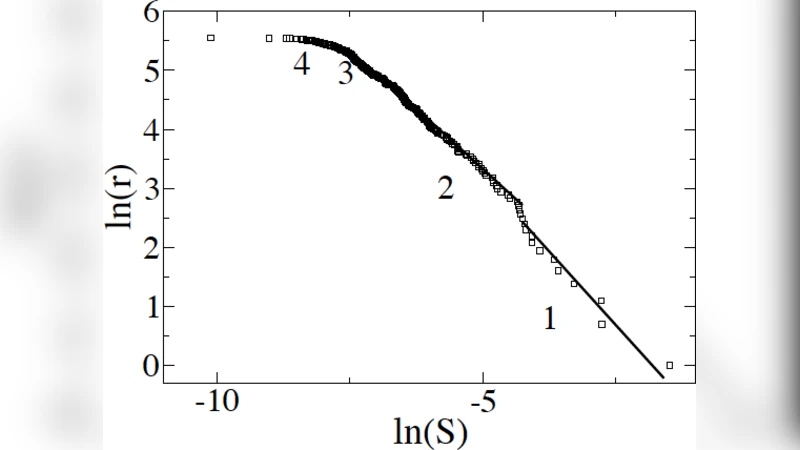
The authors first test Hypothesis 1. They compute rescaled sizes for each city and rank them. Visual inspection and statistical fitting reveal that the cities naturally separate into four size classes: large (≥70 000), medium (5 000–70 000), small (2 000–5 000), and very small (200–2 000). For classes 1, 2, and 4 the rank‑size plot is well described by a straight line with β close to 1, consistent with Zipf’s law. However, class 3 requires a quadratic term (ln r = α − β ln S − γ(ln S)^2), indicating deviation from a pure power law. Moreover, when the cumulative distribution P(S > x) is examined, a single Pareto exponent ζ does not fit the data; ζ varies with x, especially dropping well below 1 for small cities. By fitting an error‑function‑based model (Eq. 5) and deriving a local exponent ζ(x) (Eq. 8), the authors show that ζ≈1 only for the largest cities, while it falls to 0.4–0.6 for smaller ones. These findings demonstrate size‑dependent growth, thereby rejecting Hypothesis 1 for the Bulgarian city system.
Next, the authors test Hypothesis 2. They fit the observed (non‑rescaled) population distribution for 2004 and 2011 to the double Pareto‑log‑normal density (Eq. 9). The fit is excellent in both years, with estimated parameters α≈0.8 (governing the left tail) and β≈3 (governing the right tail). Consequently, for small cities p(x)∝x^{−0.8} and for large cities p(x)∝x^{−3}, exactly the behavior predicted by the dPLN model. This confirms that the initial city sizes were log‑normally distributed and that subsequent stochastic growth follows a Yule‑type process.
The paper concludes that Bulgarian city growth is not size‑independent; instead, it follows a stochastic multiplicative process that yields a double Pareto‑log‑normal distribution. The authors argue that these results have broader implications: many urban systems may also be better described by models that incorporate an initial log‑normal distribution and size‑dependent growth, rather than the traditional Gibrat‑Zipf framework. The findings are relevant for urban planning, resource allocation, and economic policy, as they highlight the need to treat large and small cities differently due to their distinct growth dynamics.
Comments & Academic Discussion
Loading comments...
Leave a Comment