Multiplex Networks with Intrinsic Fitness: Modeling the Merit-Fame Interplay via Latent Layers
We consider the problem of growing multiplex networks with intrinsic fitness and inter-layer coupling. The model comprises two layers; one that incorporates fitness and another in which attachments are preferential. In the first layer, attachment probabilities are proportional to fitness values, and in the second layer, proportional to the sum of degrees in both layers. We provide analytical closed-form solutions for the joint distributions of fitness and degrees. We also derive closed-form expressions for the expected value of the degree as a function of fitness. The model alleviates two shortcomings that are present in the current models of growing multiplex networks: homogeneity of connections, and homogeneity of fitness. In this paper, we posit and analyze a growth model that is heterogeneous in both senses.
💡 Research Summary
The paper introduces a novel growth model for multiplex networks that simultaneously incorporates node‑specific intrinsic fitness and heterogeneous link‑generation rates across two distinct layers. The first layer, termed the “merit layer,” implements a fitness‑driven attachment rule: each existing node x receives a new link with probability proportional to its immutable fitness value θₓ, drawn from a prescribed distribution ρ(θ). The second layer, called the “fame layer,” follows a preferential‑attachment mechanism based on the total degree of a node, i.e., the sum of its degrees in both layers (kₓ + ℓₓ). At each discrete time step a new node arrives, creates β₁ outgoing links in the merit layer and β₂ outgoing links in the fame layer, and is assigned a fitness θ sampled from ρ(θ).
The authors formulate a master‑equation (rate equation) for the expected number Nₜ(k,ℓ,θ) of nodes that at time t have merit‑layer degree k, fame‑layer degree ℓ, and fitness θ. By normalizing with the total number of nodes they obtain an evolution equation for the joint probability Pₜ(k,ℓ,θ). Assuming a steady state (t → ∞) they simplify the denominators using the mean fitness μ and the growth rates β₁, β₂, which yields a coupled difference equation (Eq. 4). This equation captures the competition between the fitness‑driven term (β₁ μ θ) and the preferential term (β₂/(β₁+β₂)).
To solve the non‑trivial recurrence, the authors introduce auxiliary functions ψ(k,ℓ,θ) and φ(k+ℓ,k,θ), which transform the original equation into a form reminiscent of the recurrence for unsigned Stirling numbers of the first kind. By exploiting the known combinatorial identity
φ_{n+1,k}=φ_{n,k-1}+n φ_{n,k},
they recognize that φ_{n,k}=⟨n k⟩ (the unsigned Stirling number) up to a multiplicative factor involving the model parameters and the fitness distribution. This insight leads to a closed‑form expression for ψ and consequently for the joint distribution
P(k,ℓ,θ)=\binom{k+ℓ}{k},A,\frac{Γ(A G(θ))}{Γ(A G(θ)+k+ℓ+1)},ρ(θ),
where A=(β₁+β₂)/β₂ and G(θ)=1+β₁θ/μ. The binomial coefficient reflects the combinatorial ways to split a total degree q=k+ℓ between the two layers, while the Gamma‑function terms encode the influence of fitness and the heterogeneous attachment rules.
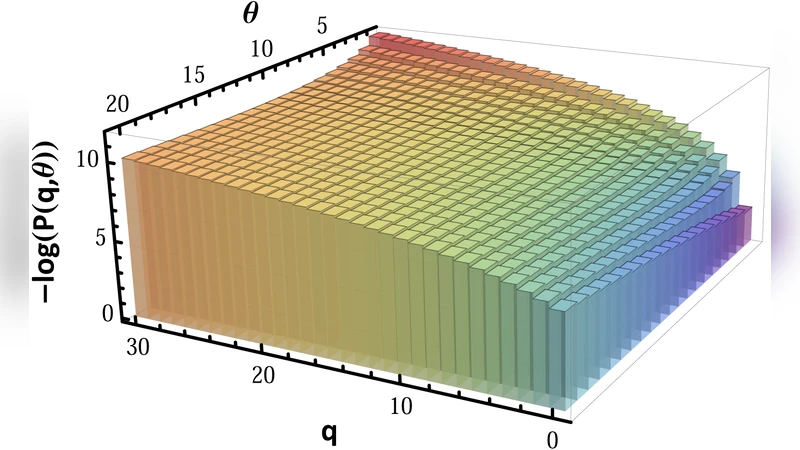
Since in most empirical settings only the aggregated degree q is observable (e.g., total citations of a paper), the authors sum over k to obtain the collapsed joint distribution P(q,θ). Using the summation identity for Stirling numbers they derive a compact formula expressed through Gamma functions and generalized binomial coefficients (Eq. 22).
From this distribution they compute the conditional expectation of total degree given fitness:
E
Comments & Academic Discussion
Loading comments...
Leave a Comment