Toward more localized local algorithms: removing assumptions concerning global knowledge
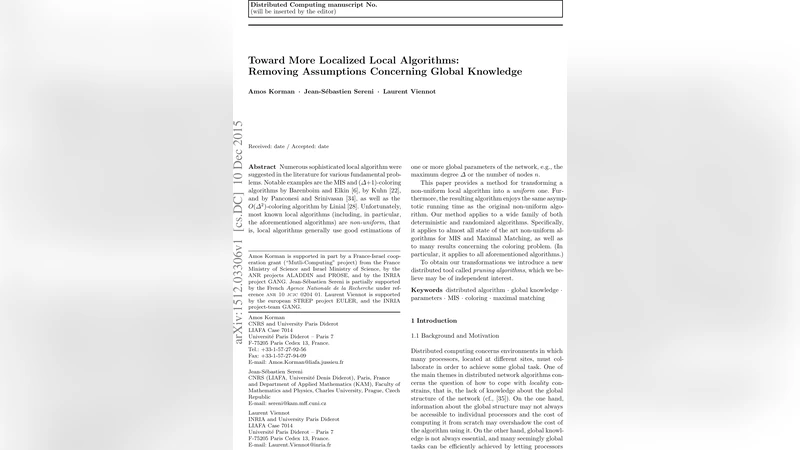
Numerous sophisticated local algorithm were suggested in the literature for various fundamental problems. Notable examples are the MIS and $(\Delta+1)$-coloring algorithms by Barenboim and Elkin [6], by Kuhn [22], and by Panconesi and Srinivasan [34], as well as the $O(\Delta 2)$-coloring algorithm by Linial [28]. Unfortunately, most known local algorithms (including, in particular, the aforementioned algorithms) are non-uniform, that is, local algorithms generally use good estimations of one or more global parameters of the network, e.g., the maximum degree $\Delta$ or the number of nodes n. This paper provides a method for transforming a non-uniform local algorithm into a uniform one. Furthermore , the resulting algorithm enjoys the same asymp-totic running time as the original non-uniform algorithm. Our method applies to a wide family of both deterministic and randomized algorithms. Specifically, it applies to almost all state of the art non-uniform algorithms for MIS and Maximal Matching, as well as to many results concerning the coloring problem. (In particular, it applies to all aforementioned algorithms.) To obtain our transformations we introduce a new distributed tool called pruning algorithms, which we believe may be of independent interest.
💡 Research Summary
The paper addresses a fundamental limitation of many state‑of‑the‑art distributed algorithms in the LOCAL model: they are non‑uniform, i.e., each node must be supplied with an upper bound on global parameters such as the maximum degree Δ or the number of nodes n. While such information can dramatically simplify algorithm design, it is often unavailable or costly to obtain in realistic networks. The authors propose a general transformation technique that converts any non‑uniform local algorithm into a uniform one without increasing its asymptotic running time.
The cornerstone of the transformation is a new class of algorithms called pruning algorithms. A pruning algorithm has two essential capabilities. First, it can locally verify whether the current partial output violates the problem specification (e.g., a node detects that two adjacent nodes are both in the MIS, or that a node is not dominated). Second, when a violation is detected, the algorithm “prunes” the offending nodes (or edges) and isolates the induced subgraph. The original non‑uniform algorithm is then re‑executed on this subgraph. This process repeats; each iteration either leaves the global output unchanged or strictly improves it, guaranteeing progress toward a correct solution. Because the verification and pruning steps are purely local, they require only a constant (or log* ) number of rounds, preserving the original time complexity.
The framework works for both deterministic and randomized algorithms. In the randomized setting, the pruning process yields a Las Vegas algorithm: it always terminates with a correct solution, and its expected running time matches that of the underlying non‑uniform algorithm. Moreover, the authors show how to combine several algorithms and automatically select the one that finishes fastest on each subgraph, thereby achieving the minimum possible running time among a given finite set of algorithms.
To demonstrate the power of the method, the paper applies pruning to three canonical problems:
-
Maximal Independent Set (MIS). Existing fast MIS algorithms (Barenboim‑Elkin, Kuhn, Panconesi‑Srinivasan) rely on Δ and n. By pruning, the authors obtain uniform MIS algorithms with the same O(Δ + log* n) or O(√log n) bounds, eliminating any need for global knowledge.
-
(Δ + 1)‑Coloring. The classic Δ‑plus‑one coloring algorithms also require Δ and n. Using pruning, the authors preserve the trade‑off between the number of colors λ and the running time O(Δ/λ + log* n), while removing all global parameter assumptions.
-
Maximum Matching. The best known deterministic matching algorithm runs in O(log⁴ n) rounds but assumes a common upper bound on n. After pruning, the uniform version retains the O(log⁴ n) bound without any prior knowledge of n or Δ.
In each case, the transformed algorithm’s round complexity is identical to that of the original non‑uniform version; the only additional cost is a constant‑factor overhead for the pruning steps.
The authors also discuss limitations. Pruning may increase communication overhead, especially in dense graphs where many nodes are repeatedly pruned. However, this overhead remains bounded by a constant factor relative to the original algorithm’s cost. Another requirement is that the original algorithm be self‑checking—it must produce an output that can be locally verified. Some sophisticated algorithms may need minor redesign to satisfy this property.
Overall, the paper makes a significant conceptual contribution by showing that the reliance on global knowledge is not intrinsic to fast distributed algorithms. The pruning technique provides a systematic, broadly applicable tool for converting non‑uniform algorithms into uniform ones, opening new avenues for both theoretical research and practical protocol design in environments where global parameters are unknown or expensive to obtain.
Comments & Academic Discussion
Loading comments...
Leave a Comment