Packing of elastic wires in flexible shells
The packing problem of long thin filaments that are injected into confined spaces is of fundamental interest for physicists and biologists alike. How linear threads pack and coil is well known only for the ideal case of rigid containers, though. Here, we force long elastic rods into flexible spatial confinement borne by an elastic shell to examine under which conditions recently acquired knowledge on wire packing in rigid spheres breaks down. We find that unlike in rigid cavities, friction plays a key role by giving rise to the emergence of two distinct packing patterns. At low friction, the wire densely coils into an ordered toroidal bundle with semi-ellipsoidal cross-section, while at high friction, it packs into a highly disordered, hierarchic structure. These two morphologies are shown to be separated by a continuous phase transition. Our findings demonstrate the dramatic impact of friction and confinement elasticity on filamentous packing and might drive future research on such systems in physics, biology and even medical technology toward including these mutually interacting effects.
💡 Research Summary
The paper investigates how long elastic wires pack inside a deformable spherical shell, a scenario relevant to many biological and medical systems where the confining container is not rigid. Using a Kirchhoff‑Rod model for the wire and a Kirchhoff‑Love thin‑shell model for the elastic sphere, the authors perform large‑scale finite‑element simulations that include Hertzian normal contact forces and Coulomb friction (static coefficient μs, dynamic μd with μd/μs = 0.9). Four dimensionless control parameters fully describe the system: the radius ratio ρ = R/r (shell radius to wire radius), the thickness ratio ξ = R/t, the elastic modulus ratio ε = Ew/Es, and the static friction coefficient μs. The wire is injected at a constant speed through a small opening, with a tiny transverse perturbation to break axial symmetry.
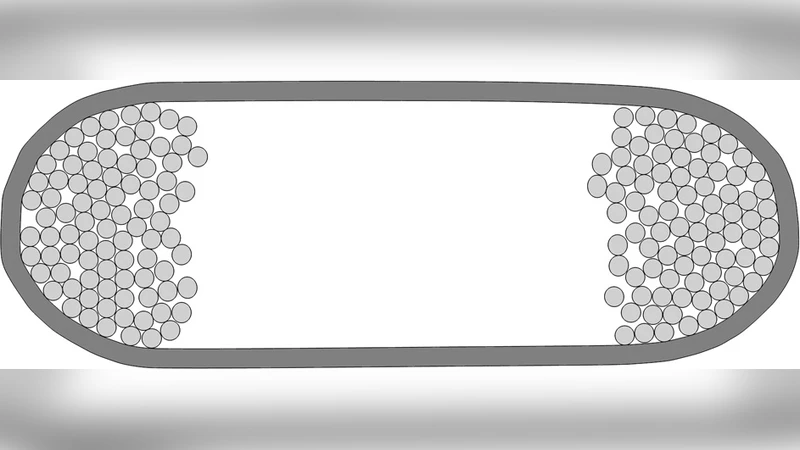
Two distinct packing morphologies emerge depending on μs. When friction is negligible (μs≈0), the wire coils into an ordered toroidal bundle. The shell flattens at its poles, and the torus cross‑section is well approximated by two half‑ellipses with a large toroidal radius Rt that remains essentially constant as more wire is added, while the minor radii Rx and Ry grow as power laws (Rx ∝ L^0.35, Ry ∝ L^0.46). By adapting the Purohit et al. geometric model originally developed for DNA in viral capsids, the authors derive an analytical expression for the average strand spacing d(L) and for the bending energy Ub (Eq. 6). This energy decreases with increasing Rt and decreasing Rx,Ry, explaining why the system prefers a large‑radius torus.
In contrast, at high friction (μs≈0.5) the wire cannot slide along the shell; compressive forces rise sharply, causing the wire to buckle out of the coiling plane and to form a three‑dimensional, hierarchically crumpled structure. This disordered phase exhibits clear power‑law scaling: the nondimensional bending energy bUb = Ub R/(ρ²EwI) scales as L^1.192, the total curvature K scales as L^1.083, and the number of wire‑wire contacts N scales as L^1.40. The distribution of local curvature squared follows a log‑normal law, indicating hierarchical disorder similar to that observed in rigid‑sphere packings of pre‑curved wires, but here it arises naturally from the flexible confinement. The transition between the ordered torus and the crumpled phase is continuous; as μs passes a critical value, N, Ub, and K change smoothly but with a marked kink, reflecting spontaneous symmetry breaking.
The authors validate the simulations with tabletop experiments using natural rubber balloons (R = 18–23 mm, wall thickness ≈ 0.25 mm) and polycaprolactam wires (r = 0.5–1 mm, lengths up to 22 m). Friction is tuned by acrylic coating or silicone lubrication, and measured by the tilt‑angle method. The same two morphologies appear experimentally, confirming the numerical predictions.
Overall, the study demonstrates that (i) friction is the decisive macroscopic parameter governing wire packing in flexible containers, (ii) the ordered toroidal state is an energy‑minimizing configuration that can be captured analytically, and (iii) the disordered crumpled state is a hierarchically organized structure characterized by robust power‑law scaling of energy, curvature, and contacts. By mapping the behavior onto the four dimensionless groups (ρ, ξ, ε, μs), the work provides a design framework for systems ranging from viral DNA packaging and cytoskeletal filament organization to medical technologies such as endovascular coil embolization of aneurysms, where neglecting friction or shell elasticity could lead to inaccurate predictions of packing density and mechanical stability.
Comments & Academic Discussion
Loading comments...
Leave a Comment