Understanding Human Mobility from Twitter
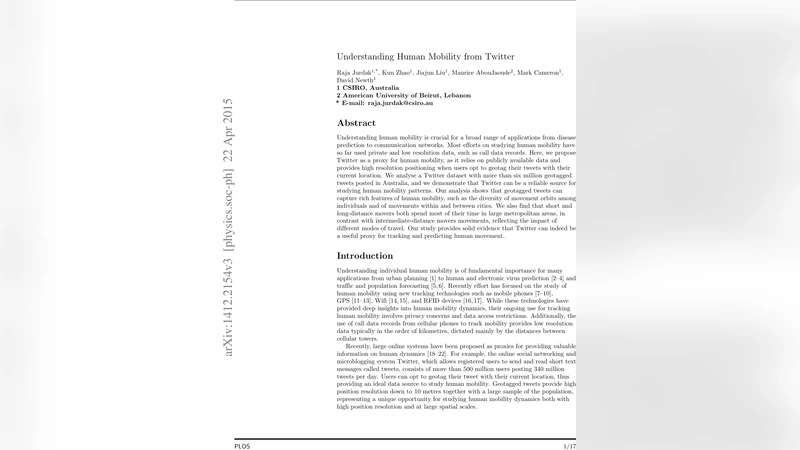
Understanding human mobility is crucial for a broad range of applications from disease prediction to communication networks. Most efforts on studying human mobility have so far used private and low resolution data, such as call data records. Here, we propose Twitter as a proxy for human mobility, as it relies on publicly available data and provides high resolution positioning when users opt to geotag their tweets with their current location. We analyse a Twitter dataset with more than six million geotagged tweets posted in Australia, and we demonstrate that Twitter can be a reliable source for studying human mobility patterns. Our analysis shows that geotagged tweets can capture rich features of human mobility, such as the diversity of movement orbits among individuals and of movements within and between cities. We also find that short and long-distance movers both spend most of their time in large metropolitan areas, in contrast with intermediate-distance movers movements, reflecting the impact of different modes of travel. Our study provides solid evidence that Twitter can indeed be a useful proxy for tracking and predicting human movement.
💡 Research Summary
The paper investigates whether publicly available, high‑resolution geotagged Twitter data can serve as a reliable proxy for studying human mobility, a task traditionally performed with private, low‑resolution sources such as call‑detail records (CDRs) or GPS traces. Using a dataset of 7,811,004 tweets posted by 156,607 users in Australia between September 2013 and April 2014, the authors conduct a comprehensive quantitative analysis and compare the results with established mobility metrics derived from CDRs.
First, the displacement distribution P(d)—the distance between two consecutive geotagged tweets—is examined over a range from 10 m to 4 000 km, spanning more than five orders of magnitude. A single parametric model (power‑law, exponential, or log‑normal) fails to capture the shape. Instead, the authors fit a hybrid function consisting of an exponential component for very short trips (d < ≈100 m) and a stretched‑exponential component for intra‑city movements (≈100 m – 50 km). The exponential dominates intra‑site mobility (e.g., within a building), while the stretched‑exponential reflects multiplicative processes such as transportation cost, lifestyle preferences, and socioeconomic status. Beyond 50 km, a power‑law tail accounts for roughly 6 % of displacements, corresponding to inter‑city travel (e.g., Sydney‑Melbourne). This multimodal pattern aligns with earlier findings from CDRs but reveals a distinct stretched‑exponential regime not previously reported, suggesting that Australian urban travel distances are shaped by a cascade of random variables.
The radius of gyration r_g, measuring the spatial spread of an individual’s trajectory, exhibits a distribution mirroring that of P(d), confirming strong heterogeneity in personal travel scales. The authors also compute the first‑passage time probability F_pt(t), which shows a clear 24‑hour periodicity, indicating daily home‑return cycles. This temporal pattern is virtually identical to that observed in CDR studies, demonstrating that the character limit of tweets does not distort the underlying temporal dynamics.
Visitation frequency follows Zipf’s law: the probability P(L) of being at the L‑th most visited location scales as L^‑α. The exponent α is larger than in mobile‑phone datasets, reflecting a higher propensity for users to tweet from their most frequented place (typically home). Indeed, the probability of finding a user at their top location ranges from 0.45 to 0.55, substantially higher than the ≈0.2 reported for CDRs. This bias is attributed to the nature of micro‑blogging, where users are more likely to post while stationary at home rather than while moving.
To assess predictability, two entropy measures are calculated for each user with at least 100 tweets: the unconditional Shannon entropy S_unc (based solely on visitation frequencies) and the real entropy S_real (which also incorporates the order of visits). Both entropies increase roughly linearly with the number of distinct locations N, but S_unc grows faster, indicating that sequence information becomes increasingly valuable for prediction as spatial diversity expands. Using the Fano‑type bound, the authors estimate the maximum predictability Π_max for each user. The population splits into a highly predictable group (Π≈0.9) that repeatedly visits a few locations—mostly within large metropolitan areas—and a less predictable group (Π≈0.6) that exhibits broader spatial exploration.
The paper acknowledges potential sampling biases: Twitter users tend to be younger, more tech‑savvy, and have reliable internet access, which may not reflect the full demographic composition. Moreover, location bias (preference for tweeting from home or work) could skew mobility estimates. Nevertheless, the authors argue that the high spatial resolution (≈10 m) and the sheer volume of data compensate for these limitations, as many fundamental mobility signatures (multimodal displacement, daily periodicity, Zipf visitation) are reproduced with high fidelity compared to CDRs.
In conclusion, the study provides strong empirical evidence that geotagged Twitter data can serve as a valuable, publicly accessible proxy for human mobility research. It captures fine‑grained movement patterns, supports the identification of distinct mobility modes, and enables the quantification of individual predictability—all while avoiding privacy concerns associated with proprietary datasets. The findings open avenues for large‑scale, real‑time mobility monitoring in epidemiology, urban planning, and transportation engineering, especially in contexts where traditional data sources are unavailable or restricted.
Comments & Academic Discussion
Loading comments...
Leave a Comment