Lattice Boltzmann methods for multiphase flow and phase-change heat transfer
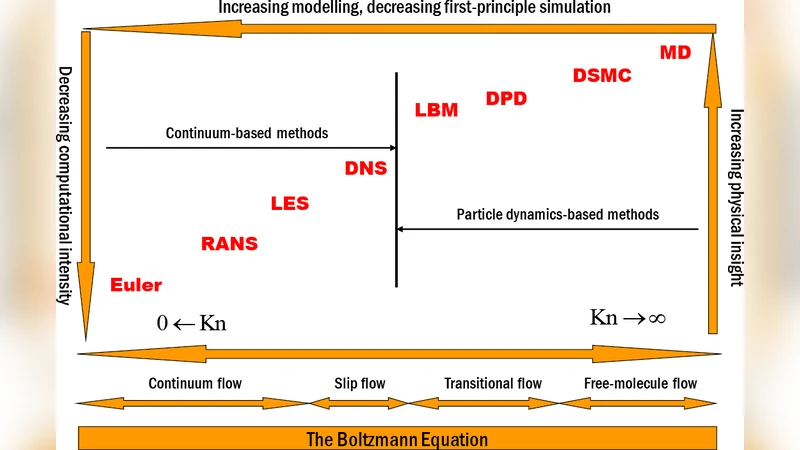
Over the past few decades, tremendous progress has been made in the development of particle-based discrete simulation methods versus the conventional continuum-based methods. In particular, the lattice Boltzmann (LB) method has evolved from a theoretical novelty to a ubiquitous, versatile and powerful computational methodology for both fundamental research and engineering applications. It is a kinetic-based mesoscopic approach that bridges the microscales and macroscales, which offers distinctive advantages in simulation fidelity and computational efficiency. Applications of the LB method have been found in a wide range of disciplines including physics, chemistry, materials, biomedicine and various branches of engineering. The present work provides a comprehensive review of the LB method for thermofluids and energy applications, focusing on multiphase flows, thermal flows and thermal multiphase flows with phase change. The review first covers the theoretical framework of the LB method, revealing the existing inconsistencies and defects as well as common features of multiphase and thermal LB models. Recent developments in improving the thermodynamic and hydrodynamic consistency, reducing the spurious currents, enhancing the numerical stability, etc., are highlighted. These efforts have put the LB method on a firmer theoretical foundation with enhanced LB models that can achieve larger liquid-gas density ratio, higher Reynolds number and flexible surface tension. Examples of applications are provided in fuel cells and batteries, droplet collision, boiling heat transfer and evaporation, and energy storage. Finally, further developments and future prospect of the LB method are outlined for thermofluids and energy applications.
💡 Research Summary
The paper presents a comprehensive review of the lattice Boltzmann (LB) method as it applies to multiphase flow, thermal flow, and phase‑change heat transfer, with a particular focus on thermofluid and energy‑related applications. It begins by contrasting particle‑based discrete simulation techniques with conventional continuum‑based methods, highlighting the LB method’s mesoscopic nature that bridges microscopic kinetic theory and macroscopic fluid dynamics. This kinetic‑based approach offers distinct advantages in terms of fidelity, flexibility in handling complex boundaries, and computational efficiency, especially when parallelized on modern hardware.
The authors then lay out the theoretical framework of LB modeling. They describe the basic lattice Boltzmann equation, the collision operators (including the single‑relaxation‑time BGK model, multiple‑relaxation‑time MRT schemes, and entropy‑based formulations), and the streaming step. The macroscopic quantities—density, momentum, and temperature—are recovered through Chapman‑Enskog expansion. For multiphase flows, the review distinguishes between free‑energy (or phase‑field) models and sharp‑interface approaches, explaining how each treats interfacial tension, wettability, and density ratios. Thermal LB models are introduced via the double‑distribution‑function (DDF) scheme, where a separate distribution evolves the temperature field, allowing for the inclusion of latent heat and temperature‑dependent material properties.
A critical part of the paper is the identification of longstanding inconsistencies in early LB multiphase and thermal models. These include thermodynamic inconsistency (mismatch between the equation of state and the imposed interfacial free energy), spurious currents near interfaces, limited achievable liquid‑gas density ratios (often <100), and restricted Reynolds numbers due to numerical instability. The review then surveys recent advances that have addressed these issues. By embedding accurate equations of state such as Carnahan‑Starling or Peng‑Robinson directly into the free‑energy functional, researchers have achieved thermodynamic consistency and higher density ratios (up to 10⁴). High‑order moment schemes and central‑difference discretizations in the collision step have reduced spurious currents by several orders of magnitude. Multi‑level grid refinement and entropy‑based collision operators have extended numerical stability, enabling simulations at Reynolds numbers exceeding 10³. Moreover, adaptive surface‑tension models and dynamic contact‑angle formulations now allow precise control of wettability while keeping the interface thickness minimal.
The review also details how latent heat is incorporated into LB simulations of phase change. Two main strategies are discussed: (1) adding a source term to the temperature distribution during the collision step, and (2) correcting the post‑streaming temperature field. Both approaches preserve energy conservation and accurately capture boiling, evaporation, and condensation dynamics.
Application examples illustrate the practical impact of these methodological improvements. In fuel‑cell modeling, LB captures water‑gas transport, bubble formation, and removal under realistic operating conditions. Battery simulations benefit from accurate gas evolution and electrolyte flow predictions. Droplet‑collision studies demonstrate the ability of LB to resolve coalescence, breakup, and secondary atomization with realistic Weber and Reynolds numbers. Boiling heat transfer simulations show that LB can reproduce nucleate boiling, transition boiling, and film boiling regimes, including the correct scaling of heat flux with superheat. Energy‑storage systems, such as latent‑heat thermal storage, are modeled with phase‑change LB to predict charging/discharging cycles efficiently.
Finally, the authors outline future research directions. They advocate for fully coupled multiphysics LB frameworks that integrate electrochemical reactions, solid mechanics, and radiation heat transfer, thereby expanding the method’s applicability to next‑generation energy devices. They emphasize the need for GPU and FPGA acceleration to achieve real‑time or near‑real‑time simulation speeds for design optimization. Machine‑learning techniques are proposed for automated parameter calibration, model selection, and error correction. The authors also suggest extending LB to nanoscale phenomena and complex fluids with non‑Newtonian rheology, which will require further theoretical development to maintain stability and accuracy.
In summary, the paper demonstrates that recent advances have placed the lattice Boltzmann method on a solid theoretical foundation, enabling high‑density‑ratio, high‑Reynolds‑number, and thermodynamically consistent simulations of multiphase flows with phase change. These capabilities open new opportunities for detailed, efficient modeling of thermofluid processes in fuel cells, batteries, boiling systems, and broader energy‑storage technologies, while pointing toward a future where LB serves as a cornerstone of multiphysics, high‑performance computational engineering.