Flips in Edge-Labelled Pseudo-Triangulations
We show that $O(n^2)$ exchanging flips suffice to transform any edge-labelled pointed pseudo-triangulation into any other with the same set of labels. By using insertion, deletion and exchanging flips, we can transform any edge-labelled pseudo-triangulation into any other with $O(n \log c + h \log h)$ flips, where $c$ is the number of convex layers and $h$ is the number of points on the convex hull.
💡 Research Summary
The paper investigates the flip distance between edge‑labelled pointed pseudo‑triangulations, a class of planar graphs that generalize ordinary triangulations. In a pointed pseudo‑triangulation every vertex is incident to a reflex angle, and each internal edge carries a unique label from the set {1,…,3n‑3‑2h}, where h is the number of hull vertices. A flip operation removes an edge, leaving a pseudo‑quadrilateral, and inserts the unique other bitangent of that quadrilateral; the new edge inherits the label of the removed edge. In addition to exchanging flips, the authors also consider insertion flips (adding a new edge with an unused label) and deletion flips (removing an edge together with its label).
The first main result shows that if only exchanging flips are allowed, any two edge‑labelled pointed pseudo‑triangulations that share the same multiset of labels can be transformed into each other using O(n²) flips. The proof proceeds by first converting any given pointed pseudo‑triangulation into a canonical “left‑shelling” pseudo‑triangulation using the known O(n log n) bound for unlabeled structures. The left‑shelling structure consists of a base vertex v₀ (the lowest point) and, for each subsequent vertex vᵢ, a bottom edge (v₀–vᵢ) and a top edge tangent to the convex hull of the earlier vertices. The authors then describe two elementary procedures—Sweep and Shuffle—that rearrange the labels within this canonical form.
A Sweep exchanges the label of a top edge with that of its corresponding bottom edge for a selected set of vertices. It is implemented by rotating a sweeping line L from the positive x‑axis to the negative x‑axis. As L passes each vertex, the vertex has degree two, and Lemma 2 guarantees that its two incident edges can swap labels using exactly three exchanging flips. Performing this for all vertices in the selected set costs O(n) flips.
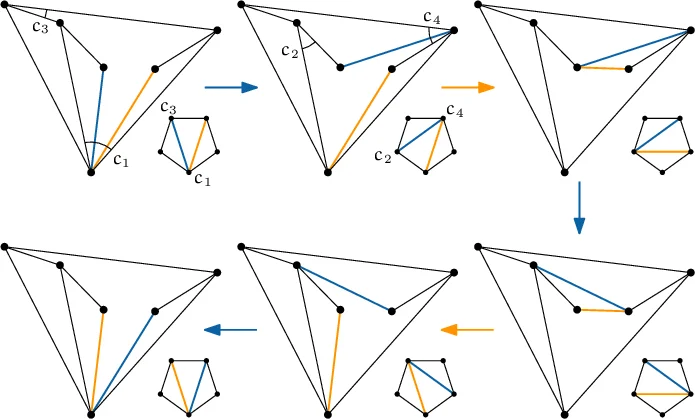
A Shuffle reorders the labels on the bottom edges. The key observation is that swapping the labels of two adjacent bottom edges can be done with O(1) exchanging flips. This is achieved by temporarily removing the two edges, which creates a pseudo‑pentagon. If the pentagon has five bitangents, the swap proceeds exactly as in a convex pentagon; if it has only four, an auxiliary flip is performed to increase the number of bitangents to five before swapping. By repeatedly applying adjacent swaps (e.g., bubble sort) the entire bottom‑edge label sequence can be sorted using O(n²) flips. The same technique, combined with a Sweep that moves top‑edge labels down to the bottom, sorts the top‑edge labels as well.
Putting these components together, any two labelled pointed pseudo‑triangulations can be transformed into each other with O(n²) exchanging flips: convert both to the left‑shelling form (O(n log n) each), perform a Shuffle to order bottom labels, a Sweep to move low labels to the bottom and high labels to the top, another Shuffle to sort each group, and finally reverse the initial conversion. The authors also prove a matching lower bound Ω(n log n) by reducing from the known lower bound for edge‑labelled triangulations of a convex polygon, which are a special case of pointed pseudo‑triangulations when all points lie on the convex hull.
The second major contribution extends the model to allow insertion and deletion flips. By using these operations, the authors achieve a tighter bound of O(n log c + h log h), where c is the number of convex layers of the point set and h is the number of hull vertices. The algorithm proceeds by first “peeling” the point set layer by layer (a process that takes O(n log c) flips) and then handling the hull vertices, which contributes the h log h term. This bound matches the Ω(n log n) lower bound in the worst case (when c = Θ(n) and h = Θ(n)), showing that the result is optimal up to constant factors.
Overall, the paper provides a comprehensive analysis of flip operations in edge‑labelled pseudo‑triangulations, establishing both upper and lower bounds for the flip distance under different operation sets. The techniques introduced—particularly the Sweep and Shuffle procedures—offer constructive ways to manipulate labels efficiently, and the results bridge the gap between labelled triangulations and the broader class of pseudo‑triangulations. This work deepens our understanding of the combinatorial structure of labelled planar graphs and may have implications for kinetic data structures, rigidity theory, and other applications where pseudo‑triangulations play a central role.
Comments & Academic Discussion
Loading comments...
Leave a Comment