The Fourth Microlensing Planet Revisited
The fourth microlensing planet, otherwise known as OGLE-2005-BLG-169Lb, was discovered by a collaboration of US, NZ, Polish and UK astronomers in 2005-2006. Recently the results were confirmed by the Hubble Space Telescope and by the Keck Observatory. OGLE-2005-BLG-169Lb is the first microlensing planet to receive such confirmation. Its discovery and confirmation are described here in an historical context.
💡 Research Summary
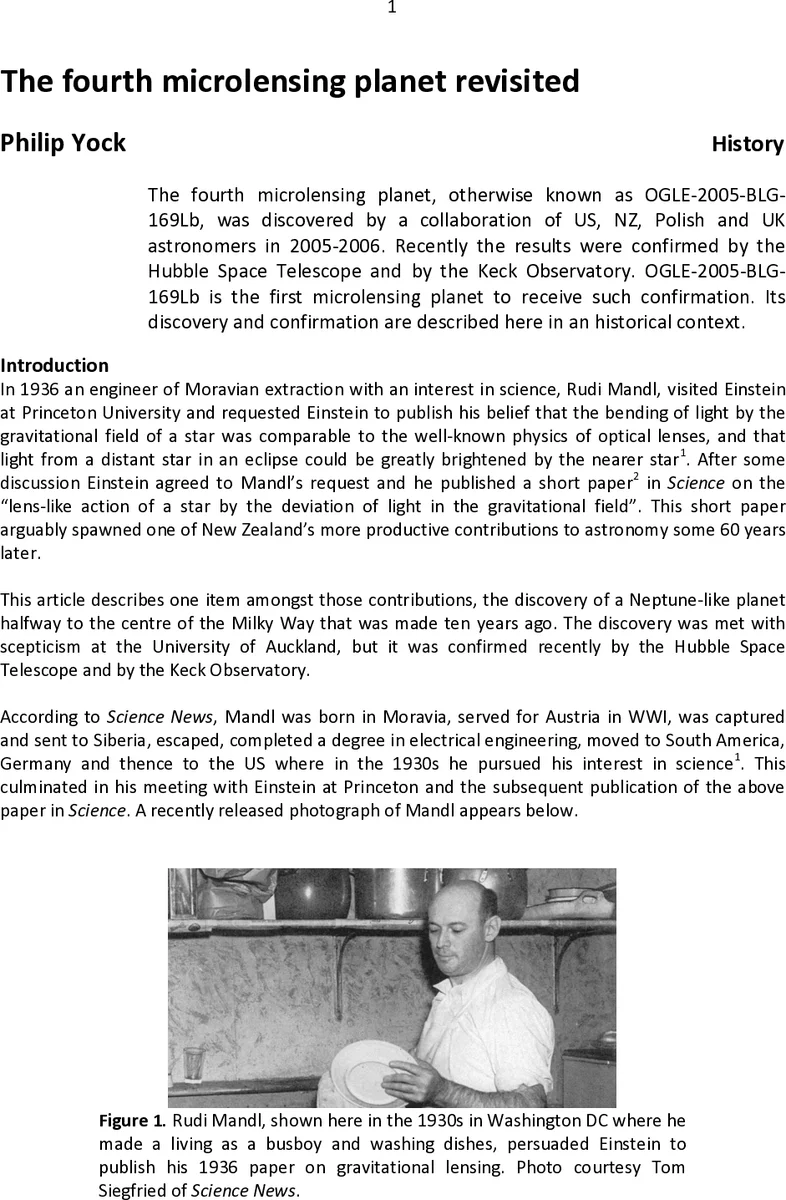
The paper “The Fourth Microlensing Planet Revisited” provides a comprehensive historical and technical account of the discovery, analysis, and subsequent confirmation of OGLE‑2005‑BLG‑169Lb, the fourth planet detected by gravitational microlensing. The narrative begins with a 1936 anecdote in which Rudi Mandl persuaded Albert Einstein to publish a short note on the lens‑like action of a star, an event that foreshadowed the modern use of gravitational lensing to detect distant planets. The authors trace the evolution of microlensing from its theoretical roots—Einstein’s light‑deflection formula Δθ = 4GM/(c²b)—to the practical implementation of wide‑field surveys such as OGLE (Optical Gravitational Lensing Experiment) in Chile and MOA (Microlensing Observations in Astrophysics) at Mt John, New Zealand.
Although the OGLE and MOA collaborations began monitoring the Galactic bulge in the early 1990s, the first microlensing planet was not identified until 2004. A key breakthrough came with the realization that high‑magnification events (where the source star passes very close to the line of sight of the lens star) are especially sensitive to planetary perturbations because planets near the Einstein ring (≈2 AU for typical lens–source geometry) can produce detectable deviations in the otherwise smooth light curve.
OGLE‑2005‑BLG‑169 was such an event, reaching a peak magnification of 800 in 2005. Multiple telescopes—OGLE’s 1.3 m in Chile, a 40 cm instrument at Auckland Observatory, the 2.4 m MDM telescope at Kitt Peak, the 2 m RoboNet telescope in Hawaii, and the 1.3 m SMARTS telescope at CTIO—collected photometric data. The MOA telescope missed the event due to a CCD gap. The combined light curve showed subtle (±1 %) deviations from a single‑lens model, hinting at a low‑mass companion.
Independent analyses were performed at the University of Auckland (Tamaki campus) and at Ohio State University (OSU). Both groups employed a ray‑shooting algorithm that traces light rays through a binary lens (star + planet) using the relativistic deflection formula. The modeling yielded two statistically indistinguishable solutions: (i) planet‑to‑star mass ratio q ≈ 8 × 10⁻⁵ with a position angle α ≈ 118°, and (ii) q ≈ 6 × 10⁻⁵ with α ≈ 89°. The best‑fit parameters implied a relative proper motion μ = 7–10 mas yr⁻¹ and an angular Einstein radius θ_E ≈ 1 mas. Assuming the lens star to be a ~0.4 M☉ red dwarf at ~4 kpc, the companion’s physical mass was initially estimated at ~0.6 M_Neptune and a projected separation of ~2.5 AU, placing it beyond the host’s snow line.
The authors note that, at the time, the lens star could not be directly resolved because it was superimposed on the source. However, the predicted proper motion suggested that after several years the two stars would separate enough to be resolved with high‑resolution imaging. This prediction was tested using the Hubble Space Telescope (HST) with the F814W filter (λ ≈ 814 nm) and the Keck Observatory with adaptive optics. By 2011 (6.5 yr after the event) HST images showed the lens and source separated by 49 mas; Keck images taken 8.2 yr after the event showed a similar separation of ~52 mas. Both measurements correspond to a divergence rate of ~7.5 mas yr⁻¹, in excellent agreement with the microlensing model.
Further analysis of the HST and Keck photometry identified the lens star as a K5 main‑sequence star with mass 0.65 ± 0.05 M☉ located at 4.0 ± 0.4 kpc. This refined the planetary parameters: mass = 0.85 ± 0.08 M_Neptune and projected separation = 3.4 ± 0.3 AU at the time of the event. The solution with q ≈ 6 × 10⁻⁵ and α ≈ 89° was confirmed as the correct one.
This work represents the first instance of a microlensing planet being confirmed through direct imaging of the lens and source separation, thereby validating the microlensing technique’s ability to detect cold, low‑mass planets that are otherwise inaccessible to radial‑velocity or transit surveys. The authors discuss the broader implications: high‑magnification microlensing events provide a powerful probe of the population of Neptune‑mass planets in the Galactic bulge, and the confirmed detection strengthens confidence in statistical studies based on microlensing surveys.
Looking forward, the paper highlights ongoing and upcoming facilities that will expand microlensing capabilities: the LCOGT network of 1 m robotic telescopes, the Korean KMTNet array of three 1.6 m wide‑field telescopes, and NASA’s planned WFIRST (now the Nancy Grace Roman Space Telescope) with a 2.4 m wide‑field imager slated for launch in the 2030s. The author also advocates for exploiting the exceptionally stable and dry Antarctic plateau for both transit and terahertz observations, suggesting that New Zealand astronomers could play a leading role in such endeavors.
In conclusion, the paper not only documents the technical journey from the initial detection of OGLE‑2005‑BLG‑169Lb to its definitive confirmation but also situates this achievement within a larger narrative of international collaboration, methodological innovation, and the continuing quest to map the diversity of planetary systems throughout our Galaxy. The author acknowledges the support of the New Zealand Marsden Fund and the contributions of numerous amateur and professional collaborators, emphasizing the importance of sustained funding for discovery‑driven science.
Comments & Academic Discussion
Loading comments...
Leave a Comment