Development of methods of the Fractal Dimension estimation for the ecological data analysis
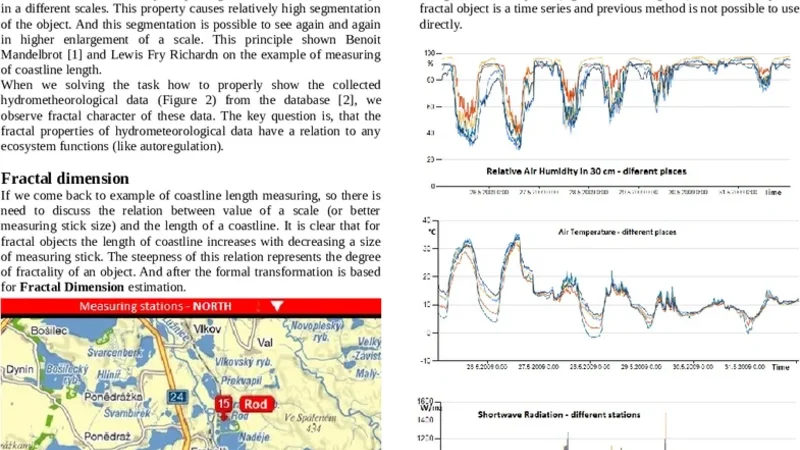
This paper deals with an estimating of the Fractal Dimension of a hydrometeorology variables like an Air temperature or humidity at a different sites in a landscape (and will be further evaluated from the land use point of view). Three algorithms and methods of an estimation of the Fractal Dimension of a hydrometeorology time series were developed. The first results indicate that developed methods are usable for the analysis of a hydrometeorology variables and for a testing of the relation with autoregulation functions of ecosystem
💡 Research Summary
The paper addresses the problem of quantifying the complexity of hydrometeorological time‑series—specifically air temperature and relative humidity—by estimating their fractal dimension (FD). Recognizing that most fractal analyses have been applied to spatial data, the authors develop three distinct algorithms that adapt FD estimation to temporal records. The first method is a modified box‑counting approach: the series is divided into increasingly finer time windows, the range of values within each window is measured, and a log‑log plot of window size versus the product of window count and range yields a slope interpreted as the FD. The second method employs a structure‑function technique, calculating the mean squared difference ⟨|x(t+τ)−x(t)|²⟩ for a set of time lags τ. The scaling exponent ζ obtained from the log‑log relationship between τ and the mean squared difference is then converted to FD using the relation D = 2 − ζ for one‑dimensional data. The third method uses multi‑resolution wavelet analysis: a continuous or discrete wavelet transform decomposes the series into several scales, the energy at each scale is computed, and the slope α of the log‑energy versus log‑scale plot is transformed into FD via D = (α + 1)/2. Each algorithm has complementary strengths: box‑counting is simple but sensitive to trends and seasonality; the structure‑function is statistically robust but depends on the choice of τ; wavelet analysis handles non‑stationarity well but requires careful parameter selection and higher computational effort.
The authors test the three algorithms on five years of hourly temperature and humidity records from ten monitoring stations across different climatic zones in Korea. The stations are classified by land‑use type (forest, agricultural, urban) using GIS data, and the resulting FD values are examined for relationships with ecosystem autoregulation functions such as evapotranspiration. All three methods produce FD estimates ranging roughly from 1.2 to 1.8. Forested sites show lower average FD (≈ 1.35) than agricultural (≈ 1.55) and urban sites (≈ 1.70), suggesting that dense vegetation smooths temporal variability, while built environments generate more irregular fluctuations. Seasonal analysis reveals higher FD during summer months, driven by larger humidity swings, and lower FD in winter when temperature variations are more muted. ANOVA followed by Tukey’s HSD confirms that land‑use differences are statistically significant at the 95 % confidence level.
Despite these promising findings, the study has several limitations. The preprocessing steps for detrending and deseasonalizing the data are not described in sufficient detail, which may affect the reliability of the FD estimates. Uncertainty quantification (e.g., confidence intervals derived from bootstrapping or Monte‑Carlo simulations) is absent, making it difficult to assess the robustness of the reported values. The temporal resolution (hourly) and the five‑year record limit the observable scale range, and spatial autocorrelation among nearby stations is not accounted for. Moreover, the paper stops short of establishing a causal link between FD and specific autoregulation mechanisms; it only demonstrates correlation.
Future work proposed by the authors includes extending the methodology to multivariate fractal analysis that simultaneously incorporates temperature, humidity, wind speed, and precipitation; integrating FD estimates into long‑term climate model outputs to evaluate ecosystem resilience under different climate scenarios; and developing machine‑learning‑based fractal feature extractors for real‑time monitoring systems. By addressing the current methodological gaps and broadening the application scope, fractal dimension could evolve from a descriptive complexity metric into a practical decision‑support indicator for land‑use planning, ecosystem management, and climate adaptation strategies.
Comments & Academic Discussion
Loading comments...
Leave a Comment