Science Use in Regulatory Impact Analysis: The Effects of Political Attention and Controversy
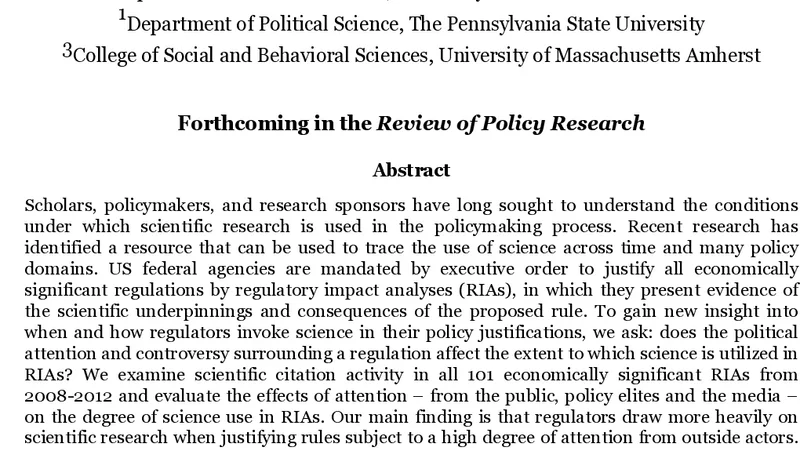
Scholars, policymakers, and research sponsors have long sought to understand the conditions under which scientific research is used in the policymaking process. Recent research has identified a resource that can be used to trace the use of science across time and many policy domains. US federal agencies are mandated by executive order to justify all economically significant regulations by regulatory impact analyses (RIAs), in which they present evidence of the scientific underpinnings and consequences of the proposed rule. To gain new insight into when and how regulators invoke science in their policy justifications, we ask: does the political attention and controversy surrounding a regulation affect the extent to which science is utilized in RIAs? We examine scientific citation activity in all 101 economically significant RIAs from 2008-2012 and evaluate the effects of attention – from the public, policy elites and the media – on the degree of science use in RIAs. Our main finding is that regulators draw more heavily on scientific research when justifying rules subject to a high degree of attention from outside actors. These findings suggest that scientific research plays an important role in the justification of regulations, especially those that are highly salient to the public and other policy actors.
💡 Research Summary
This study investigates how external political attention influences the extent to which federal agencies cite scientific research in Regulatory Impact Analyses (RIAs), the mandated documents that justify economically significant regulations in the United States. The authors assembled a complete sample of 101 RIAs issued between 2008 and 2012, a period marked by heightened emphasis on evidence‑based policymaking. For each RIA they counted the number of peer‑reviewed scientific articles referenced, using this count as a quantitative proxy for “science use.”
Political attention was operationalized along three dimensions: public attention (measured through petitions, public comment volumes, and citizen‑group submissions), elite attention (captured by congressional hearings, committee reports, and formal requests from legislators), and media attention (derived from the number of newspaper articles, article length, and keyword frequency in major U.S. outlets). Each indicator was standardized to allow comparison across years and policy domains.
Because citation counts are discrete and over‑dispersed, the authors employed a negative‑binomial regression model. Control variables included regulatory sector (environment, health, finance, energy, etc.), estimated budgetary impact, rule type (mandatory versus advisory), and year fixed effects. Multicollinearity diagnostics (VIF < 2) confirmed that the independent variables were not excessively correlated.
The regression results reveal a robust, positive relationship between all three forms of political attention and the number of scientific citations. Media attention exhibits the largest coefficient, indicating that rules that attract substantial press coverage are accompanied by a markedly higher reliance on scientific literature. Elite attention also shows a strong positive effect, suggesting that congressional scrutiny or formal legislative inquiries prompt agencies to bolster their justifications with peer‑reviewed evidence. Public attention is statistically significant but its magnitude is comparatively modest, implying that direct citizen pressure influences science use primarily through its amplification in the media and elite channels.
These findings support the view that scientific research functions as a strategic resource rather than a passive input in the regulatory process. Agencies appear to increase the visibility of scientific evidence when a rule is politically salient, likely to mitigate legal challenges, enhance legitimacy, and satisfy demands from oversight bodies. The study contributes to the literature on evidence‑based policymaking by providing the first large‑scale, quantitative assessment of how external political dynamics shape the citation behavior of regulators.
Nevertheless, the authors acknowledge several limitations. First, counting citations does not capture the quality or relevance of the cited work; future work could weight citations by journal impact or citation frequency. Second, the construction of political attention indices relies on available data sources and may omit informal channels such as social media or lobbying activities. Third, the analysis does not link scientific citation intensity to actual regulatory outcomes, leaving open the question of whether greater science use translates into more effective or efficient regulations.
The paper concludes by emphasizing that scientific evidence plays a pivotal role in the justification of high‑profile regulations. Policymakers and scholars should recognize that the deployment of science is responsive to external pressures, and that strengthening mechanisms for transparent, high‑quality scientific input could improve the overall credibility and performance of the regulatory system.
Comments & Academic Discussion
Loading comments...
Leave a Comment