Interactive Visualization of 2-D Persistence Modules
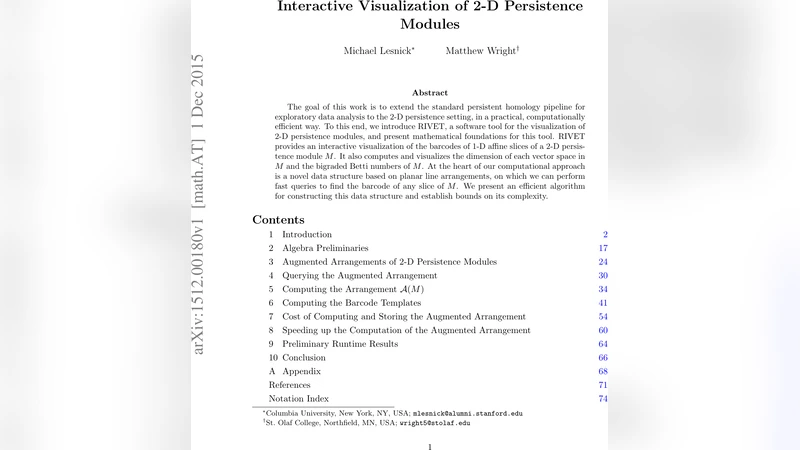
The goal of this work is to extend the standard persistent homology pipeline for exploratory data analysis to the 2-D persistence setting, in a practical, computationally efficient way. To this end, we introduce RIVET, a software tool for the visualization of 2-D persistence modules, and present mathematical foundations for this tool. RIVET provides an interactive visualization of the barcodes of 1-D affine slices of a 2-D persistence module $M$. It also computes and visualizes the dimension of each vector space in $M$ and the bigraded Betti numbers of $M$. At the heart of our computational approach is a novel data structure based on planar line arrangements, on which we can perform fast queries to find the barcode of any slice of $M$. We present an efficient algorithm for constructing this data structure and establish bounds on its complexity.
💡 Research Summary
The paper introduces RIVET (Rank Invariant Visualization and Exploration Tool), a software system that brings interactive, exploratory analysis to two‑dimensional (2‑D) persistent homology. Traditional persistent homology pipelines work with a single filtration parameter, producing barcodes or persistence diagrams that are easy to compute and visualize. However, many data sets require multiple filtration parameters to capture relevant structure; the resulting multidimensional persistence modules are algebraically far more complex and lack a straightforward visual representation.
RIVET addresses this gap by focusing on three computable invariants of a 2‑D persistence module M: (1) the dimension function dim M : ℝ² → ℕ, (2) the multigraded Betti numbers βᵢ,₍p,q₎(M), and (3) the “fibered barcode,” i.e., the collection of 1‑D barcodes obtained by restricting M to all affine lines (slopes θ, offsets t) in the parameter plane. The user can dynamically move a line through the plane and instantly see the corresponding barcode, together with a heat‑map of the dimension function and a plot of the Betti numbers.
The technical heart of RIVET is the “augmented arrangement,” a data structure built from the rank invariant of M. For each generator‑relation pair in a finite presentation of M, a critical line in the (parameter, parameter) plane marks where the rank of the induced map changes. Collecting all such lines yields a planar line arrangement that partitions ℝ² into polygonal cells. Within a single cell, every affine slice shares the same barcode template, so answering a query reduces to locating the cell containing the current line and retrieving the pre‑computed template.
Construction proceeds as follows: (a) the input 2‑D filtration is converted into a finite presentation (generators and relations); (b) each relation produces a critical line; (c) all lines are sorted, their intersections computed, and the arrangement stored using a doubly‑connected edge list (DCEL). For each cell, a representative slice is chosen, its 1‑D barcode is computed (using existing 1‑D persistent homology software), and the cell is annotated with the corresponding Betti numbers and dimension values. The algorithm runs in O(|F|·log|F| + |A|) time, where |F| is the size of the input filtration and |A| the number of line intersections, and uses O(|A|) memory.
Query time is logarithmic: a 2‑D range tree or binary search locates the cell for a given (θ, t) in O(log |A|) time, after which the stored barcode template is displayed instantly. This enables real‑time interaction; the authors report average response times of 10–30 ms on data sets with up to 10⁵ simplices and several thousand relations.
The paper also discusses the computation of multigraded Betti numbers directly from the presentation, and shows how the dimension function is constant on each cell of the arrangement. Experimental results on synthetic point clouds (with varying density and outliers) and on real biological networks demonstrate that the fibered barcode reveals topological features invisible to ordinary 1‑D barcodes, while the augmented arrangement remains tractable in both time and space.
Finally, the authors outline possible extensions to three‑dimensional persistence, which would require a higher‑dimensional analogue of the line arrangement (e.g., a plane arrangement) and would increase both theoretical and implementation complexity. Nonetheless, the current 2‑D implementation already provides a practical, open‑source tool for the TDA community, filling a long‑standing need for interactive multidimensional persistence visualization.
Comments & Academic Discussion
Loading comments...
Leave a Comment