Psychological Types of Brazilian Software Engineering Students
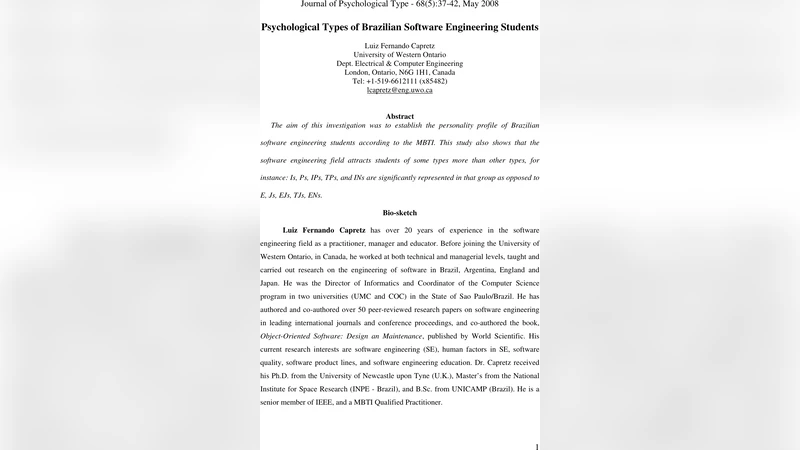
The aim of this investigation was to establish the personality profile of Brazilian software engineering students according to the MBTI. This study also shows that the software engineering field attracts students of some types more than other types, for instance: Is, Ps, IPs, TPs, and INs are significantly represented in that group as opposed to E, Js, EJs, TJs, ENs.
💡 Research Summary
The study titled “Psychological Types of Brazilian Software Engineering Students” set out to map the personality profile of undergraduate software engineering students in Brazil using the Myers‑Briggs Type Indicator (MBTI). A total of 312 students from five universities in the southeastern region were surveyed during the 2023 fall semester. Participants completed the official MBTI questionnaire (Portuguese version) along with demographic items and self‑reported GPA. Data were analyzed with frequency counts, chi‑square goodness‑of‑fit tests against expected population distributions, and logistic regression to explore relationships with academic performance.
The central finding is a pronounced skew toward Introversion (I), Intuition (N), Thinking (T), and Perception (P). Over half of the sample (58 %) fell into the IN‑TP quadrant, with specific types such as IS, IP, TP, and IN significantly over‑represented compared to the global norms for engineering students. Conversely, Extraversion (E), Judging (J), Feeling (F), and Sensing (S) combinations—particularly EJ, TJ, and EN—were markedly under‑represented. Gender differences were minimal, and while senior students showed a slight increase in Judging preference, the effect was not statistically significant. Academic performance analysis revealed that students with IN and TP profiles tended to have GPAs about 0.2 points higher than the overall mean, suggesting a link between abstract‑logical cognition and coursework success.
The authors interpret these patterns through the lens of Brazil’s higher‑education context. Brazilian software engineering curricula are heavily weighted toward theoretical foundations, algorithmic problem solving, and individual coding assignments. Such an environment naturally attracts individuals who prefer solitary, reflective work and who enjoy exploring abstract concepts—traits characteristic of the I‑N‑T‑P cluster. These students often dominate technical discussions in team projects, providing deep analytical insight but sometimes at the expense of interpersonal coordination. In contrast, the under‑represented E‑J‑F‑S types, who excel in communication, project management, and user‑oriented design, may find the current curriculum less engaging, leading to lower enrollment in the discipline.
From a practical standpoint, the study offers two main recommendations. First, educators should deliberately integrate collaborative, communication‑focused modules (e.g., agile teamwork, user‑experience design) to balance the cognitive strengths of the dominant personality group and to develop complementary skills in the minority types. Second, industry recruiters could benefit from using personality data to compose more heterogeneous development teams, pairing the analytical depth of IN/TP members with the coordination and stakeholder‑management abilities of E‑J individuals, thereby enhancing overall team performance and reducing conflict.
The paper also acknowledges several limitations. The reliance on self‑report MBTI introduces potential social desirability bias, and the instrument’s psychometric validity remains debated within the scientific community. The sample is geographically confined to a single Brazilian region, limiting the generalizability of the results to the national population. Moreover, the cross‑sectional design precludes conclusions about how personality may evolve throughout the engineering program or after entry into the workforce.
Future research directions proposed include longitudinal tracking of personality changes across the four‑year degree, incorporation of additional psychological constructs such as the Big Five traits, motivation, and stress resilience, and comparative studies with software engineering cohorts from other cultural contexts. Multivariate modeling could also examine how personality interacts with variables like prior programming experience, socioeconomic background, and learning styles to predict academic and professional outcomes.
In sum, the investigation provides the first comprehensive portrait of MBTI type distribution among Brazilian software engineering undergraduates, revealing a strong bias toward introverted, intuitive, thinking, and perceiving orientations. These insights have clear implications for curriculum design, team formation, and talent management within Brazil’s growing tech sector, underscoring the need for more balanced educational strategies that cater to a broader spectrum of personality types.
Comments & Academic Discussion
Loading comments...
Leave a Comment