Algebraic K-theory over the infinite dihedral group: a controlled topology approach
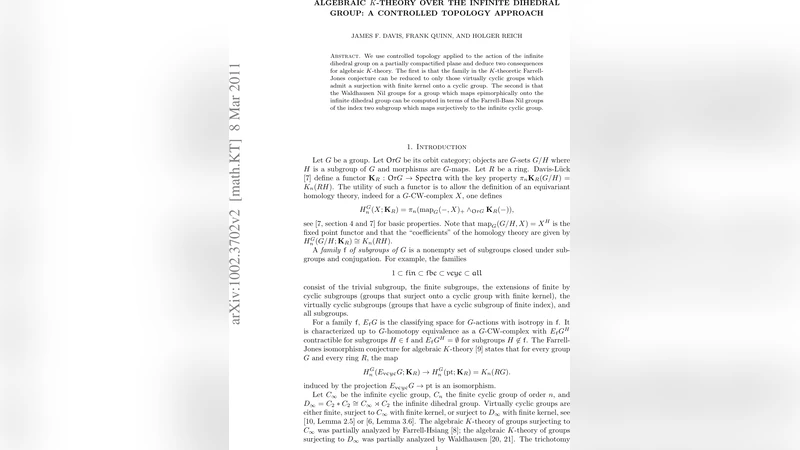
We use controlled topology applied to the action of the infinite dihedral group on a partially compactified plane and deduce two consequences for algebraic K-theory. The first is that the family in the K-theoretic Farrell-Jones conjecture can be reduced to only those virtually cyclic groups which admit a surjection with finite kernel onto a cyclic group. The second is that the Waldhausen Nil groups for a group which maps epimorphically onto the infinite dihedral group can be computed in terms of the Farrell-Bass Nil groups of the index two subgroup which maps surjectively to the infinite cyclic group.
💡 Research Summary
The paper studies the algebraic K‑theory of groups that map onto the infinite dihedral group (D_{\infty}) by using a controlled‑topology framework. The authors begin by observing that (D_{\infty}= \mathbb Z\rtimes C_{2}) acts naturally on the Euclidean plane (\mathbb R^{2}) by a reflection and a translation. By partially compactifying the plane (for example, adding a circle at infinity) they obtain a space (\overline{\mathbb R^{2}}) on which the action extends continuously and, crucially, becomes “controlled”: the infinite orbits accumulate only at the added boundary, while the interior consists of finitely many equivariant cells. This controlled model provides a classifying space (E_{\mathcal F}D_{\infty}) for a family (\mathcal F) of subgroups that is much smaller than the full family of virtually cyclic subgroups (\mathcal{VCYC}).
The first major result concerns the Farrell–Jones conjecture (FJC) for algebraic K‑theory. The conjecture predicts that the assembly map \
Comments & Academic Discussion
Loading comments...
Leave a Comment