Exploiting Environmental Computation in a Multi-Agent Model of Slime Mould
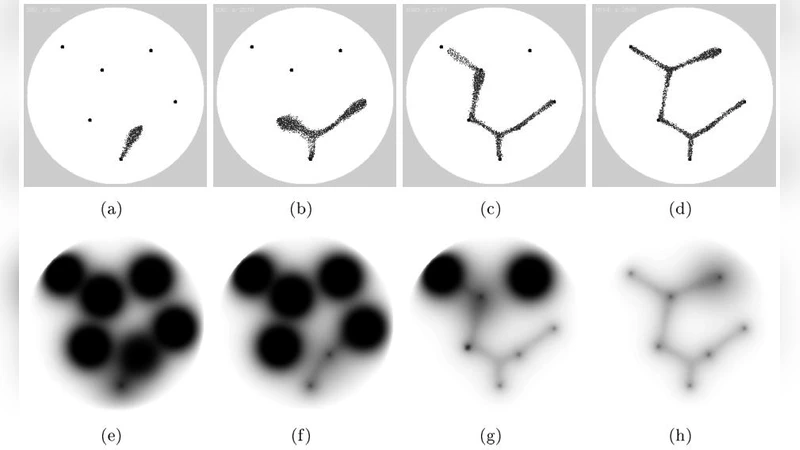
Very simple organisms, such as the single-celled amoeboid slime mould Physarum polycephalum possess no neural tissue yet, despite this, are known to exhibit complex biological and computational behaviour. Given such limited resources, can environmental stimuli play a role in generating the complexity of slime mould behaviour? We use a multi-agent collective model of slime mould to explore a two-way mechanism where the collective behaviour is influenced by simulated chemical concentration gradient fields and, in turn, this behaviour alters the spatial pattern of the concentration gradients. This simple mechanism yields complex behaviour amid the dynamically changing gradient profiles and suggests how the apparently intelligent response of the slime mould could possibly be due to outsourcing of computation to the environment.
💡 Research Summary
The paper investigates how the acellular slime mould Physarum polycephalum can display sophisticated problem‑solving behavior without any nervous system, proposing that the environment itself performs a substantial part of the computation. The authors construct a multi‑agent model in which a continuous chemical concentration field (representing nutrients, attractants, or pheromones) diffuses and decays across a two‑dimensional lattice. Simple agents sense the local gradient of this field, move preferentially up‑gradient, and deposit or consume chemicals along their trajectories, thereby altering the field. This creates a two‑way coupling: the agents are guided by the gradient, and their collective motion reshapes the gradient.
Two experimental regimes are explored. In the first, a static nutrient gradient is imposed. Starting from random positions, agents converge on high‑concentration regions, forming a network of virtual tubes that progressively reinforces the shortest, highest‑flux paths while pruning weaker connections. The emergent network closely matches the minimum‑spanning‑tree structures observed in laboratory Physarum experiments, demonstrating that the model reproduces classic foraging and transport optimization without any explicit global planning algorithm.
In the second regime, the nutrient landscape is dynamic: sources are added or removed during the simulation. When a new source appears, the local concentration spikes, generating a new gradient that rapidly attracts agents. Existing connections are re‑routed toward the new source, and obsolete links decay as the field around removed sources diminishes. Over time the system settles into a new efficient network that integrates the updated resource distribution. Quantitative metrics (total network length, node degree distribution, convergence time) show that while dynamic scenarios incur a modest initial delay, the final network efficiency is comparable to or better than the static case.
The analysis highlights three key insights. First, the environment functions as an external computational substrate; agents need only simple, local rules to achieve globally optimal outcomes. Second, the feedback loop between agents and the field introduces non‑linear dynamics that give rise to complex emergent behavior such as branch selection, loop elimination, and adaptive reconnection. Third, by tuning diffusion coefficients, decay rates, and agent sensitivity, the model can reproduce a spectrum of behaviors ranging from rapid exploratory spreading to stable, low‑cost transport networks.
Beyond biological explanation, the authors argue that this “environmental computation” paradigm has practical implications for engineered systems. Swarm robotics, distributed sensor networks, and unconventional computing architectures could exploit ambient physical fields (chemical, thermal, electromagnetic) to off‑load intensive calculations, achieving robust, scalable, and adaptive performance with minimal onboard processing.
In conclusion, the study provides strong computational evidence that the apparently intelligent behavior of Physarum may largely stem from a symbiotic relationship with its chemical environment. By externalizing part of the computation, the organism leverages simple, decentralized agents to solve complex spatial problems, offering a fresh perspective on biological intelligence and a promising blueprint for bio‑inspired engineering.