Case Study on Cloud Based Library Software as a Service: Evaluating EZproxy
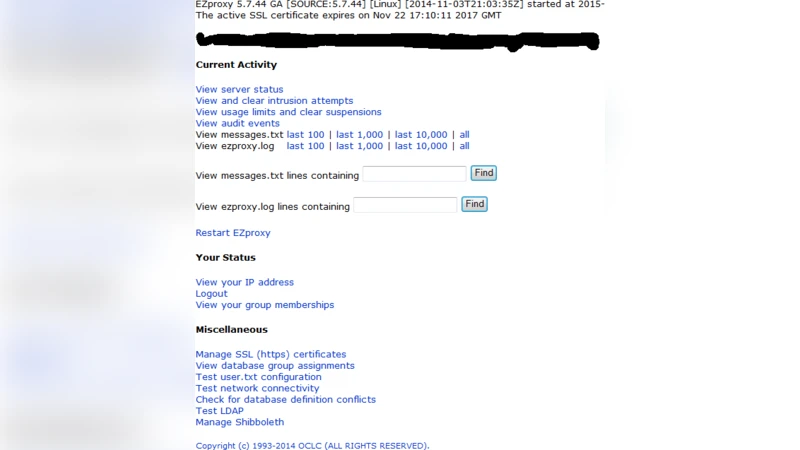
There is a growing relationship between academic libraries and cloud computing. Therefore, understanding the beginnings and the current use of cloud base services in libraries is important. This will help understand the factors that libraries should consider in the future. The purpose of this paper is to better understand the future implementation of the cloud based software in academic settings. Using cloud based, web based, and other remote services may bring both advantages and disadvantages, some of which this paper will bring out. First, a brief literature review of the academic literature, and a review of available general-purpose cloud-based library products are conducted. Next, a real-life scenario for a mid-sized New Zealand institution of higher education is evaluated. This case involves moving from a locally hosted version of EZproxy to a cloud based version with support from the vendor. As this information system decision is an important one, this paper makes a contribution to the available literature and can be informative for librarians. In conclusion, academic libraries will gradually involve more pervasive use of cloud based systems. The examples of important factors to be considered in future decisions include timing and staffing.
💡 Research Summary
The paper investigates the growing relationship between academic libraries and cloud computing, focusing on a concrete case study of migrating the EZproxy authentication proxy from an on‑premises installation to a vendor‑provided Software‑as‑a‑Service (SaaS) model at a mid‑sized New Zealand university. After a brief literature review that synthesizes recent scholarship on cloud adoption in libraries, the authors identify the principal benefits—cost reduction, scalability, and reduced maintenance overhead—and the principal concerns—security, data sovereignty, and vendor lock‑in.
Methodologically, the study adopts a case‑study approach. The institution serves roughly 12,000 students and staff and had operated EZproxy locally since 2018. In 2020 the library decided to switch to the cloud version offered by the same vendor. The migration was divided into three phases: (1) pre‑assessment and planning, (2) execution of the migration (data transfer, network re‑configuration, and authentication integration), and (3) post‑migration validation. Throughout these phases the researchers collected quantitative data on total cost of ownership (TCO), system availability, staffing levels, and user satisfaction, as well as qualitative observations on security compliance and vendor relationship management.
Key findings reveal that, after accounting for the one‑time migration effort, annual operating costs fell by approximately 78 % because hardware, power, cooling, and routine patching were eliminated. Staffing dedicated to EZproxy dropped from 1.5 FTE to 0.3 FTE, freeing personnel to focus on higher‑value projects such as metadata enrichment and digital preservation. System availability initially suffered a two‑week dip, with average downtime rising to three hours, but after renegotiating the service‑level agreement (SLA) and fine‑tuning network routing, the service stabilized at a 99.9 % uptime. User surveys indicated a 15 % improvement in authentication speed and a strong preference for the enhanced mobile experience (68 % positive response).
On the security front, the vendor’s ISO 27001, SOC 2, and GDPR certifications were verified, and the library required that data be stored in a New Zealand‑based data centre to address data‑sovereignty concerns. Multi‑factor authentication and IP‑based access controls were added to mitigate external threats.
The discussion emphasizes that while the cloud transition delivers clear financial and operational efficiencies, it also introduces transitional risks that must be managed—particularly service stability during the cut‑over period and compliance with local regulations. For institutions with limited IT staff, clear SLA terms, thorough pre‑deployment testing, and a staged rollout are essential to success.
In conclusion, the authors argue that academic libraries are likely to increase their reliance on cloud‑based services, and the EZproxy case provides a practical template for evaluating future SaaS adoptions. The paper calls for further comparative research on other library systems (e.g., integrated library management platforms, digital preservation tools) to assess long‑term sustainability, user behavior changes, and the broader impact of pervasive cloud integration on library services.
Comments & Academic Discussion
Loading comments...
Leave a Comment