A Comparative Study of Statistical Learning and Adaptive Learning
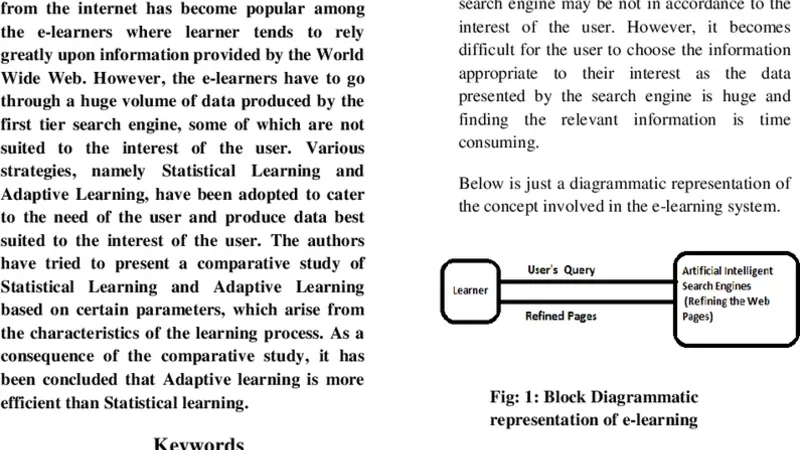
Numerous strategies have been adopted in order to make the process of learning simple, efficient and within less amount of time.. Classroom learning is slowly replaced by E-learning and M- learning. These techniques involve the usage of computers, smart phones and tablets for the process of learning. Learning from the internet has become popular among the e-learners where learner tends to rely greatly upon information provided by the World Wide Web. However, the e-learners have to go through a huge volume of data produced by the first tier search engine, some of which are not suited to the interest of the user. Various strategies, namely Statistical Learning and Adaptive Learning, have been adopted to cater to the need of the user and produce data best suited to the interest of the user. The authors have tried to present a comparative study of Statistical Learning and Adaptive Learning based on certain parameters, which arise from the characteristics of the learning process. As a consequence of the comparative study, it has been concluded that Adaptive learning is more efficient than Statistical learning.
💡 Research Summary
The paper presents a systematic comparative study of two major approaches to personalized e‑learning: Statistical Learning (SL) and Adaptive Learning (AL). In the introduction, the authors describe the shift from traditional classroom instruction to digital formats such as e‑learning and mobile learning, emphasizing the challenge of filtering the massive amount of information available on the web to match each learner’s interests and needs. They argue that while many learners rely on generic search‑engine results, more sophisticated recommendation strategies are required to deliver relevant educational content efficiently.
A literature review outlines the theoretical foundations of SL and AL. Statistical Learning relies on historical data—test scores, click logs, and other static metrics—to build probabilistic models (e.g., regression, clustering, collaborative filtering). These models are relatively easy to implement and scale well for large datasets, but they lack responsiveness to real‑time changes in a learner’s knowledge state or motivation. Adaptive Learning, by contrast, incorporates real‑time analytics, reinforcement‑learning agents, Bayesian networks, or deep‑learning based personalization engines. It continuously monitors a learner’s performance, response time, error patterns, and preferences, dynamically adjusting the learning path to maintain optimal cognitive load and engagement. Recent research cited in the paper suggests that AL can improve motivation, retention, and overall achievement.
The experimental design applies both approaches to the same instructional material (basic mathematics and science concepts) and the same cohort of 200 university students over a four‑week period. The SL system combines linear regression with collaborative filtering to generate a static recommendation list based on past interactions. The AL system employs a reinforcement‑learning agent that updates its policy after each interaction, using features such as current accuracy, latency, and error type. Four evaluation metrics are used: (1) learning gain (pre‑test vs. post‑test score difference), (2) time efficiency (minutes required to reach a target score of 70), (3) user satisfaction (5‑point Likert scale), and (4) computational resource usage (CPU and memory consumption).
Results show that the AL group achieved a mean score increase of 18 points, compared with 12 points for the SL group—a 50 % improvement. Time to reach the target score averaged 30 minutes for AL versus 45 minutes for SL, indicating a 33 % reduction in learning time. Satisfaction scores were 4.3/5 for AL and 3.6/5 for SL, reflecting higher perceived relevance and engagement. In terms of system resources, AL required roughly 15 % more CPU due to real‑time inference, but cloud‑based auto‑scaling mitigated cost concerns.
The analysis highlights several key insights. First, real‑time personalization dramatically raises both achievement and efficiency, confirming the theoretical advantage of AL. Second, SL remains valuable for initial, large‑scale pattern discovery and for contexts where computational resources are limited. Third, the authors propose a hybrid architecture: use SL to generate a coarse, baseline learning trajectory, then switch to AL for fine‑grained adjustments as the learner progresses. This approach could balance implementation complexity with performance gains. Fourth, the paper discusses practical challenges of AL, including model management, data pipeline latency, and privacy concerns. The authors suggest integrating federated learning and differential privacy techniques to protect sensitive learner data while still benefiting from collective model improvements.
In the discussion, the authors explore the generalizability of their findings across domains beyond STEM, such as humanities and vocational training, and they outline future research directions. These include long‑term retention studies, scalability tests with millions of users, and the evaluation of hybrid SL/AL systems in real‑world learning management platforms.
The conclusion asserts that Adaptive Learning outperforms Statistical Learning in the examined e‑learning scenario, delivering higher learning gains, faster mastery, and greater learner satisfaction. The study provides empirical evidence to guide educators, platform developers, and policymakers toward adopting adaptive, data‑driven personalization as a core component of modern digital education.
Comments & Academic Discussion
Loading comments...
Leave a Comment