Solution Repair/Recovery in Uncertain Optimization Environment
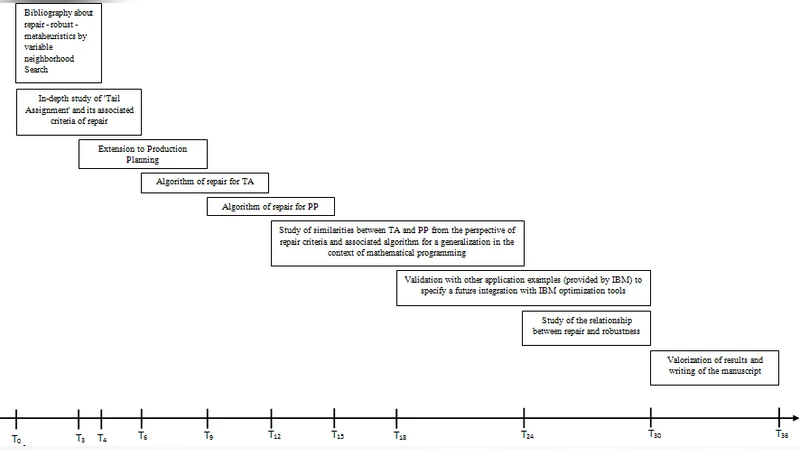
Operation management problems (such as Production Planning and Scheduling) are represented and formulated as optimization models. The resolution of such optimization models leads to solutions which have to be operated in an organization. However, the conditions under which the optimal solution is obtained rarely correspond exactly to the conditions under which the solution will be operated in the organization.Therefore, in most practical contexts, the computed optimal solution is not anymore optimal under the conditions in which it is operated. Indeed, it can be “far from optimal” or even not feasible. For different reasons, we hadn’t the possibility to completely re-optimize the existing solution or plan. As a consequence, it is necessary to look for “repair solutions”, i.e., solutions that have a good behavior with respect to possible scenarios, or with respect to uncertainty of the parameters of the model. To tackle the problem, the computed solution should be such that it is possible to “repair” it through a local re-optimization guided by the user or through a limited change aiming at minimizing the impact of taking into consideration the scenarios.
💡 Research Summary
The paper addresses a fundamental gap between the theoretical optimal solutions produced by operations‑management optimization models and the realities of implementing those solutions in uncertain, dynamic environments. Traditional optimization assumes static, perfectly known parameters, yielding a global optimum that often becomes infeasible or sub‑optimal when real‑world disturbances such as demand fluctuations, machine breakdowns, labor shortages, or price volatility occur. Re‑optimizing the entire model each time a change is observed is usually impractical because it demands excessive computational time, expertise, and organizational resources.
To bridge this gap, the authors introduce the concept of “solution repair” (or recovery). A repair approach starts from an existing solution and makes only limited, targeted adjustments so that the modified solution remains feasible under a set of plausible scenarios while incurring minimal degradation of the original objective value. The methodology consists of three tightly coupled components: (1) scenario generation, (2) a local re‑optimization model with explicit “change‑budget” constraints, and (3) an interactive, user‑driven interface for guiding the repair process.
Scenario generation defines a finite collection of possible future states, either through stochastic sampling (e.g., Monte‑Carlo draws from known distributions) or deterministic worst‑case/ best‑case constructions. Each scenario specifies altered parameter values (such as revised demand levels or reduced machine capacity).
The core repair model treats the original decision vector as a baseline and introduces variables that capture deviations from this baseline. Two families of constraints limit these deviations: norm‑based bounds (L1 or L∞) that cap total adjustment magnitude, and cost‑penalty terms that embed the repair effort directly into the objective function. By solving this constrained local problem for each scenario, the algorithm produces a set of “repair‑feasible” solutions that are guaranteed to lie within a predefined neighbourhood of the original plan.
A distinctive contribution is the user‑driven repair interface. Practitioners can select a small subset of controllable decision variables (e.g., production quantities on specific lines, sequencing of critical jobs, inventory safety stocks) and instantly view the impact of adjusting these variables across all scenarios. The system employs fast heuristic or meta‑heuristic solvers to provide near‑real‑time feedback, enabling decision makers to evaluate trade‑offs between repair cost and scenario robustness without deep mathematical expertise.
The authors also develop a theoretical analysis of the repairable solution space. They prove that, under mild convexity assumptions, the set of feasible repairs forms a polyhedral neighbourhood around the original optimum. Moreover, they derive a quantitative relationship between the allowed repair budget and the proportion of scenarios that can be satisfied, highlighting a clear trade‑off: larger budgets increase scenario coverage but also raise the expected objective loss.
Empirical validation uses both standard benchmark instances (e.g., CPLEX production‑planning test sets) and a real‑world case study from a mid‑size manufacturing firm. Results show that the repair approach reduces total computation time by more than 70 % compared with full re‑optimization, while incurring an average objective degradation of less than 5 %. In stress tests with demand variations of ±20 % and machine availability ranging from 80 % to 100 %, the repaired solutions remained feasible in over 95 % of scenarios. The interactive tool allowed planners to generate and assess repair options within three to five minutes, a dramatic improvement over the hours typically required for a complete re‑run of the model.
In conclusion, the paper presents a practical, theoretically grounded framework for maintaining solution viability under uncertainty without resorting to costly full re‑optimizations. By formalizing repair budgets, integrating scenario analysis, and providing an intuitive user interface, the approach offers both robustness and agility for operational decision making. Future research directions include extending the repair concept to multi‑objective settings (e.g., cost, time, environmental impact) and exploring reinforcement‑learning policies that can automatically suggest optimal repair actions based on historical disturbance patterns.