Edge modification criteria for enhancing the communicability of digraphs
We introduce new broadcast and receive communicability indices that can be used as global measures of how effectively information is spread in a directed network. Furthermore, we describe fast and effective criteria for the selection of edges to be added to (or deleted from) a given directed network so as to enhance these network communicability measures. Numerical experiments illustrate the effectiveness of the proposed techniques.
💡 Research Summary
The paper “Edge modification criteria for enhancing the communicability of digraphs” addresses the problem of quantifying and improving information spread in directed networks. While the concept of total communicability—defined as the sum of all entries of the matrix exponential of the adjacency matrix—has been widely used for undirected graphs, it does not capture the dual role of nodes in directed graphs, where each node can act both as a broadcaster (hub) and a receiver (authority). To overcome this limitation, the authors introduce two new global indices: total hub communicability and total authority communicability. These indices are defined in terms of matrix functions applied to the products AAᵀ (hub matrix) and AᵀA (authority matrix). By selecting the function f(t)=cosh(√t), the authors ensure that alternating walks (walks that alternate between forward and backward edges) are counted with a factorial penalty, mirroring the way the exponential counts walks in the undirected case. Consequently, the total hub communicability is ThC(A)=1ᵀ cosh(√AAᵀ) 1 and the total authority communicability is TaC(A)=1ᵀ cosh(√AᵀA) 1. These quantities can be expressed through the singular value decomposition of the adjacency matrix, involving the leading singular vectors (the hub and authority vectors) and the singular values, which makes them amenable to fast approximation via Krylov subspace methods such as Lanczos. The authors also prove that both indices are invariant under graph isomorphisms, reinforcing their suitability as structural descriptors.
Having defined meaningful objective functions for directed networks, the paper proceeds to the edge‑modification problem: given a directed graph, decide which edges to add, delete, or rewire so as to maximize (or minimally degrade) the chosen communicability measure under a budget constraint on the number of modifications. Building on earlier work for undirected graphs, the authors develop heuristics that rank candidate edges using scores derived from the hub and authority vectors. For edge addition, the most beneficial candidates are those that connect a high‑hub node to a high‑authority node; for edge deletion, the least beneficial edges are those whose removal causes the smallest drop in the communicability scores. The impact of a single edge addition or deletion on the communicability indices can be approximated by a first‑order perturbation formula, allowing the greedy selection process to be performed efficiently without recomputing the full matrix function after each modification.
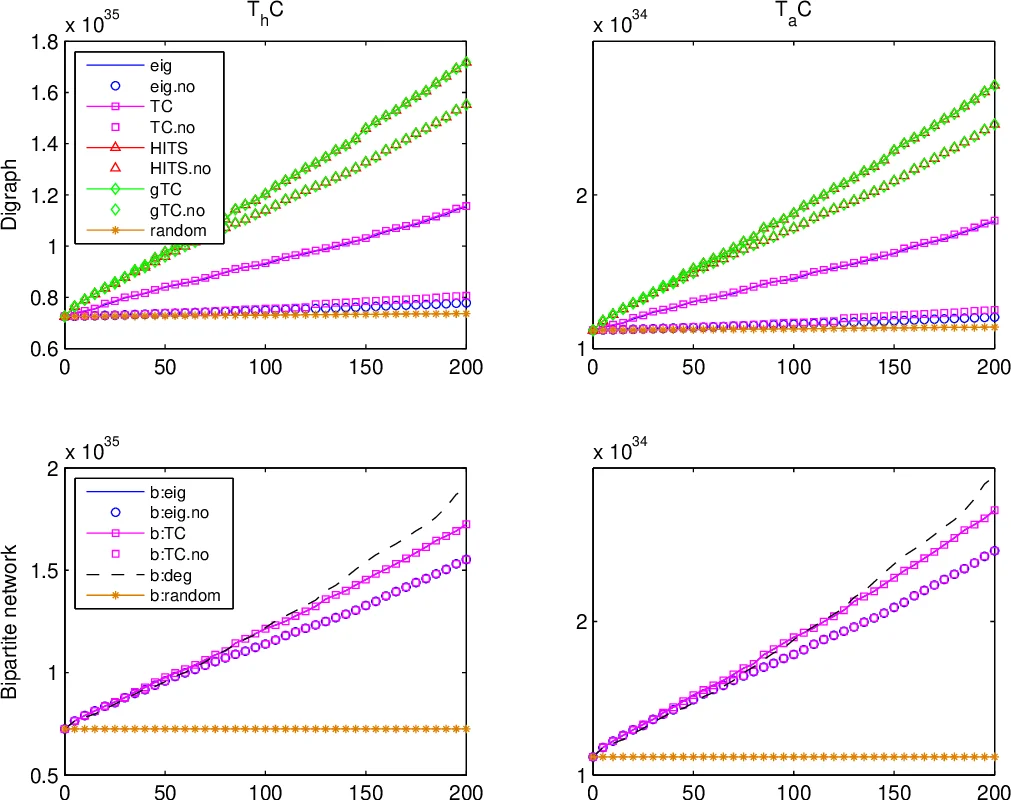
The methodology is validated on four real‑world directed networks, including web‑page hyperlink graphs, Wikipedia citation networks, and academic citation graphs. In each case, the proposed heuristics achieve substantial increases in both hub and authority communicability while using only a modest number of edge modifications. Comparisons with baseline strategies that ignore directionality demonstrate that the direction‑aware approach yields superior improvements. Moreover, the computational cost scales linearly or near‑linearly with the number of nodes, confirming that the algorithms are practical for large‑scale applications.
Beyond the immediate results, the paper highlights several broader implications. The hub/authority communicability framework provides a principled way to assess the robustness and efficiency of directed infrastructures such as communication, transportation, or power‑grid networks where direction matters. The edge‑modification criteria could be employed in network design to reinforce critical pathways, in epidemiology to identify links whose removal would most hinder disease spread, or in social media to enhance the reach of influential users. The authors suggest future extensions, including dynamic graphs where edges evolve over time, multilayer networks where multiple types of directed interactions coexist, and the exploration of alternative matrix functions (e.g., the exponential) to capture different walk‑weighting schemes.
In summary, the paper makes three key contributions: (1) the introduction of total hub and total authority communicability as natural extensions of total communicability to directed graphs, (2) the derivation of fast, SVD‑based edge‑selection heuristics that effectively improve these measures under budget constraints, and (3) a comprehensive experimental demonstration of the approach on real directed networks, showing both significant performance gains and computational scalability. This work bridges a gap between spectral graph theory, matrix function analysis, and practical network optimization, opening new avenues for research and application in directed network science.
Comments & Academic Discussion
Loading comments...
Leave a Comment