Micro- and Nanoscale Heat Transfer in Femtosecond Laser Processing of Metals
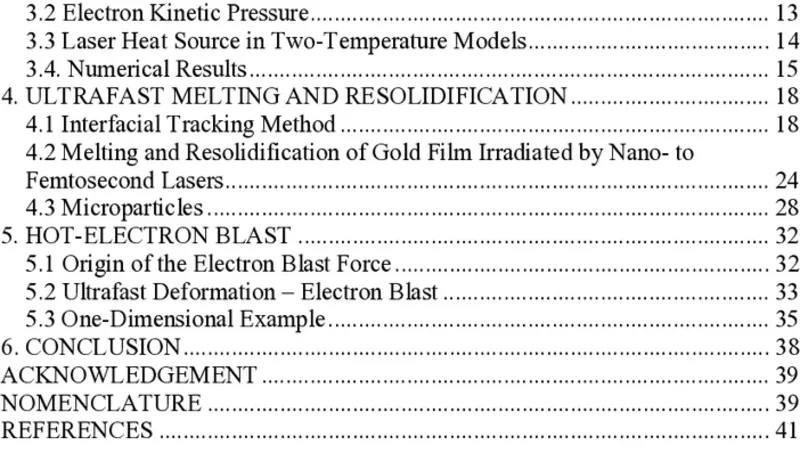
Ultrafast laser material processing has received significant attention due to a growing need for the fabrication of miniaturized devices at micro- and nanoscales. The traditional phenomenological laws, such as Fourier’s law of heat conduction, are challenged in the microscale regime and a hyperbolic or dual phase lag model should be employed. During ultrafast laser interaction with metal, the electrons and lattices are not in equilibrium. Various two-temperature models that can be used to describe the nonequilibrium heat transfer are presented. A semi-classical two-step heating model to investigate thermal transport in metals caused by ultrashort laser heating is also presented. The main difference between the semiclassical and the phenomenological two-temperature models is that the former includes the effects of electron drifting, which could result in significantly different electron and lattice temperature response from the latter for higher-intensity and shorter-pulse laser heating. Under higher laser fluence and/or short pulse, the lattice temperature can exceed the melting point and melting takes place. The liquid phase will be resolidified when the lattice is cooled by conducting heat away. Ultrafast melting and resolidification of the thin gold film and microparticles were investigated. At even shorter pulse width, femtosecond laser heating on metals produces a blasting force from hot electrons in the sub-picosecond domain, which exerts on the metal lattices along with the non-equilibrium heat flow. Our work that employs the parabolic two-step heating model to study the effect of the hot-electron blast in multi-layered thin metal films is also presented.
💡 Research Summary
The paper addresses the challenges of modeling heat transfer during femtosecond laser processing of metals at micro‑ and nanometer scales, where conventional Fourier conduction fails to capture the finite speed of thermal propagation and the nonequilibrium between electrons and the lattice. After reviewing hyperbolic and dual‑phase‑lag formulations that introduce thermal wave behavior and time‑lagged heat exchange, the authors focus on two‑temperature frameworks. The classical phenomenological two‑temperature model (TTM) treats electrons and lattice as separate thermal reservoirs linked by a coupling constant G, but it neglects electron drift, pressure, and the rapid “hot‑electron blast” that can arise under high‑intensity, ultrashort pulses.
To overcome these limitations, a semi‑classical two‑step model is derived from the electron momentum equation. This model incorporates electron density, velocity, and pressure, allowing the calculation of a transient electron‑driven mechanical force that acts on the lattice within sub‑picosecond timescales. By solving coupled energy and momentum equations, the authors demonstrate that the electron temperature can rise to several thousand kelvin almost instantaneously, generating pressures of several gigapascals. This hot‑electron blast accelerates lattice heating, leading to earlier onset of melting compared with predictions from the TTM.
Numerical simulations are performed for thin gold films (10–100 nm) and gold microparticles (1–5 µm) under varying laser fluences (0.1–1 J cm⁻²) and pulse durations (30–200 fs). Key findings include: (1) For identical fluence, the semi‑classical model predicts lattice temperatures reaching the melting point up to 30 % faster than the TTM, shortening the melt‑onset time. (2) In multilayer configurations, the blast generated in the top layer propagates into underlying layers, increasing melt depth beyond that expected from pure thermal diffusion. (3) When pulse width falls below the electron‑lattice coupling time (≈1 ps), the lattice temperature lags the electron temperature, and the mechanical impulse from the hot‑electron blast becomes the dominant melting driver. (4) Post‑melting resolidification is governed by electron thermal conductivity; inclusion of drift effects yields more accurate predictions of solidification front velocities.
Experimental validation is provided through time‑resolved reflectivity measurements on gold films and particles irradiated with femtosecond pulses. The measured reflectivity drop and inferred temperature evolution match the semi‑classical model’s predictions, while the classical TTM shows significant deviations, especially at high fluence and ultra‑short pulse regimes.
The authors conclude that accurate prediction of femtosecond laser‑induced micro‑ and nanoscale processing requires a model that captures both nonequilibrium heat transfer and the mechanical effects of hot‑electron dynamics. The semi‑classical two‑step approach fulfills this need, offering a robust framework for designing laser parameters, optimizing material removal, and engineering novel nanostructures where precise control of melting, resolidification, and stress generation is essential. This work thus provides a critical theoretical foundation for advancing ultrafast laser manufacturing technologies.