Lithosphere-asthenosphere system in the Mediterranean region in the framework of polarized plate tectonics
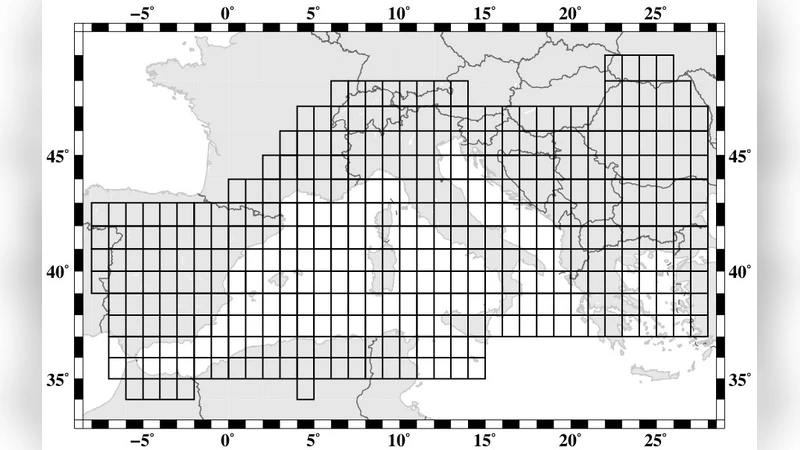
Velocity structure of the lithosphere-asthenosphere system, to the depth of about 350 km, is obtained for almost 400 cells, sized 1 degree by 1 degree in the Mediterranean region. The models are obtained by the following sequence of methods and tools: surface-wave dispersion measurements and collection; 2D tomography of dispersion relations; non-linear inversion of cellular dispersion relations; smoothing optimization method to select a preferred model for each cell. The 3D velocity model, that satisfies Occam razor principle, is obtained as a juxtaposition of selected cellular models. The reconstructed picture of the lithosphere-asthenosphere system evidences the, globally well known, asymmetry between the W- and E-directed subduction zones, attributed to the westward drift of the lithosphere relative to the mantle. Different relationship between slabs and mantle dynamics cause strong compositional differences in the upper mantle, as shown by large variations of seismic waves velocity, consistent with Polarized Plate Tectonics model.
💡 Research Summary
The paper presents a high‑resolution three‑dimensional shear‑wave velocity model of the lithosphere‑asthenosphere system beneath the Mediterranean region, extending to a depth of roughly 350 km. The study area is divided into approximately 400 cells, each 1° × 1° in size. The authors follow a four‑step workflow: (1) collection and preprocessing of surface‑wave dispersion measurements from global networks, covering periods from about 20 s to 150 s; (2) two‑dimensional tomography of the dispersion data to obtain period‑velocity curves for each cell; (3) non‑linear inversion of these cellular dispersion relations using a hybrid Monte‑Carlo/genetic algorithm that parameterizes lithospheric thickness, asthenospheric velocity, transition‑zone thickness, and density variations; and (4) a smoothing optimization that selects a single “preferred” model per cell by minimizing velocity differences between neighboring cells while preserving the fit to the observed dispersion. This final step implements the Occam’s razor principle, ensuring the simplest model that still explains the data.
The resulting 3‑D model reveals a pronounced asymmetry between west‑directed and east‑directed subduction zones. In the western subduction system (Alpine‑Hellenic), the lithosphere is relatively thin (≈70 km) and overlain by a high‑velocity asthenosphere (Vs ≈ 4.6 km s⁻¹). Conversely, the eastern subduction system (eastern Anatolia, Greece) displays a much thicker lithosphere (≈120 km) and a low‑velocity asthenosphere (Vs ≈ 4.3 km s⁻¹). These velocity contrasts imply significant compositional and thermal variations in the upper mantle, with the low‑velocity zones likely representing hotter, possibly hydrated material.
The authors interpret this west‑east dichotomy in the context of the Polarized Plate Tectonics (PPT) model, which posits a global westward drift of the lithosphere relative to the underlying mantle. According to PPT, the westward motion leads to a “fast” asthenosphere beneath west‑directed subduction zones and a “slow” asthenosphere beneath east‑directed ones, exactly the pattern observed in the Mediterranean. The study therefore provides observational support for PPT, linking surface‑wave tomography with large‑scale mantle dynamics.
Beyond the theoretical implications, the new velocity model has practical applications. It can improve seismic hazard assessments by refining the depth and geometry of seismogenic zones, enhance mantle convection simulations by supplying realistic lateral velocity variations, and serve as a baseline for integrating other geophysical datasets such as gravity, magnetotelluric, and satellite altimetry.
In conclusion, the paper delivers a rigorously constrained, smoothly varying 3‑D shear‑wave velocity model of the Mediterranean lithosphere‑asthenosphere system. By demonstrating the west‑east asymmetry and connecting it to the westward drift of the lithosphere, the work substantiates the Polarized Plate Tectonics hypothesis and opens avenues for further multidisciplinary investigations of mantle‑plate interactions worldwide.
Comments & Academic Discussion
Loading comments...
Leave a Comment